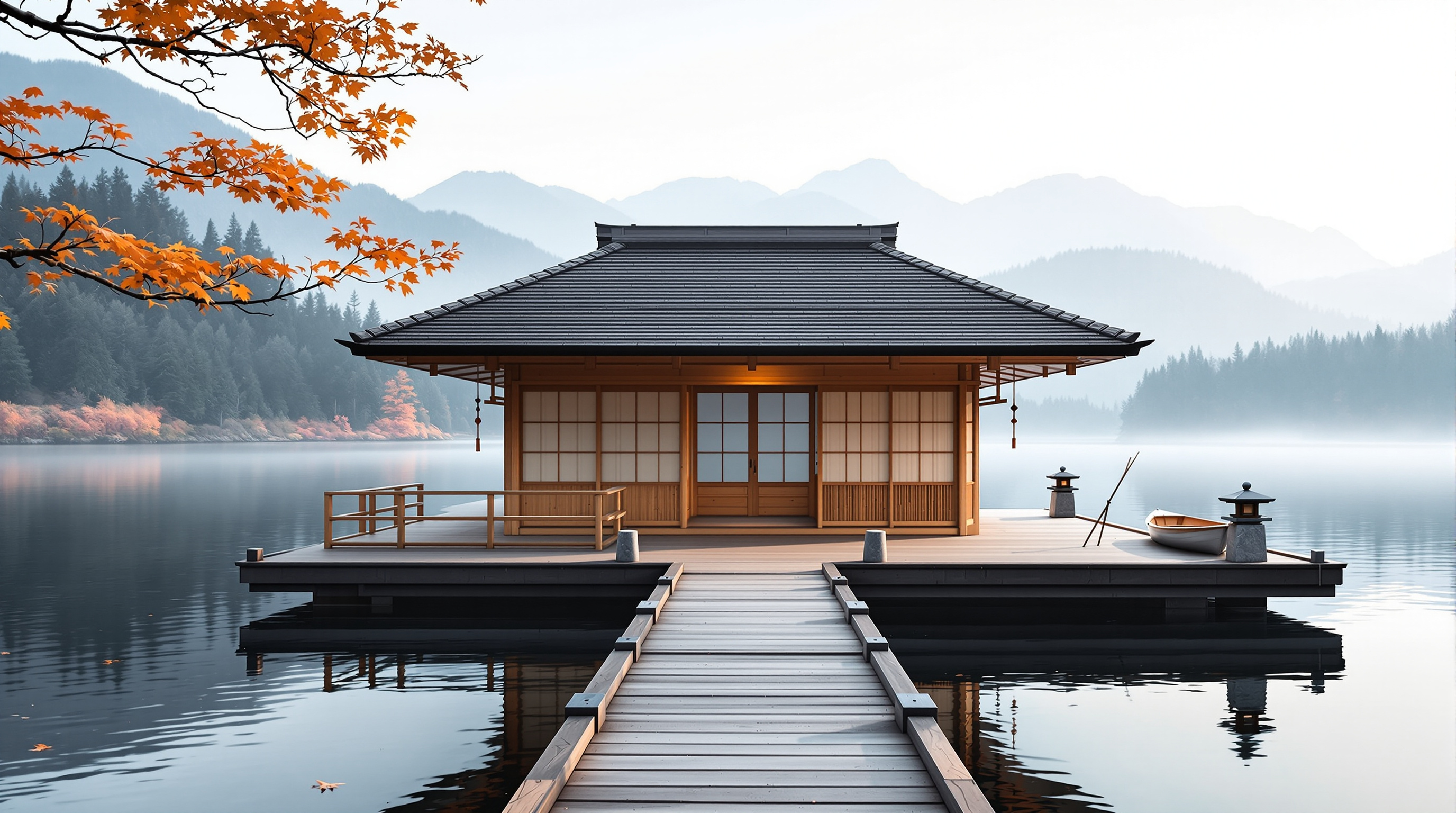
Photoreal view of a small floating cedar teahouse with a hipped shingle roof and shoji screens, approached from a shore path on a misty autumn morning, stone lanterns on the dock, a tied wooden boat, soft fog over still water, warm wood against cool blue-gray lake and mountains.
Photoreal architectural photograph of a small floating cedar teahouse on a still mountain lake in early autumn mist, 16:9 landscape, viewed from a wooden shore path approaching the dock. Key subjects first: a square one-room cedar teahouse with a dark weathered hipped shingle roof, four sliding shoji paper screens on the lake-facing side, a narrow engawa deck with simple vertical railings, two squat granite stone lanterns flanking the dock entrance, and a small tied wooden rowboat at the right side of the floating platform. The platform sits on dark timber pontoons just above the water; pale cedar walls show soft grain; copper rain chains hang at two corners. Behind the teahouse, layered blue-gray mountains fade into fog; pine forest lines the far shore; the water mirrors the roof as a soft blur. Light: low morning sun from the left, cool mist, warm wood highlights, quiet contemplative mood, crisp architectural detail, true colors. No people, no smoke plumes, no neon, no readable text, no watermark.
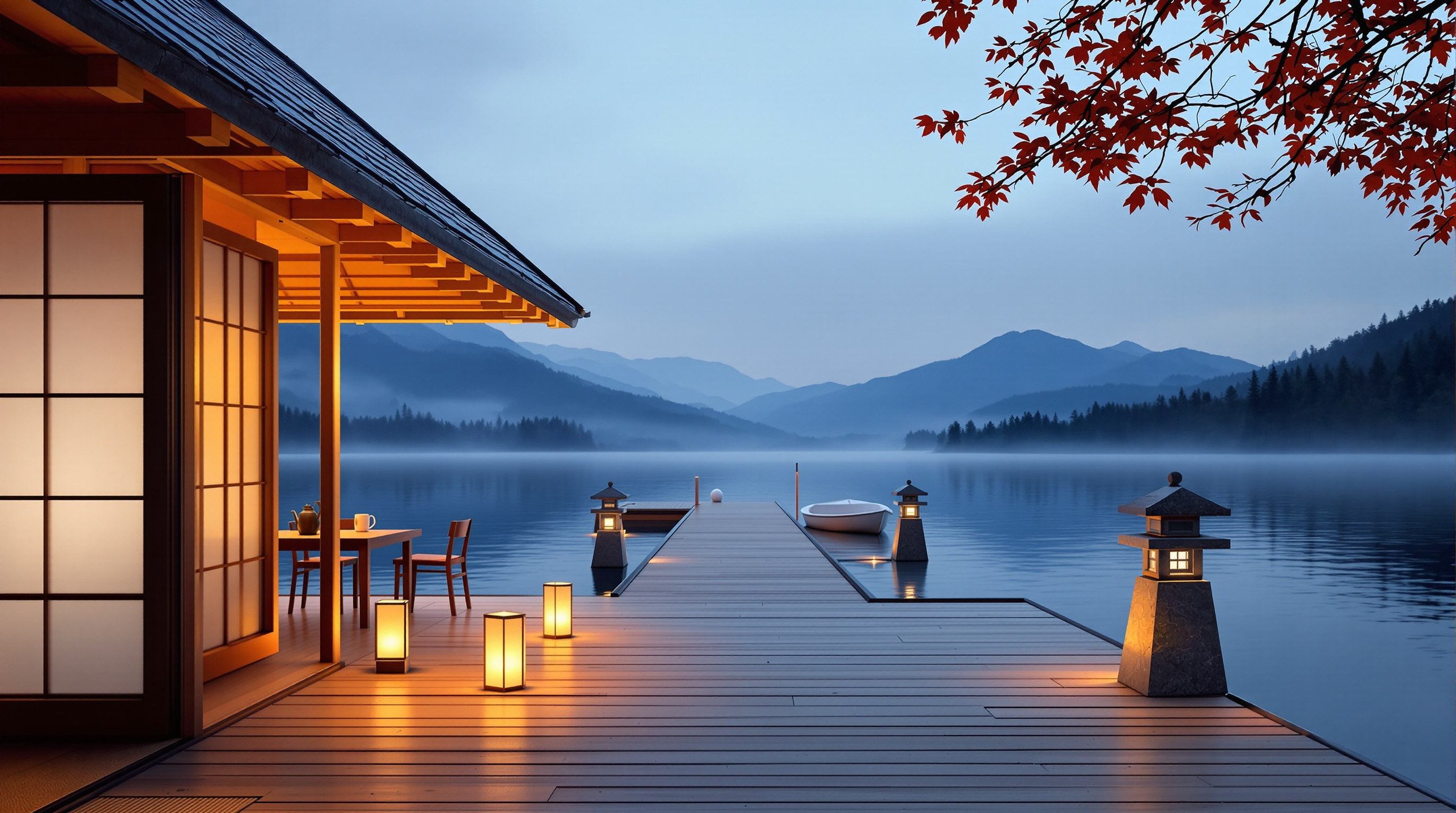
Photoreal dusk view from the deck of the same floating cedar teahouse: glowing shoji and dark tiled eaves on the left, paper and stone lanterns along the boards, a white rowboat, a long boardwalk over still blue-hour water, misty mountains and a red maple branch, restating the fixed design details of the morning view.
Photoreal photograph from the wide plank deck of a small floating cedar teahouse at lantern dusk, 16:9 landscape, camera at standing eye level beside the teahouse wall, looking out along the deck toward the lake. Key subjects first: the teahouse on the left edge with deep dark gray tiled eaves, warm honey-cedar posts and glowing pale shoji panels lit from inside, a low wooden table with two chairs on the deck, small paper lanterns glowing along the deck boards, two squat granite stone lanterns lit softly near the end of the deck, and a small white wooden rowboat resting on the far deck. Beyond, a long straight plank boardwalk runs out across still lake water at blue hour, reflecting the lantern glow, with layered blue-gray mountains in dusk silhouette, dark pine forest on the far shore, thin mist over the water, and a branch of red-orange autumn maple leaves at the upper edge. Same fixed design as the morning view: dark tiled hipped roof, cedar frame, shoji bays, stone lanterns, white rowboat, maple branch. Soft dusk light mixed with warm lantern glow, quiet contemplative mood, crisp wood grain, true colors. No people, no readable text, no neon, no watermark.
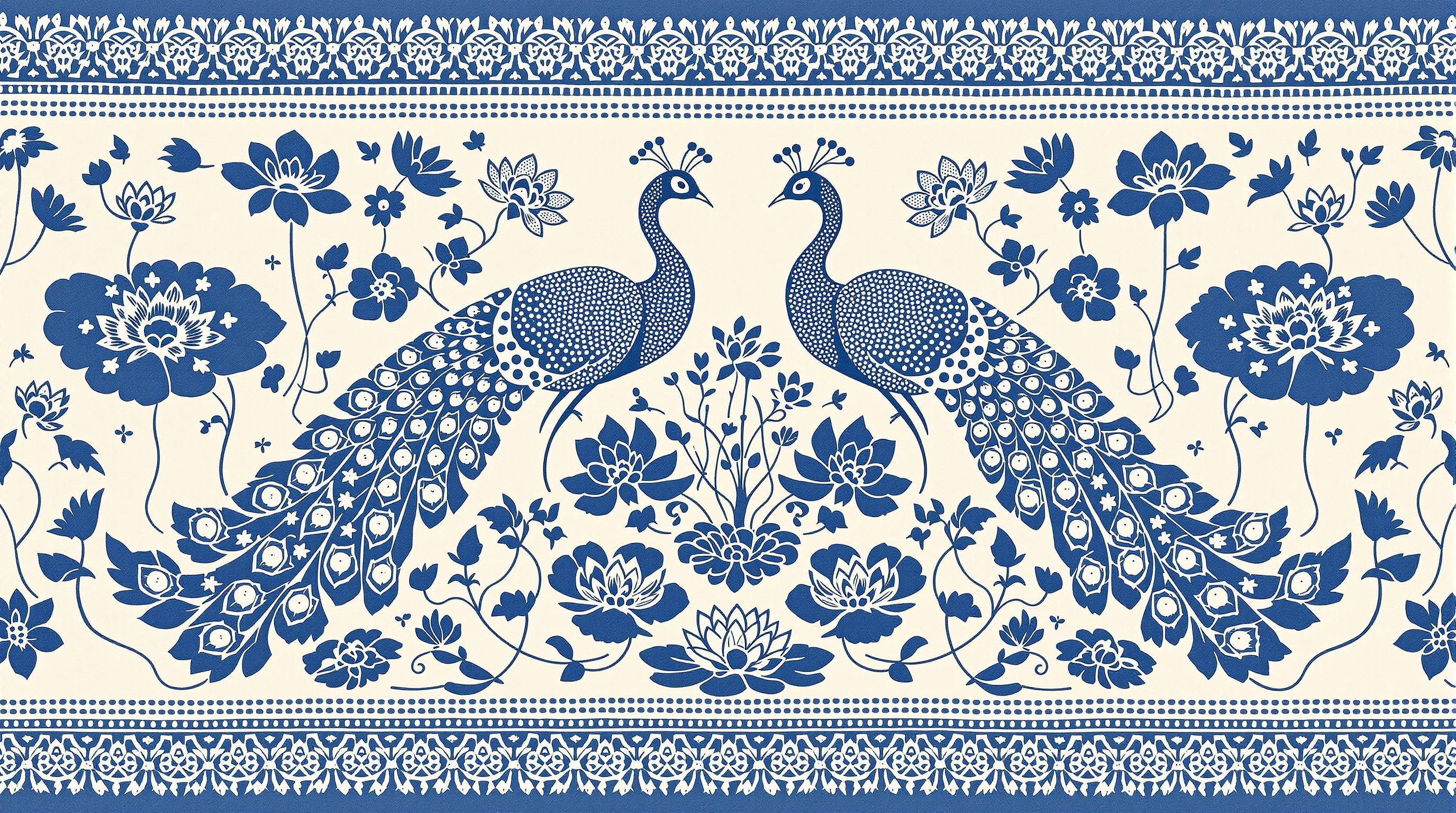
Indonesian batik textile pattern of mirrored twin peacocks beside lotus ponds in indigo and cream, with isen fills, kawung border, wax-resist crackle, and cloth weave texture. Flat ornamental fabric layout.
Twin peacocks facing each other beside lotus ponds, rendered as a traditional Indonesian batik textile pattern in indigo and cream. The peacocks fill the center with mirrored S-curved necks, fan tails filled with dotted isen motifs, and small floral medallions along the wings. Around them, oval lotus ponds hold blooming lotus flowers, pads, and tiny fish drawn as repeating geometric fills. A classic batik border frames the cloth: interlocking kawung and ceplok shapes with fine crackle lines from wax-resist dyeing. Palette limited to deep indigo blue, soft cream ground, and a few pale grey-blue washes. Hand-drawn irregularity in the lines, visible wax crackle texture, cloth weave grain, flat ornamental layout suitable for fabric. No people, no modern objects, no text, no signature.
Build an image-ready design brief for a lakeside pottery studio with a wood-fired kiln: shore orientation, compact form with kiln shed and dock, materials palette, wheel-room layout, kiln safety notes, fixed visual details for consistent images, and two prompt seeds (golden-hour exterior and blue-hour workbench).
Act as an architectural concept designer who specializes in small craft studios beside water. Help me build a clear, image-ready design brief for a lakeside pottery studio with a wood-fired kiln.

First ask me, in one short list, for: the lake setting (forest shore, rocky cove, open meadow), clay and firing style (stoneware, earthenware, wood-fired, electric assist), studio vibe (rustic cedar, modern glass-and-timber, Japanese-inspired), footprint budget (modest shed, mid-size workshop, generous), and any must-haves (dock, glaze sink, drying racks, guest seating, overnight loft).

Then produce the brief with these sections:

1. **Concept in One Sentence**: the feeling and purpose of the studio.
2. **Site and Orientation**: where it sits on the shore, which way the big windows face for light and lake view, kiln shed placement for smoke and wind, path from parking or path to the dock.
3. **Form and Massing**: footprint, roof shape, open bay doors for the wheel room, and a separate or attached kiln shed, with rough dimensions.
4. **Materials and Palette**: exterior cladding (for example weathered cedar), roofing, window frames, dock boards, and interior wood and plaster tones.
5. **Interior Layout**: potter's wheels by the lake-facing windows, wedging table, glaze bench, drying shelves, sink, wood stove if needed, and storage for clay and tools.
6. **Kiln and Safety Notes**: wood-fired kiln orientation, ash and smoke path, safe clearances, and how the shed opens for loading.
7. **Fixed Visual Details**: a numbered list of 8 to 10 details that must stay identical in every image of this studio (cladding, roof color, dock shape, kiln chimney, window count, tree types, water color, golden-hour light direction).
8. **Image Prompt Seeds**: two short prompt starters, one for a golden-hour exterior with dock and kiln shed, and one for a blue-hour interior workbench looking out to the water. Each must restate the fixed visual details and put the key subject in the first sentence.

Keep it concise, practical, and buildable. Avoid naming real architects or brands. Flag anything unsafe for wood firing near trees or a dock.
Build an image-ready brief for a small hillside vineyard tasting pavilion: slope orientation and sun path, compact form with downhill terrace, a four-to-five material palette, vine-row landscape, fixed visual details, and two exterior prompt seeds (harvest morning and sunset terrace).
Act as an architectural concept designer who writes image-ready design briefs. Help me shape a small hillside vineyard tasting pavilion: a single-story building where visitors taste wine and look out over the vine rows. Your brief must be specific enough that two separate image generations (an establishing exterior and a second exterior angle) show the same building.

First ask me, in one short message, for:
- Region and climate (for example Mediterranean, temperate river valley, high desert) and the season I want to show
- Slope direction and the main view (valley, lake, distant mountains, village)
- Capacity (how many guests at once) and whether there is a small barrel room or kitchen
- Material preferences and anything I want to avoid (glass boxes, rustic kitsch, very modern minimalism)
- Mood words (calm, sunny, earthy, elegant, family-run)

Then produce the brief with these sections:

1. **Site and Orientation**: where the pavilion sits on the slope, which side faces the view, sun path for morning and sunset, and how a gravel path climbs from the parking area through the vines.

2. **Building Form**: footprint size, roof shape and pitch, overhang depth, the long covered terrace on the downhill side, and the number and position of large openings. Keep it compact and believable.

3. **Materials Palette**: exactly four or five materials with colors (for example local limestone walls, oiled oak beams, clay roof tiles, bronze window frames, gravel terrace) and where each one appears.

4. **Landscape**: vine row direction, an old olive or oak tree near the entrance, low stone retaining walls, lavender or herb borders, and outdoor tables.

5. **Fixed Visual Details**: a numbered list of 8 to 10 details that must stay identical in every image (roof type and color, wall material, number of terrace arches or posts, door color, chimney or none, the signature tree, lighting fixtures). These details make the images consistent.

6. **Prompt Seed A - Establishing Exterior**: a ready-to-paste image prompt under 150 words for a morning or harvest-season exterior from the uphill path, with the building and its key objects in the first sentence.

7. **Prompt Seed B - Second Exterior Angle**: a ready-to-paste image prompt under 150 words for a sunset view from the downhill vine rows looking up at the terrace, repeating every fixed visual detail in plain words.

8. **Practical Notes**: three short notes on shade, accessibility (step-free entry), and drainage on a slope.

Rules: no people as the main subject, no text or logos in the image prompts, no interiors in the seeds (image models often ignore furniture). Use short paragraphs and lists.
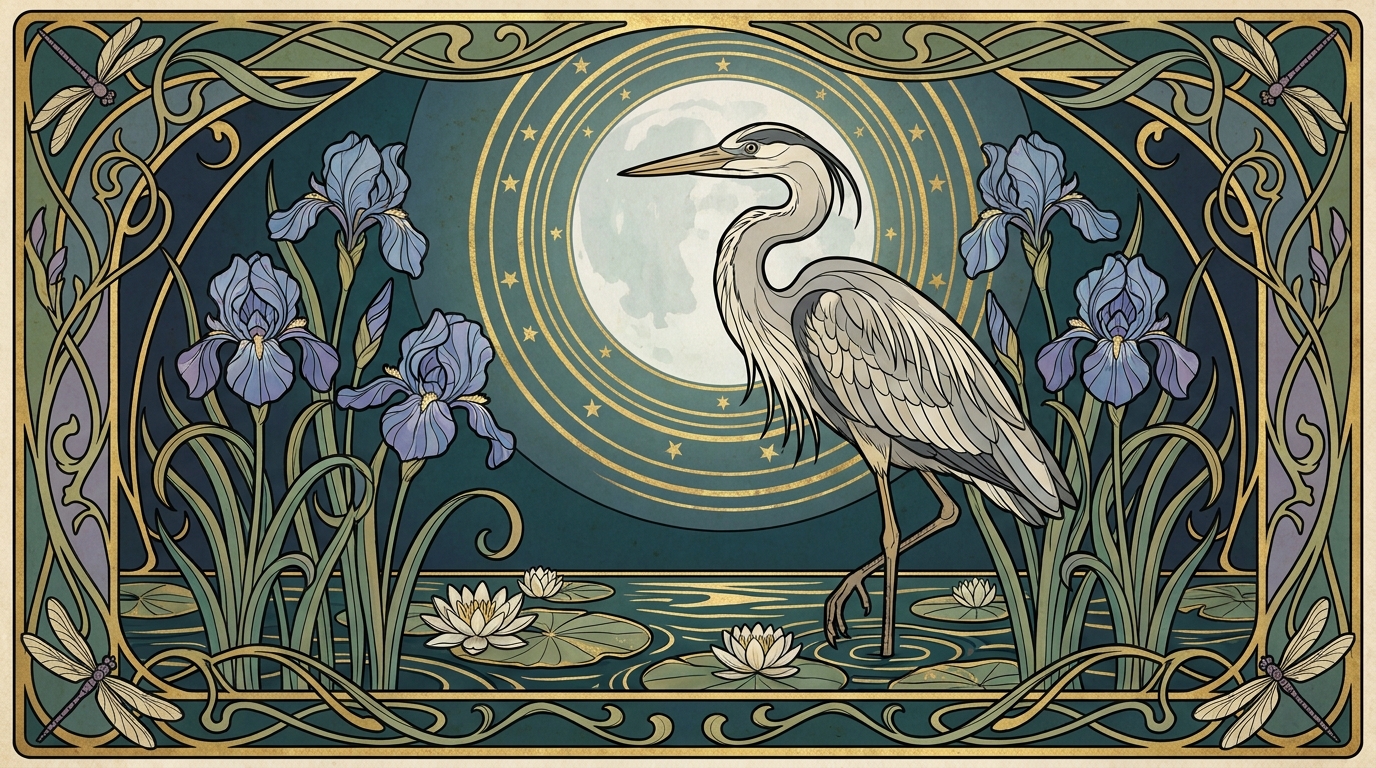
Art Nouveau decorative panel: a grey heron with an S-curved neck among blue and violet irises at a moonlit lily pond, a gold-leaf moon halo, dragonflies, and a whiplash-vine border. Bold outlines, flat muted teal, sage, iris blue, and gold.
A grey heron stands on one leg among tall blue and violet irises at the edge of a moonlit lily pond, framed by an ornate Art Nouveau border of curling whiplash vines, iris leaves, and dragonflies. Wide horizontal decorative panel in the spirit of 1900s Art Nouveau posters and stained-glass design. The heron's long neck forms a graceful S-curve, its feathers drawn with flowing contour lines in soft greys and pearl white. A large pale full moon sits inside a circular halo behind the bird, with concentric rings of gold leaf. Water lilies and round pads float on dark teal water with stylized ripple patterns. Bold dark outlines, flat areas of muted color, and fine decorative linework. Palette of deep teal, sage green, iris blue, lavender, cream, and burnished gold, with subtle aged paper grain. Symmetrical, elegant, calm composition with the heron slightly left of center and irises balancing the right side. Landscape 16:9. No people, no text, no lettering, no signature, no logos.
Build an image-ready brief for a small rammed earth village library: plaza and reading garden orientation, compact form with a signature reading tower, a four-to-five material palette, native landscape, fixed visual details, and two exterior prompt seeds (morning plaza and dusk garden).
Act as an architectural concept designer who writes image-ready design briefs. Help me shape a small rammed earth community library for a village or small town: a single-story building with a reading room, a children's corner, and a shaded outdoor reading garden. Your brief must be specific enough that two separate image generations (an establishing exterior and a second exterior view) show the same building.

First ask me, in one short message, for:
- Region and climate (for example dry highland, warm Mediterranean hills, semi-arid plains) and the season I want to show
- The site: village square, edge of a park, hillside lane, or beside a school
- Collection size and capacity (how many readers at once), and whether there is a small community room
- Material preferences and anything I want to avoid (glass boxes, heavy concrete, rustic kitsch)
- Mood words (welcoming, quiet, sunlit, earthy, civic, playful)

Then produce the brief with these sections:

1. **Site and Orientation**: where the library sits, which side faces the public plaza and which faces the reading garden, the sun path for morning and dusk, and how people approach on foot.

2. **Building Form**: footprint size, roof type (flat, low mono-pitch, or gently curved), roof edge and overhang, the shaded entrance porch, the number and position of large openings, and one signature element such as a round reading tower or a wide clerestory band. Keep it compact and buildable.

3. **Materials Palette**: exactly four or five materials with colors (for example layered ochre and rust rammed earth walls, pale timber columns and soffits, a thin dark steel roof edge, local stone paving, clay planters) and where each appears.

4. **Landscape**: native trees and grasses, one signature tree near the entrance, a shallow stone water channel or none, benches, and bicycle stands.

5. **Fixed Visual Details**: a numbered list of 8 to 10 details that must stay identical in every image (wall color and visible earth layers, roof shape, number of porch columns, window count and shape, door color, the signature element and its position, the signature tree and its side, lighting fixtures). These details make the images consistent.

6. **Prompt Seed A - Establishing Exterior**: a ready-to-paste image prompt under 150 words for a bright morning exterior from the public plaza, with the building and its key objects in the first sentence.

7. **Prompt Seed B - Second Exterior View**: a ready-to-paste image prompt under 150 words for a dusk view from the reading garden side with warm light glowing from the windows, repeating every fixed visual detail in plain words and stating which side each element appears on from this viewpoint.

8. **Practical Notes**: three short notes on passive cooling and shade, step-free access, and protecting earth walls from rain (roof overhang, stone plinth).

Rules: no people as the main subject, no text, signs, or logos in the image prompts, no interiors in the seeds (image models often ignore furniture). Use short paragraphs and lists.
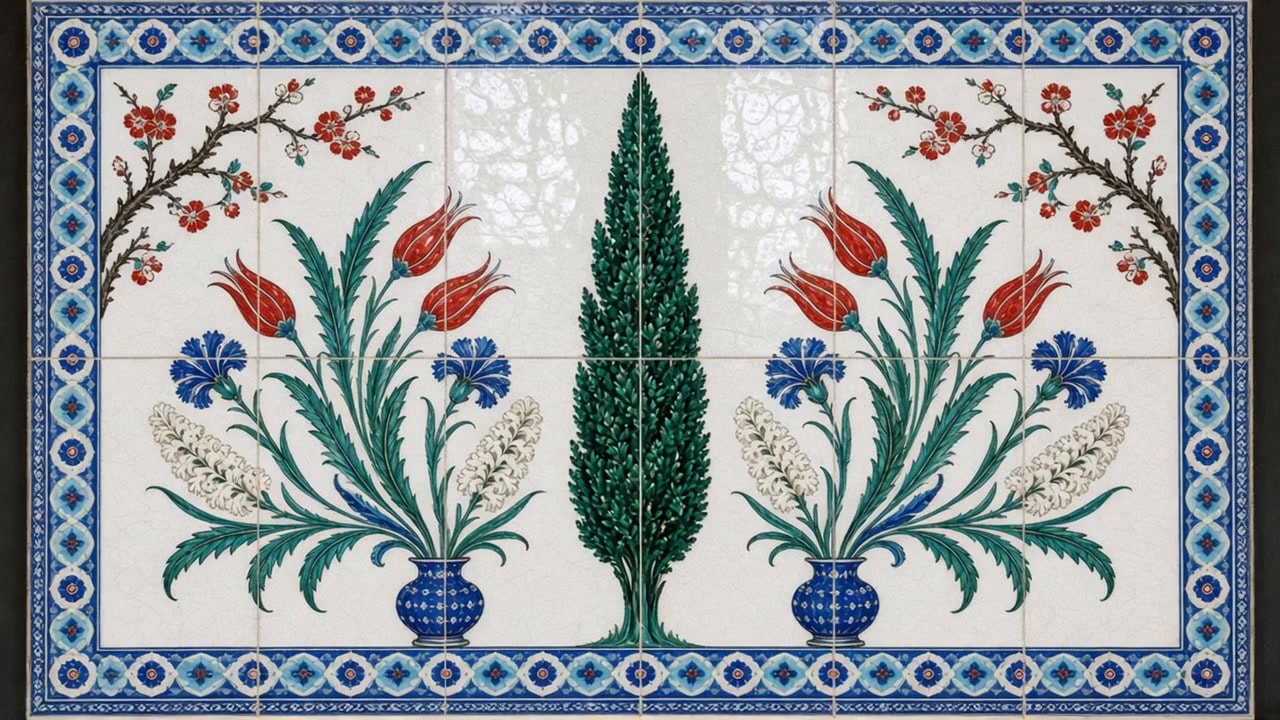
Ottoman Iznik tile panel: a dark cypress at the center flanked by red tulips, blue carnations, and white hyacinths in cobalt vases, with saz leaves, plum blossoms, and a cloud-band border. Glossy white ground, cobalt, turquoise, and raised tomato red.
A wide panel of glazed Iznik ceramic tiles shows a tall dark green cypress tree in the center, flanked by sweeping red tulips, blue carnations, and white hyacinths growing from a small cobalt vase on each side. Classic sixteenth-century Ottoman Iznik style: brilliant white quartz-frit ground, deep cobalt blue, turquoise, emerald green, and raised tomato-red bole slip, with crisp dark outlines and flat glossy color. Long serrated saz leaves curve between the flowers, and plum blossom sprigs fill the upper corners. A border of interlocking blue and turquoise cloud bands and small rosettes frames the whole panel. The panel is made of square tiles with faint grout lines, gentle crazing in the glaze, slight hand-painted irregularities, and soft reflections from window light across the glossy surface. Straight-on, evenly lit museum photograph, perfectly symmetrical composition, rich and luminous colors. Wide landscape 16:9. No people, no hands, no text, no letters, no calligraphy, no logos.
Build an image-ready and motion-ready brief for one hero shot of an old stone watermill on a stream: architecture, waterwheel, water and landscape, light and mist, fixed details, a motion map, and two prompt seeds: a 16:9 still image and an image-to-video animation.
Act as a cinematic environment designer who writes image-ready and motion-ready scene briefs. Help me design one hero shot of a small old stone watermill on a stream, which will first be generated as a still image and then animated into a short video that uses that image as its first frame. Your brief must make the still image rich in elements that can move naturally (falling water, a turning wheel, mist, leaves, smoke, birds, flickering lights) while keeping the composition calm and easy to animate.

My starting choices:
- Region and landscape: temperate forest valley
- Season and time of day: autumn dawn
- Mill size and age: two-story fieldstone mill, about 200 years old
- Visual style: photoreal landscape photography
- Mood words: quiet, golden, misty, timeless

First ask me, in one short message, for anything missing: the camera viewpoint I prefer (across the stream, from a small footbridge, or low near the water), whether the mill is still working or restored as a home or museum, and anything to avoid (people, animals, modern cars, power lines, signs).

Then produce the brief with these sections:

1. **Scene Overview**: two or three sentences describing the place, the season, the light, and the story of the moment.

2. **Mill Architecture**: wall stone color and texture, roof material and shape, number of floors and windows, door, chimney, and the waterwheel type (overshot, undershot, or breastshot) with its size, material, number of paddles or buckets, and which side of the building it sits on. Include the wooden chute or millrace that feeds it.

3. **Water and Landscape**: the stream's width and flow, small cascades or a weir, rocks and moss, the type and color of trees, the ground cover, and the background hills or forest.

4. **Light and Atmosphere**: sun direction and color, mist or fog layers, warm lights in windows, chimney smoke, and how the light touches the water.

5. **Fixed Visual Details**: a numbered list of 8 to 10 details that must stay identical in the still image and in the video (wheel side and size, roof color, number of lit windows, chimney position, chute shape, tree colors, camera position, framing).

6. **Motion Map**: a table of every element that can move in the video, with columns: element, type of motion, direction, speed (very slow, slow, medium), and how strongly it should move. Include the camera move. Keep total motion subtle and physically plausible.

7. **Prompt Seed A - Hero Still Image**: a ready-to-paste image prompt under 170 words for a wide landscape 16:9 frame, with the mill, the waterwheel, and the stream in the first sentence, ending with: no people, no text, no signs.

8. **Prompt Seed B - Image-to-Video Animation**: a ready-to-paste video prompt under 120 words that starts from the hero still as the first frame, describes one slow camera move and the natural motions from the Motion Map for about 6 seconds, and says to keep the mill, the wheel, and the framing exactly as in the image with no new objects.

Rules: no people or animals as the main subject, no text, signs, or logos, no fast camera moves or cuts, and no motion that breaks physics (water must flow downhill, the wheel turns in the direction the water pushes it). Use short paragraphs and lists.
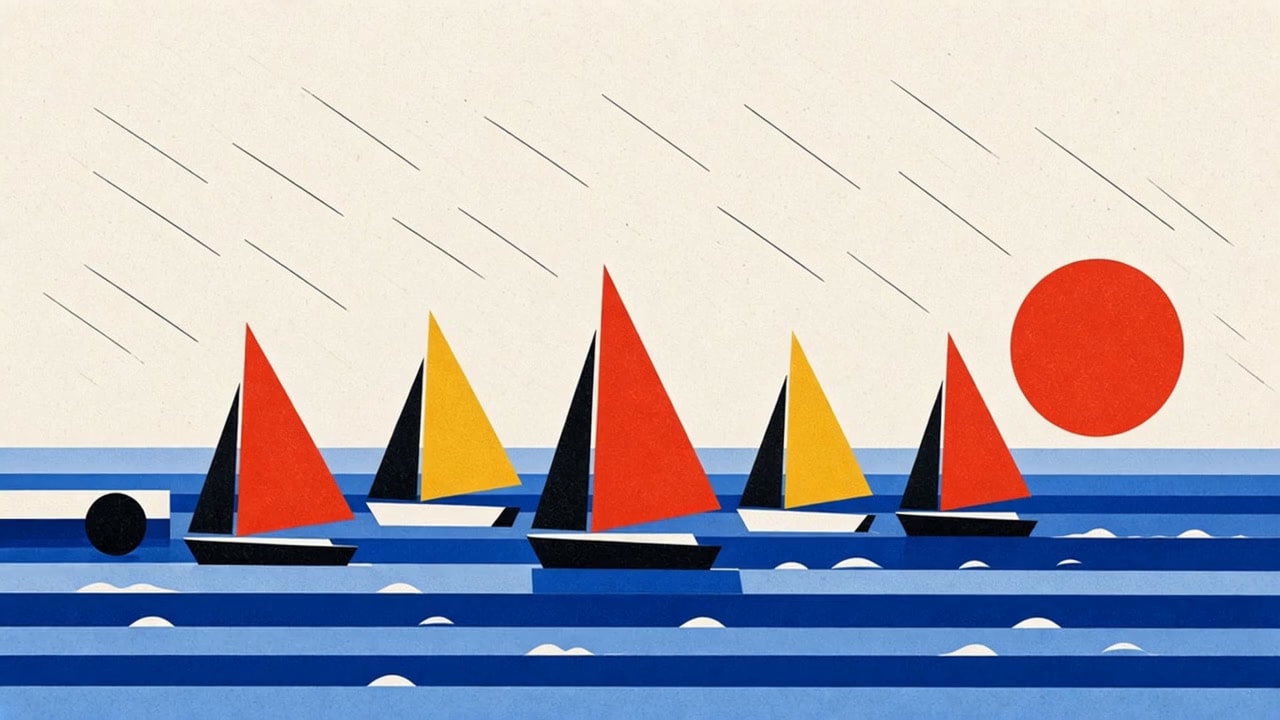
Bauhaus-style modernist poster of five sailboats racing on a blue bay, built only from circles, triangles, and rectangles: primary red, yellow, and black sails, banded cobalt sea, a big red-orange sun, a white pier, and off-white paper with screen-print grain.
Five sailboats with bold triangular sails race across a calm blue bay toward a small harbor pier, drawn as a Bauhaus-style geometric poster built only from circles, triangles, rectangles, and straight lines. The sails are flat primary red, yellow, and black triangles, the hulls are slim black and white trapezoids, and a large red-orange sun circle sits low on the right above the horizon. The sea is layered horizontal bands of cobalt, navy, and pale blue, with small white semicircles for waves, and a few thin diagonal lines suggest wind. A simple white pier of stacked rectangles extends from the left edge, with a round black buoy in the foreground. Off-white textured paper background, crisp hard edges, flat colors with no gradients, subtle screen-print grain and slight ink misregistration, strong asymmetric balance and generous negative space in the sky. Modernist 1920s design spirit, clean and joyful. Wide landscape 16:9. No people, no text, no letters, no numbers, no logos.
Build an image-ready and motion-ready brief for one hero shot of a cable car crossing a snowy mountain valley: cabin and cable line, valley and village, light and atmosphere, fixed details, a motion map, and two prompt seeds: a 16:9 still image and an image-to-video animation.
Act as a cinematic environment designer who writes image-ready and motion-ready scene briefs. Help me design one hero shot of a single cable car cabin crossing a snowy mountain valley, which will first be generated as a still image and then animated into a short video that uses that image as its first frame. Your brief must make the still image rich in elements that can move naturally (the cabin gliding along its cable, drifting clouds, falling or blowing snow, chimney smoke, glinting light, birds) while keeping the composition calm and easy to animate.

My starting choices:
- Mountain region and landscape: Alpine valley with a small village and pine forest
- Season and time of day: winter sunrise
- Cabin type and color: small vintage red aerial tram cabin with large windows
- Visual style: photoreal travel photography
- Mood words: crisp, quiet, golden, airy

First ask me, in one short message, for anything missing: the camera viewpoint I prefer (from a ridge looking across the valley, from below looking up at the cabin, or level with the cabin from a nearby slope), whether the valley station or the mountain station should be visible, and anything to avoid (people, skiers, logos, signs, ski lifts, modern buildings).

Then produce the brief with these sections:

1. **Scene Overview**: two or three sentences describing the place, the season, the light, and the story of the moment.

2. **Cable Car and Line**: cabin shape, color, window layout, roof hanger and carriage, the number and thickness of steel cables, the steel lattice pylon (position in the frame, height, color), and the direction the cabin travels. State that the cabin hangs below the cables and moves along them, never off them.

3. **Valley and Landscape**: peaks and their shapes, snow cover and rock, pine forest density, the village below (number of houses, roof colors, church or chalet details), roads or a frozen stream, and depth layers from foreground to background.

4. **Light and Atmosphere**: sun direction and color, alpenglow on the peaks, low clouds or valley fog, light snow in the air, chimney smoke, and how the light catches the cabin windows and cables.

5. **Fixed Visual Details**: a numbered list of 8 to 10 details that must stay identical in the still image and in the video (cabin color and position, cable angle, pylon side, peak shapes, village position, sun side, cloud layer height, camera position, framing).

6. **Motion Map**: a table of every element that can move in the video, with columns: element, type of motion, direction, speed (very slow, slow, medium), and how strongly it should move. Include the camera move. Keep total motion subtle and physically plausible.

7. **Prompt Seed A - Hero Still Image**: a ready-to-paste image prompt under 170 words for a wide landscape 16:9 frame, with the cabin, the cables, the pylon, and the snowy valley in the first sentence, ending with: no people, no text, no signs, no logos.

8. **Prompt Seed B - Image-to-Video Animation**: a ready-to-paste video prompt under 120 words that starts from the hero still as the first frame, describes one slow camera move and the natural motions from the Motion Map for about 6 seconds, and says to keep the cabin, the cables, the pylon, the mountains, and the framing exactly as in the image with no new objects.

Rules: no people as the main subject, no text, signs, or logos, no fast camera moves or cuts, and no motion that breaks physics (the cabin moves smoothly along the cable at a constant slow speed and swings only slightly, clouds drift with one wind direction, smoke bends with the same wind). Use short paragraphs and lists.
Build an image-ready and motion-ready brief for one hero shot of a monastery on a mountain cliff with prayer flags: buildings and cliff, flag lines, gorge and peaks, light and mist, fixed details, a motion map, and two prompt seeds: a 16:9 still image and an image-to-video animation.
Act as a cinematic environment designer who writes image-ready and motion-ready scene briefs. Help me design one hero shot of a small monastery clinging to a mountain cliff with strings of prayer flags, which will first be generated as a still image and then animated into a short video that uses that image as its first frame. Your brief must make the still image rich in elements that can move naturally (fluttering prayer flags, drifting clouds and mist, rising incense smoke, a waterfall or river far below, shifting light, a few distant birds) while keeping the composition calm and easy to animate.

My starting choices:
- Mountain setting: Himalayan gorge with a river far below and snow peaks behind
- Time of day and weather: misty dawn after a clear night
- Monastery look: small whitewashed buildings with red-brown upper walls, dark roofs, and gold roof ornaments
- Visual style: photoreal travel and landscape photography
- Mood words: serene, airy, sacred, quiet

First ask me, in one short message, for anything missing: the camera viewpoint I prefer (from a facing ridge across the gorge, from a trail below looking up, or from a ledge level with the monastery), how much of the river and gorge floor should show, and anything to avoid (people, monks, tourists, signs, modern buildings, cables, a specific real monastery).

Then produce the brief with these sections:

1. **Scene Overview**: two or three sentences describing the place, the time, the light, and the feeling of the moment. Describe an imagined monastery, not a copy of a real, named one.

2. **Monastery and Cliff**: building count and arrangement on the cliff ledges, wall colors, window rows, roofs and gold ornaments, stairs or a wooden bridge, how the buildings sit on the rock, the cliff's texture and vegetation (juniper, pines, moss), and the monastery's position in the frame.

3. **Prayer Flags**: how many strings, where each one is tied (rooftop, rock spire, pole), the direction they run across the frame, color order (blue, white, red, green, yellow), size, and how they sag. State that the flags move with the wind but their tie points never move.

4. **Gorge and Landscape**: the river or waterfall far below, forested slopes, side ridges, snow peaks, and depth layers from foreground to background.

5. **Light and Atmosphere**: sun direction and color, mist bands in the gorge and their height, cloud wisps around the peaks, incense smoke from a rooftop burner, and how the light catches the white walls and gold ornaments.

6. **Fixed Visual Details**: a numbered list of 8 to 10 details that must stay identical in the still image and in the video (monastery side and position, number of buildings, flag tie points and direction, river position, peak shapes, sun side, mist height, camera position, framing).

7. **Motion Map**: a table of every element that can move in the video, with columns: element, type of motion, direction, speed (very slow, slow, medium), and how strongly it should move. Include the camera move. Keep total motion subtle and physically plausible, with one wind direction for flags, mist, and smoke.

8. **Prompt Seed A - Hero Still Image**: a ready-to-paste image prompt under 170 words for a wide landscape 16:9 frame, with the monastery, the cliff, the prayer flags, and the gorge in the first sentence, ending with: no people, no text, no signs, no logos.

9. **Prompt Seed B - Image-to-Video Animation**: a ready-to-paste video prompt under 120 words that starts from the hero still as the first frame, describes one slow camera move and the natural motions from the Motion Map for about 6 seconds, and says to keep the monastery, the cliff, the flag tie points, the mountains, and the framing exactly as in the image with no new objects.

Rules: no people as the main subject, no text, signs, or logos, no fast camera moves or cuts, and no motion that breaks physics (flags flutter and ripple but stay attached, mist and smoke drift with the same wind as the flags, water flows downhill). Use short paragraphs and lists.
Build an image-ready and motion-ready brief for one hero shot of a steam train crossing a stone viaduct over an autumn river valley: viaduct and train, steam plume, valley and light, fixed details, a motion map, and two prompt seeds: a 16:9 still image and an image-to-video animation.
Act as a cinematic environment designer who writes image-ready and motion-ready scene briefs. Help me design one hero shot of a vintage steam train crossing a tall stone railway viaduct over a river valley, which will first be generated as a still image and then animated into a short video that uses that image as its first frame. Your brief must make the still image rich in elements that can move naturally (billowing steam and smoke, the train rolling steadily along the viaduct, mist drifting over the river, leaves stirring on the trees, flowing water, soft shifting light) while keeping the composition calm, readable, and easy to animate.

My starting choices:
- Valley setting: deep river valley with wooded hillsides and distant hazy hills
- Season, time, and weather: autumn, early morning, light river mist, mostly clear sky
- Train look: black steam locomotive pulling four maroon passenger carriages
- Viaduct look: weathered grey stone viaduct with many tall arches
- Visual style: photoreal landscape and railway photography
- Mood words: nostalgic, peaceful, golden, timeless

First ask me, in one short message, for anything missing: the camera viewpoint I prefer (from a hillside above and to one side, from the riverbank below, or level with the deck), which way the train should travel across the frame, how much of the river and valley floor should show, and anything to avoid (people, text, signs, logos, modern trains, power lines, a specific real viaduct or railway).

Then produce the brief with these sections:

1. **Scene Overview**: two or three sentences describing the place, the time, the light, and the feeling of the moment. Describe an imagined viaduct and train, not a copy of a real, named one.

2. **Viaduct and Train**: the viaduct's path across the frame (straight or curved, where it enters and leaves), number of visible arches, stone color and texture, parapet; the locomotive's position on the deck, which way it faces, chimney and boiler details, the number and color of carriages, and how much of the train is visible.

3. **Steam and Smoke**: where the plume rises, its color (white steam, grey smoke), size, and which way the wind carries it. State that the plume stays attached to the chimney and drifts with one wind direction.

4. **Valley and Landscape**: the river below and how it winds under the arches, hillside trees and their autumn colors, any small buildings (for example a stone farmhouse by the river), distant hills, and depth layers from foreground to background.

5. **Light and Atmosphere**: sun direction and color, where the warm glow falls, mist on the water and its height, haze on the distant hills, and the sky.

6. **Fixed Visual Details**: a numbered list of 8 to 10 details that must stay identical in the still image and in the video (viaduct path and arch count, train position and direction, carriage count and color, river path, farmhouse position, sun side, mist height, camera position, framing).

7. **Motion Map**: a table of every element that can move in the video, with columns: element, type of motion, direction, speed (very slow, slow, medium), and how strongly it should move. Include the train's travel along the deck and the camera move. Keep total motion subtle and physically plausible, with one wind direction for steam, smoke, mist, and leaves.

8. **Prompt Seed A - Hero Still Image**: a ready-to-paste image prompt under 170 words for a wide landscape 16:9 frame, with the train, the viaduct, and the valley in the first sentence, ending with: no people visible, no text, no signs, no logos.

9. **Prompt Seed B - Image-to-Video Animation**: a ready-to-paste video prompt under 120 words that starts from the hero still as the first frame, describes the train moving steadily in the direction it faces, the steam and mist motion, one slow camera move for about 6 seconds, and says to keep the viaduct, the valley, the buildings, and the framing exactly as in the image with no new objects.

Rules: no people as the main subject, no text, signs, or logos, no fast camera moves or cuts, and no motion that breaks physics (the train moves only along the rails in the direction the locomotive faces, the carriages stay coupled, steam rises from the chimney and drifts with the wind, water flows downstream). Use short paragraphs and lists.
Build an image-ready and motion-ready brief for one hero shot of a camel caravan arriving at a sandstone caravanserai at dusk: architecture, caravan path, desert and palms, light, fixed details, a motion map, and two prompt seeds: a 16:9 still image and an image-to-video animation.
Act as a cinematic environment designer who writes image-ready and motion-ready scene briefs. Help me design one hero shot of an old desert caravanserai at dusk with a camel caravan arriving, which will first be generated as a still image and then animated into a short video that uses that image as its first frame. Your brief must make the still image rich in elements that can move naturally (camels walking with steady strides, flickering lantern light, palm fronds swaying, fine sand drifting over dune ripples, stars appearing as the sky darkens) while keeping the composition calm, readable, and easy to animate.

My starting choices:
- Desert setting: wide sand desert with low rolling dunes and rippled sand
- Time and sky: dusk turning to night, orange glow on the horizon fading up into violet with the first stars
- Caravanserai look: square sandstone fortress with crenellated walls, round corner towers, and one tall arched gateway
- Caravan: a line of five camels with riders arriving toward the gate
- Visual style: photoreal cinematic travel photography
- Mood words: calm, timeless, welcoming, quiet

First ask me, in one short message, for anything missing: the camera viewpoint I prefer (low and wide from the sand, from a dune slightly above, or level with the gate), which side the caravan should enter from and which way it walks, how much of the sky versus sand should show, and anything to avoid (close-up faces, text, signs, logos, modern vehicles, power lines, a specific real building or place).

Then produce the brief with these sections:

1. **Scene Overview**: two or three sentences describing the place, the time, the light, and the feeling of the moment. Describe an imagined caravanserai, not a copy of a real, named one.

2. **Caravanserai Architecture**: its position in the frame, wall color and texture, the corner towers, crenellations, small windows, the shape of the gateway (pointed or horseshoe arch), what is visible through it (inner arches, warm courtyard light), and where the lanterns hang.

3. **Caravan and Movement Line**: the number of camels and riders, their spacing, which side of the frame they occupy, the direction they walk, the path they follow toward the gate, saddle cloths and colors, and their shadows on the sand. State that every camel faces the direction it walks.

4. **Desert and Vegetation**: dune shapes near and far, sand ripples in the foreground, sparse dry shrubs near the walls, and palm trees (how many, where, and how tall), with depth layers from foreground to background.

5. **Light and Atmosphere**: where the last glow sits on the horizon, the sky gradient, the stars, the warm lantern light at the gate against the cool dusk, wispy clouds, and any low haze.

6. **Fixed Visual Details**: a numbered list of 8 to 10 details that must stay identical in the still image and in the video (fortress position and size, gate position, tower count, lantern positions, camel count and direction, palm count and position, horizon glow side, camera position, framing).

7. **Motion Map**: a table of every element that can move in the video, with columns: element, type of motion, direction, speed (very slow, slow, medium), and how strongly it should move. Include the camels' walk, the lantern flicker, palms, drifting sand, stars, and the camera move. Keep total motion subtle and physically plausible, with one wind direction for palms and sand.

8. **Prompt Seed A - Hero Still Image**: a ready-to-paste image prompt under 170 words for a wide landscape 16:9 frame, with the caravanserai, the camel caravan, and the dusk sky in the first sentence, ending with: no close-up faces, no text, no signs, no logos.

9. **Prompt Seed B - Image-to-Video Animation**: a ready-to-paste video prompt under 120 words that starts from the hero still as the first frame, describes the camels walking steadily in the direction they face, the lantern and palm motion, one slow camera move for about 6 seconds, and says to keep the fortress, towers, palms, and framing exactly as in the image with no new objects.

Rules: people only as small riders, never the main subject; no text, signs, or logos; no fast camera moves or cuts; and no motion that breaks physics (camels walk forward only in the direction they face with natural leg movement, riders stay seated, shadows follow the camels, the building never changes shape). Use short paragraphs and lists.