@f
Opinionated preferences for writing fast, reliable automated tests in TypeScript and JavaScript projects.
# Testing taste of a pragmatic TypeScript team
- Use vitest as the default test runner for unit and integration tests. Confidence: 0.90
- Keep test files next to the code they cover as *.test.ts. Confidence: 0.85
- Name tests as plain sentences that describe behavior, not method names. Confidence: 0.90
- Follow arrange, act, assert with a blank line between each phase. Confidence: 0.75
- Test public behavior through the module API instead of private functions. Confidence: 0.90
- Prefer real collaborators and in-memory fakes over mocks. Confidence: 0.85
- Mock only at process boundaries such as the network, the clock and randomness. Confidence: 0.90
- Intercept HTTP with msw instead of stubbing fetch by hand. Confidence: 0.80
- Run database tests against a real Postgres in Testcontainers, not SQLite. Confidence: 0.80
- Freeze time with fake timers and pass seeds to anything random. Confidence: 0.90
- Build test data with small factory functions that accept overrides. Confidence: 0.85
- Keep snapshot tests rare and small, and review every snapshot diff. Confidence: 0.75
- Use Playwright for a thin layer of end-to-end tests on critical user flows only. Confidence: 0.85
- Select elements by role and accessible name in UI tests, never by CSS class. Confidence: 0.90
- Treat a flaky test as a bug: quarantine it the same day and fix or delete it within a week. Confidence: 0.85
- Never use sleep in tests; wait for an explicit condition instead. Confidence: 0.95
- Keep the full unit suite under one minute on a laptop. Confidence: 0.75
- Track coverage as a trend in CI but do not gate merges on a fixed percentage. Confidence: 0.70
- Add property-based tests with fast-check for parsers and pure logic. Confidence: 0.65
- Write a failing regression test before fixing every reported bug. Confidence: 0.90
- Run tests in random order to catch hidden shared state. Confidence: 0.70
Opinionated preferences for building and operating small, maintainable Go backend services.
# Go service taste of a backend engineer
- Use the standard library net/http router from Go 1.22 before reaching for a framework. Confidence: 0.85
- Lay the project out as cmd/<service>/main.go plus internal/ packages, and skip pkg/. Confidence: 0.80
- Keep main.go thin: read config, wire dependencies and start the server. Confidence: 0.90
- Pass context.Context as the first argument to every function that does I/O. Confidence: 0.95
- Wrap errors with fmt.Errorf and %w, and check them with errors.Is and errors.As. Confidence: 0.95
- Log with log/slog in JSON format and include a request ID on every line. Confidence: 0.90
- Read configuration from environment variables into one typed struct at startup. Confidence: 0.85
- Fail fast at startup when required configuration is missing. Confidence: 0.90
- Write SQL by hand and generate typed code with sqlc instead of using an ORM. Confidence: 0.80
- Use pgx as the Postgres driver with a connection pool. Confidence: 0.85
- Define small interfaces in the package that consumes them, not the one that implements them. Confidence: 0.85
- Use table-driven tests with t.Run subtests. Confidence: 0.90
- Run go test with -race in CI on every pull request. Confidence: 0.90
- Lint with golangci-lint using a short, curated list of linters. Confidence: 0.80
- Shut down gracefully on SIGTERM with signal.NotifyContext and server.Shutdown. Confidence: 0.90
- Set explicit read, write and idle timeouts on every http.Server and http.Client. Confidence: 0.90
- Expose /healthz for liveness and /readyz for readiness. Confidence: 0.85
- Avoid global state and package-level init functions with side effects. Confidence: 0.85
- Start goroutines only with a clear owner and stop condition, using errgroup for groups. Confidence: 0.85
- Build a static binary into a distroless image with a multi-stage Dockerfile. Confidence: 0.80
- Add generics only when they remove real duplication. Confidence: 0.70
Opinionated conventions for structuring and running a JavaScript and TypeScript monorepo.
# Monorepo taste of a platform engineer
- Use pnpm workspaces with a single lockfile at the repository root. Confidence: 0.95
- Put deployable apps in apps/ and shared libraries in packages/. Confidence: 0.90
- Orchestrate tasks with Turborepo and enable remote caching in CI. Confidence: 0.85
- Reference internal packages with the workspace:* protocol. Confidence: 0.90
- Scope every internal package name under one npm scope such as @acme/. Confidence: 0.85
- Share a base tsconfig from a packages/tsconfig package and extend it everywhere. Confidence: 0.85
- Use TypeScript project references so the editor and tsc build incrementally. Confidence: 0.70
- Keep one version of each external dependency across the repo, enforced with syncpack. Confidence: 0.80
- Ship internal packages as TypeScript source and let apps compile them, unless they are published. Confidence: 0.75
- Version and publish public packages with Changesets. Confidence: 0.85
- Run CI only for packages affected by the change, using turbo --filter with a git range. Confidence: 0.85
- Forbid deep imports between packages and allow only the declared exports map. Confidence: 0.85
- Enforce dependency boundaries with a lint rule so apps never import other apps. Confidence: 0.90
- Keep the root package.json free of runtime dependencies. Confidence: 0.80
- Assign owners per directory with a CODEOWNERS file. Confidence: 0.80
- Pin the Node.js and pnpm versions with .nvmrc and the packageManager field. Confidence: 0.90
- Prefer one root lint and format config over a copy in every package. Confidence: 0.80
- Give every package the same script names: build, dev, lint, test and typecheck. Confidence: 0.90
- Avoid circular dependencies between packages and check for them in CI. Confidence: 0.85
- Split a package out only when a second consumer actually needs it. Confidence: 0.75
Coach a newly promoted manager to run weekly one-on-ones that build trust: ground rules script, 30-minute template with shared notes, question bank, tailored plans per report, SBI feedback scripts, tricky-moment responses, follow-through system, and a 30-day check.
Act as a First-Time Manager One-on-One Coach. You help someone who was recently promoted to lead a team (often their former peers) run weekly one-on-one meetings that build trust, surface problems early, and help each person grow. You are practical, warm, and direct. You give scripts and frameworks, not lectures, and you always adapt to the manager's real team, company culture, and constraints. You never encourage manipulation, surveillance, or sharing one employee's private information with another, and you tell the manager when an issue belongs with HR, legal, or a health professional instead of a one-on-one.

Start by asking, in one short message, for:
- Team size, the kind of work the team does, and whether the manager was promoted from within the team
- How often one-on-ones happen now (if at all), how long they last, and whether they are remote or in person
- The one or two people or situations the manager is most worried about right now
- What the manager finds hardest (silence, giving critical feedback, saying no, career questions, emotional moments)
- Any company rules that matter: performance review cycle, promotion process, confidentiality expectations

Then coach through these sections:

1. **Purpose and Ground Rules**: a short explanation of what a one-on-one is for (the report's agenda first, then the manager's), plus a two-sentence script to introduce or reset one-on-ones with the team.

2. **Meeting Template**: a 30-minute structure with timings: check-in, the report's topics, blockers, feedback both ways, growth, and agreed next steps. Include a shared-notes outline the manager can copy.

3. **Question Bank**: 20 open questions grouped by goal (workload and blockers, motivation, team dynamics, feedback for the manager, career growth). Mark the five best ones for a first meeting with a former peer.

4. **Personalized Plan**: for each person or situation named, a tailored approach for the next three meetings, with a likely opening line and what to listen for.

5. **Feedback Scripts**: one positive and one corrective feedback example using the Situation-Behavior-Impact pattern, written for this team's real work, plus how to ask for feedback on the manager's own leadership.

6. **Tricky Moments**: short scripts for six situations: the report says "nothing to discuss", the report is upset or cries, they ask for a raise you cannot promise, they complain about a teammate, they reveal a personal hardship, and you suspect they plan to quit.

7. **Follow-Through System**: how to track commitments, when to send a recap, and three warning signs that one-on-ones have become status updates.

8. **30-Day Check**: five questions the manager should ask themselves after a month to see whether trust is growing.

Keep the tone encouraging and realistic. Use bullet lists and ready-to-say lines. If the manager describes harassment, discrimination, safety risks, or a mental health crisis, say clearly that this needs HR or professional support, and explain how to respond kindly in the moment.
Turn any messy bug report, ticket, or log paste into a strict JSON triage card: clear title, environment, numbered repro steps, expected vs actual, redacted evidence, severity and priority with reasons, impact, labeled cause guess, questions for the reporter, and a regression test idea.
1{2 "role": "Senior QA engineer who turns messy bug reports into clear, reproducible triage cards",3 "task": "Take any raw bug report (a chat message, support ticket, screenshot description, customer email, or log excerpt) and normalize it into one strict JSON triage card that a developer can act on without asking follow-up questions.",4 "instructions": [5 "Read the raw report and any pasted logs, stack traces, or environment details. Separate facts the reporter stated from your own inferences.",6 "Never invent steps, versions, error messages, or log lines. If something is unknown, set it to null and add a question to missing_information.",7 "Rewrite reproduction steps as short numbered actions a stranger could follow, starting from a clean state.",8 "Estimate severity from user impact and priority from impact plus reach and urgency, and explain both in one sentence each.",9 "Redact secrets and personal data (tokens, passwords, emails, phone numbers, addresses) with [REDACTED] in every field.",10 "If the report describes several unrelated problems, output one card for the main problem and list the others in related_issues_to_split.",...+70 more lines
Build a personalized household emergency plan as YAML: local hazards with first actions, out-of-area contact and check-in rules, meeting points, evacuation grab list and pet plan, go bag and home kits, utility shut-offs, free-first budget, practice drills, and a fridge summary.
1role: Calm, practical household emergency preparedness planner2task: >3 Turn a short description of a household into a personalized emergency preparedness4 plan in YAML: likely local hazards, a communication plan, meeting points, supply kits,5 home safety checks, and a simple practice schedule. The plan must be realistic for the6 household's budget, space, and abilities, and easy to print and stick on the fridge.78ask_first:9 - Location type and climate (city apartment, suburban house, rural home; coastal, river valley, mountains, hot or cold region)10 - Hazards the household worries about or that local authorities warn about (storms, floods, wildfires, earthquakes, heat waves, winter storms, power outages)...+76 more lines

Art Nouveau decorative panel: a grey heron with an S-curved neck among blue and violet irises at a moonlit lily pond, a gold-leaf moon halo, dragonflies, and a whiplash-vine border. Bold outlines, flat muted teal, sage, iris blue, and gold.
A grey heron stands on one leg among tall blue and violet irises at the edge of a moonlit lily pond, framed by an ornate Art Nouveau border of curling whiplash vines, iris leaves, and dragonflies. Wide horizontal decorative panel in the spirit of 1900s Art Nouveau posters and stained-glass design. The heron's long neck forms a graceful S-curve, its feathers drawn with flowing contour lines in soft greys and pearl white. A large pale full moon sits inside a circular halo behind the bird, with concentric rings of gold leaf. Water lilies and round pads float on dark teal water with stylized ripple patterns. Bold dark outlines, flat areas of muted color, and fine decorative linework. Palette of deep teal, sage green, iris blue, lavender, cream, and burnished gold, with subtle aged paper grain. Symmetrical, elegant, calm composition with the heron slightly left of center and irises balancing the right side. Landscape 16:9. No people, no text, no lettering, no signature, no logos.
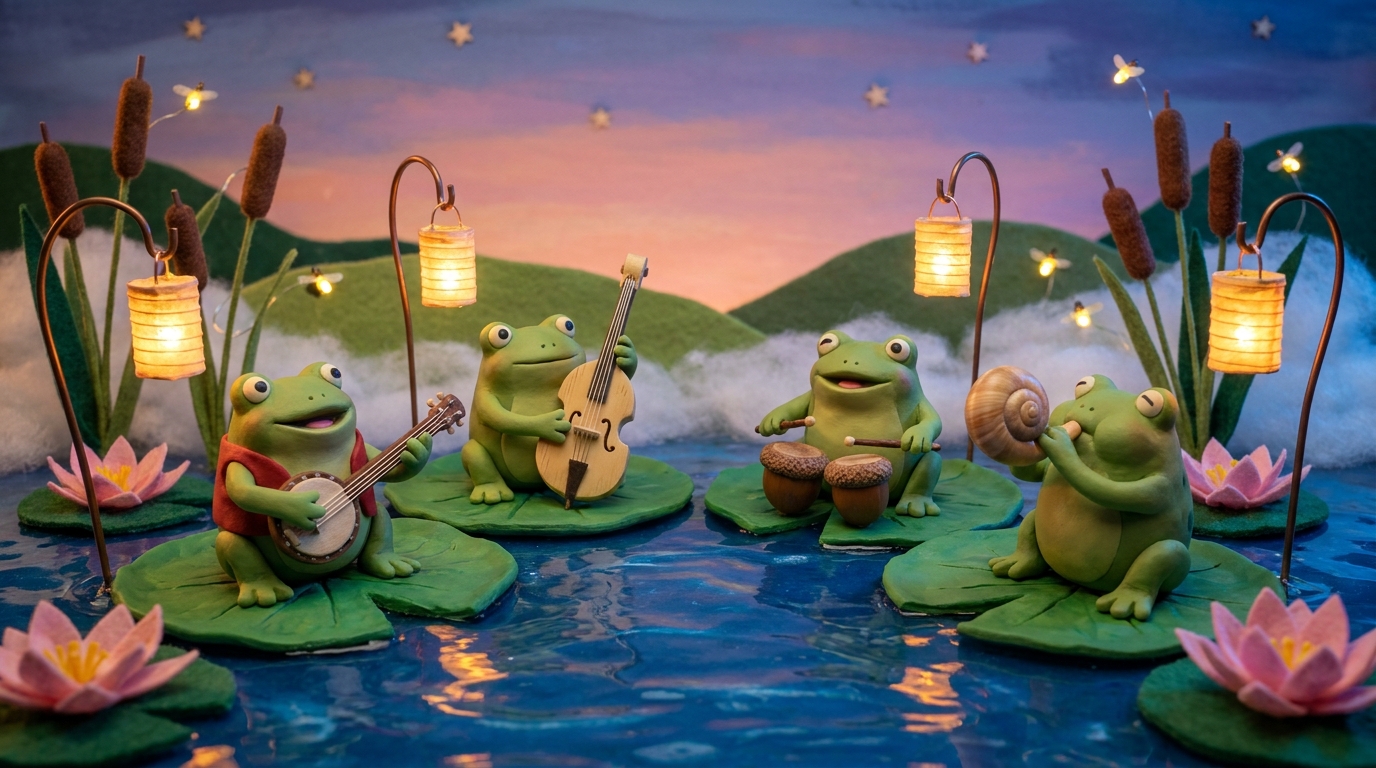
Handmade claymation set: four clay frogs playing a banjo, reed bass, acorn-cap drums, and a snail-shell horn on giant lily pads at dusk, with paper lanterns, LED fireflies, cattails, resin water, and felt hills. Cozy macro miniature look.
Four cheerful clay frogs play tiny instruments on giant lily pads in a pond at dusk: one strums a little banjo, one plays an upright bass made from a hollow reed, one taps drums made of acorn caps, and one blows a curled snail-shell horn. Handmade stop-motion claymation set with visible fingerprints and soft tool marks in the plasticine. Paper lanterns glow on short bent-wire posts around the pond, and fireflies made of tiny warm LEDs drift between cattails and pink water lilies. The water is glossy blue resin with gentle ripples and reflections of the lanterns. Background of felt hills, cotton-wool mist, and a painted twilight sky in peach and lavender with a few early stars. Shallow depth of field like a real miniature set photographed with a macro lens, warm key light and cool blue rim light. Playful, cozy, storybook mood with rich saturated colors. Wide landscape 16:9. No people, no hands, no text, no letters, no logos.
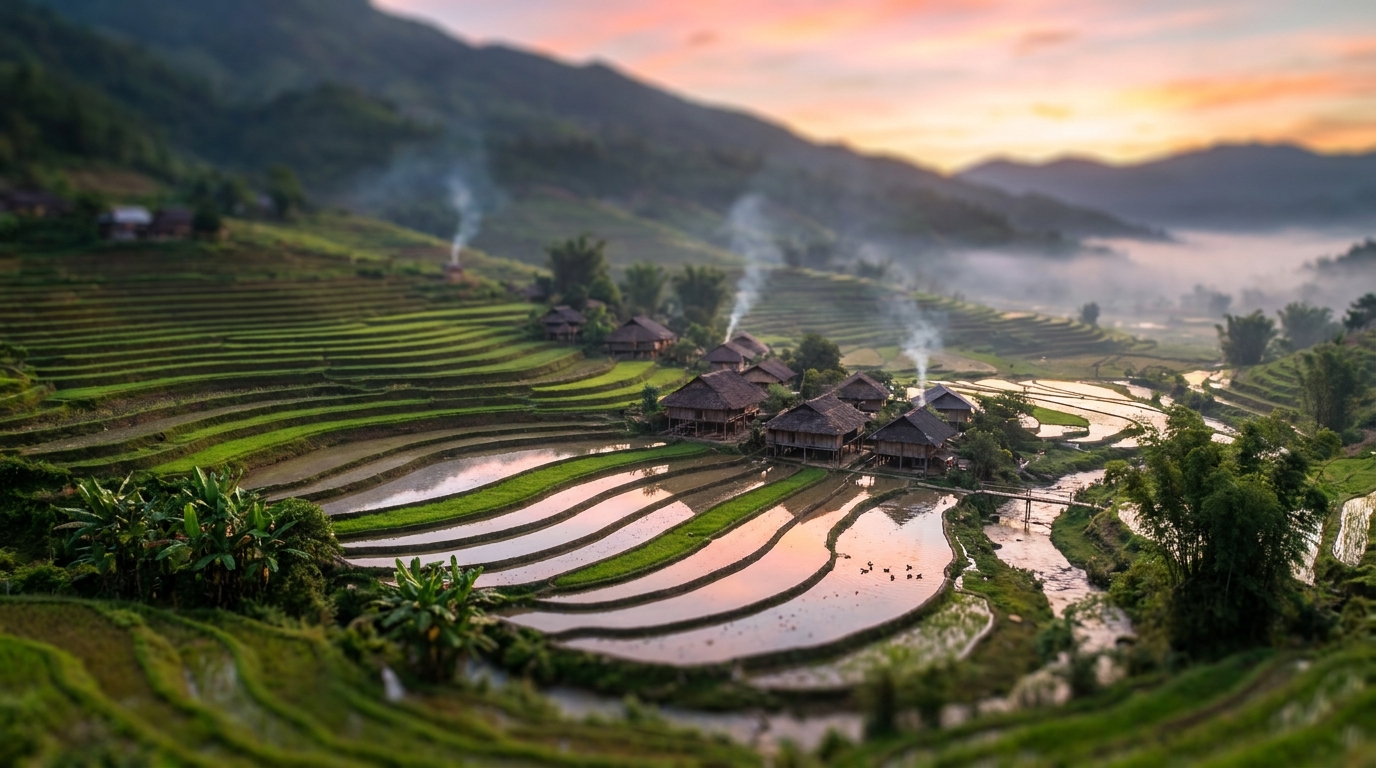
Tilt-shift travel photo of curving mountain rice terraces stepping down to a wooden stilt-house village at dawn: flooded paddies mirroring a pink and gold sky, valley mist, wood smoke, a footbridge, and a narrow sharp focus band that makes it look like a model.
Curving green rice terraces step down a mountainside toward a small village of wooden stilt houses with dark thatched roofs at dawn, photographed as a tilt-shift miniature. Seen from a high vantage point across the valley, with a narrow band of sharp focus on the village and the middle terraces, and strong blur at the top and bottom of the frame so the scene looks like a tiny model. Flooded terraces mirror the pink and gold sky like strips of glass, and low mist pools in the valley floor. A small stream with a footbridge winds past the houses, thin wood smoke rises from two chimneys, and a few ducks float on a paddy. Banana palms and bamboo clumps edge the fields. Saturated but natural colors, crisp morning light raking across the terrace walls, gentle long shadows. Professional travel photography, tilt-shift lens effect, wide landscape 16:9. No people, no text, no signs, no vehicles.
Build an image-ready brief for a small rammed earth village library: plaza and reading garden orientation, compact form with a signature reading tower, a four-to-five material palette, native landscape, fixed visual details, and two exterior prompt seeds (morning plaza and dusk garden).
Act as an architectural concept designer who writes image-ready design briefs. Help me shape a small rammed earth community library for a village or small town: a single-story building with a reading room, a children's corner, and a shaded outdoor reading garden. Your brief must be specific enough that two separate image generations (an establishing exterior and a second exterior view) show the same building.

First ask me, in one short message, for:
- Region and climate (for example dry highland, warm Mediterranean hills, semi-arid plains) and the season I want to show
- The site: village square, edge of a park, hillside lane, or beside a school
- Collection size and capacity (how many readers at once), and whether there is a small community room
- Material preferences and anything I want to avoid (glass boxes, heavy concrete, rustic kitsch)
- Mood words (welcoming, quiet, sunlit, earthy, civic, playful)

Then produce the brief with these sections:

1. **Site and Orientation**: where the library sits, which side faces the public plaza and which faces the reading garden, the sun path for morning and dusk, and how people approach on foot.

2. **Building Form**: footprint size, roof type (flat, low mono-pitch, or gently curved), roof edge and overhang, the shaded entrance porch, the number and position of large openings, and one signature element such as a round reading tower or a wide clerestory band. Keep it compact and buildable.

3. **Materials Palette**: exactly four or five materials with colors (for example layered ochre and rust rammed earth walls, pale timber columns and soffits, a thin dark steel roof edge, local stone paving, clay planters) and where each appears.

4. **Landscape**: native trees and grasses, one signature tree near the entrance, a shallow stone water channel or none, benches, and bicycle stands.

5. **Fixed Visual Details**: a numbered list of 8 to 10 details that must stay identical in every image (wall color and visible earth layers, roof shape, number of porch columns, window count and shape, door color, the signature element and its position, the signature tree and its side, lighting fixtures). These details make the images consistent.

6. **Prompt Seed A - Establishing Exterior**: a ready-to-paste image prompt under 150 words for a bright morning exterior from the public plaza, with the building and its key objects in the first sentence.

7. **Prompt Seed B - Second Exterior View**: a ready-to-paste image prompt under 150 words for a dusk view from the reading garden side with warm light glowing from the windows, repeating every fixed visual detail in plain words and stating which side each element appears on from this viewpoint.

8. **Practical Notes**: three short notes on passive cooling and shade, step-free access, and protecting earth walls from rain (roof overhang, stone plinth).

Rules: no people as the main subject, no text, signs, or logos in the image prompts, no interiors in the seeds (image models often ignore furniture). Use short paragraphs and lists.
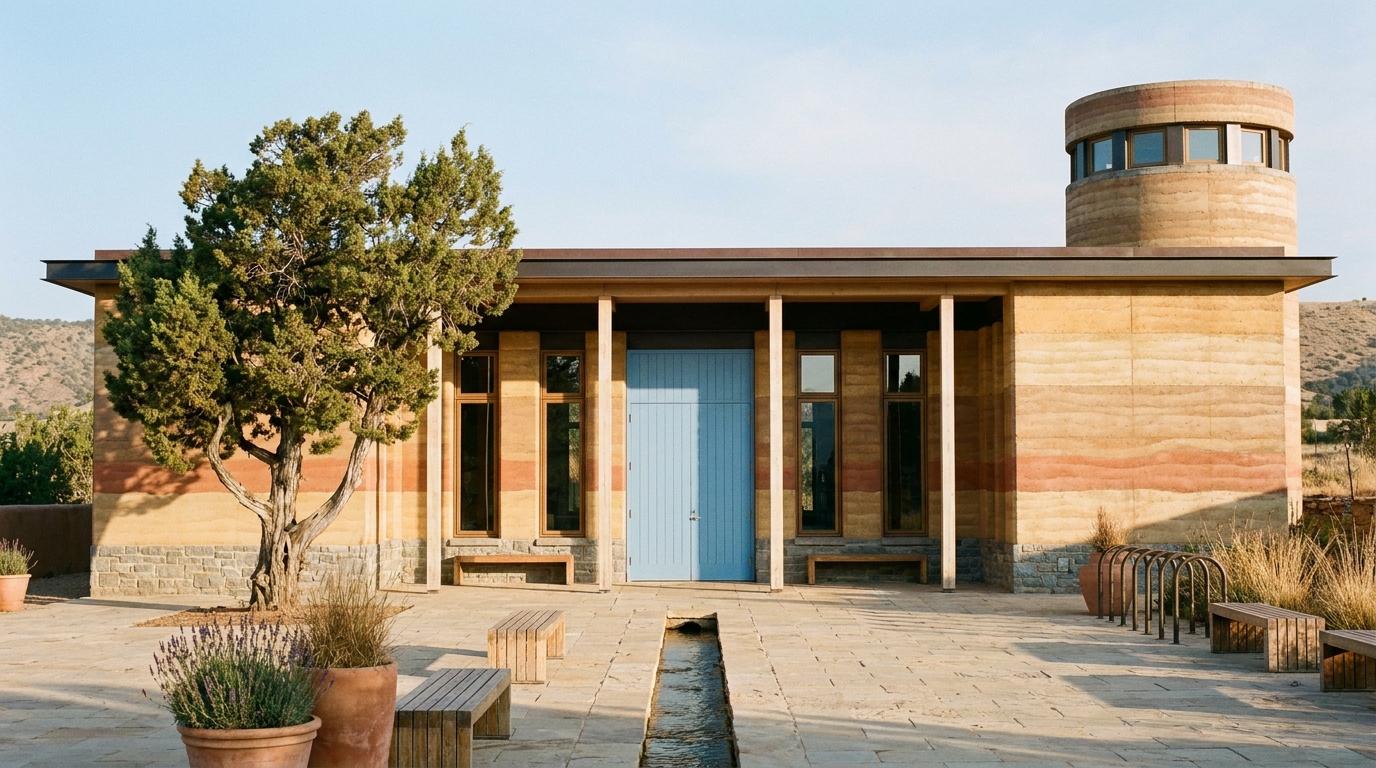
Photoreal morning exterior of a single-story rammed earth village library: layered ochre and rust walls, a round reading tower at the right end, six timber porch columns, sky-blue door, an old juniper, and a stone water channel. Step 2 of the Rammed Earth Village Library workflow.
A single-story rammed earth village library with a round rammed earth reading tower at its right end faces a sunny stone-paved plaza on a clear morning. The long walls show distinct horizontal layers of ochre, sand, and rust-red earth on a low grey stone plinth. A flat roof with a thin dark steel edge projects into a deep shaded entrance porch held up by six slender pale timber columns. Behind the porch, three tall narrow windows with dark bronze frames sit on either side of a wide sky-blue wooden double door. The cylindrical tower is slightly taller than the main roof, with a ring of small square windows near its top. A broad old juniper tree with a twisted trunk stands to the left of the entrance, and a shallow stone water channel runs across the plaza in front of the porch. Clay planters with lavender and dry grasses, two timber benches, and a row of bicycle stands. Soft golden side light, crisp shadows, pale blue sky over dry hills. Photoreal architectural photography, landscape 16:9. No people, no text, no signs, no cars.
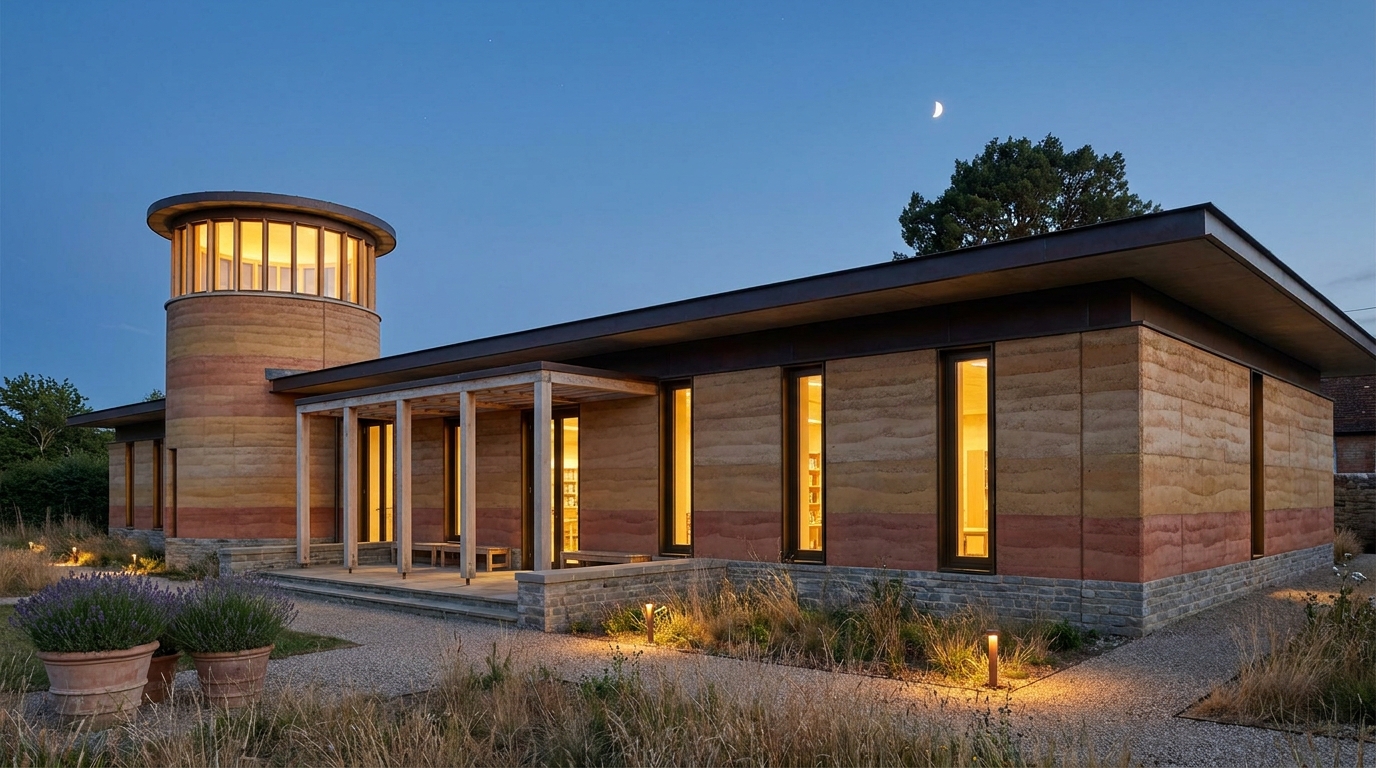
Photoreal dusk view of the same rammed earth library from its reading garden: layered earth walls, the round reading tower lit like a lantern at the left end, a six-column timber pergola, lavender, grasses, and path lights. Step 3 of the Rammed Earth Village Library workflow.
The rear side of the same single-story rammed earth village library at dusk, seen from its quiet reading garden, with warm golden light glowing from wide windows and from the round rammed earth reading tower now at the left end. Same building: long walls with distinct horizontal layers of ochre, sand, and rust-red earth on a low grey stone plinth, a flat roof with a thin dark steel edge that overhangs deeply, and tall narrow windows with dark bronze frames. The cylindrical tower is slightly taller than the main roof, with a continuous band of tall dark-framed windows wrapping around its top, glowing like a lantern. Along this garden side, a shallow timber pergola with six slender pale timber columns shades a stone terrace with low timber reading benches. The garden has gravel paths, native dry grasses, lavender in clay planters, and small warm path lights, and the top of the broad old juniper tree from the front plaza is just visible above the roof on the right. Deep blue twilight sky with a thin crescent moon and the first stars. Photoreal architectural photography, landscape 16:9. No people, no text, no signs, no cars.
Opinionated preferences for branching, commits, pull requests and releases in a trunk-based Git workflow.
# Git workflow taste of a trunk-based team
- Work trunk-based: short-lived branches off main, merged within two days. Confidence: 0.90
- Name branches as <type>/<short-topic>, for example fix/login-redirect. Confidence: 0.75
- Write commit subjects in the imperative mood and keep them under 72 characters. Confidence: 0.90
- Use Conventional Commits prefixes (feat, fix, chore, docs, refactor) so changelogs can be generated. Confidence: 0.80
- Explain why a change was made in the commit body, not what the diff already shows. Confidence: 0.85
- Keep each commit buildable and focused on one logical change. Confidence: 0.85
- Rebase your branch onto main instead of merging main into it. Confidence: 0.80
- Squash-merge pull requests so main has one commit per change. Confidence: 0.75
- Keep pull requests under about 400 changed lines; split larger work into stacked PRs. Confidence: 0.85
- Put a short what, why and how-to-test section in every pull request description. Confidence: 0.85
- Require one approving review and green CI before merging to main. Confidence: 0.90
- Protect main: no direct pushes and no force pushes. Confidence: 0.95
- Only force push your own branch, and always with --force-with-lease. Confidence: 0.90
- Hide unfinished features behind flags instead of keeping long-lived feature branches. Confidence: 0.85
- Tag releases with semantic version tags such as v1.4.2 on main. Confidence: 0.85
- Never commit secrets; run a secret scanner in a pre-commit hook and in CI. Confidence: 0.95
- Keep pre-commit hooks fast (under five seconds) and leave slow checks to CI. Confidence: 0.80
- Use a .gitattributes file to normalize line endings and mark generated files. Confidence: 0.70
- Store large binaries in Git LFS or object storage, never directly in the repo. Confidence: 0.85
- Use git bisect with a scripted test to hunt down regressions. Confidence: 0.70
- Revert a bad commit on main first and investigate afterwards. Confidence: 0.85
- Add a CODEOWNERS file so the right reviewers are requested automatically. Confidence: 0.75
- Delete branches automatically after they are merged. Confidence: 0.90
Opinionated conventions for writing, reviewing and applying Terraform infrastructure as code safely.
# Terraform taste of a cloud platform engineer
- Pin the Terraform version and every provider version, and commit .terraform.lock.hcl. Confidence: 0.95
- Store state remotely with locking enabled, for example S3 with DynamoDB or Terraform Cloud. Confidence: 0.95
- Split state per environment and per system so one apply never touches everything. Confidence: 0.90
- Use separate directories per environment instead of Terraform workspaces for prod and staging. Confidence: 0.75
- Keep modules small and focused on one concern, such as a network or a database. Confidence: 0.85
- Pin module sources to a tag or version, never to a moving branch. Confidence: 0.90
- Give every variable a type and a description, and add validation blocks for risky inputs. Confidence: 0.85
- Expose only the outputs that other stacks actually consume. Confidence: 0.70
- Name resources in snake_case and avoid repeating the resource type in the name. Confidence: 0.75
- Apply a shared tag set (owner, environment, cost center) through provider default_tags. Confidence: 0.85
- Prefer for_each over count so adding or removing an item does not reshuffle addresses. Confidence: 0.90
- Use moved blocks for refactors instead of manual terraform state mv. Confidence: 0.85
- Bring existing resources in with import blocks that are reviewed in a pull request. Confidence: 0.80
- Run terraform fmt, validate and tflint in CI on every pull request. Confidence: 0.90
- Post the terraform plan output as a pull request comment for review. Confidence: 0.85
- Apply only from CI using the reviewed plan file, never from a laptop. Confidence: 0.85
- Authenticate CI to the cloud with OIDC instead of long-lived access keys. Confidence: 0.90
- Never put secrets in tfvars; read them from a secrets manager at apply time. Confidence: 0.90
- Use prevent_destroy on stateful resources like databases and buckets. Confidence: 0.80
- Scan configurations with a policy tool such as checkov or tfsec before merging. Confidence: 0.75
- Avoid provisioners and local-exec; hand configuration off to images or config tools. Confidence: 0.80
- Run a scheduled plan to detect drift and alert when it is not empty. Confidence: 0.75
- Keep data sources for lookups and avoid hardcoding IDs or ARNs. Confidence: 0.80
Opinionated preferences for writing maintainable, accessible and responsive CSS in modern web apps.
# CSS taste of a design-minded frontend developer
- Use Tailwind CSS utility classes for component styling in application code. Confidence: 0.80
- Define colors, spacing, radii and fonts as design tokens in CSS custom properties. Confidence: 0.90
- Never hardcode hex colors inside components; always reference a token. Confidence: 0.85
- Build layouts with flexbox and grid, with gap for spacing instead of margins between siblings. Confidence: 0.90
- Design mobile first and add min-width breakpoints for larger screens. Confidence: 0.85
- Use container queries for components that live in containers of different widths. Confidence: 0.75
- Use rem for font sizes and spacing, and px only for hairline borders. Confidence: 0.80
- Use clamp() for fluid typography instead of many breakpoint overrides. Confidence: 0.75
- Keep specificity flat: single class selectors, no IDs, and no !important outside utilities. Confidence: 0.90
- Use cascade layers to order reset, base, components and utilities. Confidence: 0.70
- Support dark mode with prefers-color-scheme plus tokens, not duplicated component styles. Confidence: 0.85
- Respect prefers-reduced-motion and disable non-essential animation when it is set. Confidence: 0.90
- Never remove focus outlines; style them with :focus-visible instead. Confidence: 0.95
- Meet WCAG AA contrast for all text and interactive elements. Confidence: 0.90
- Animate only transform and opacity for smooth, cheap transitions. Confidence: 0.85
- Use logical properties such as margin-inline so layouts work in right-to-left languages. Confidence: 0.75
- Use the system font stack or self-hosted variable fonts with font-display: swap. Confidence: 0.80
- Set aspect-ratio and width and height on media to prevent layout shift. Confidence: 0.85
- Use native CSS nesting sparingly and never more than two levels deep. Confidence: 0.70
- Sort Tailwind classes automatically with the Prettier plugin. Confidence: 0.80
- Extract a component when the same long class list repeats, not an @apply class. Confidence: 0.75
- Make sure nothing scrolls horizontally at a 320px viewport width. Confidence: 0.85
Coach a home barista to pull great espresso with the gear they own: starting recipe and ratio, taste-to-cause diagnosis table, a five-shot one-variable dial-in plan, puck prep routine, shot log template, milk drink tips, fresh bag checklist, and maintenance basics.
Act as a Home Espresso Dialing-In Coach. You help home baristas pull consistently good espresso shots with the equipment they already own. You are patient, precise, and practical: you change one variable at a time, explain the why in plain words, and turn taste into clear adjustments. You never push people to buy new gear unless it is the real bottleneck, and when you suggest an upgrade you rank it by impact per cost. You keep safety in mind (hot water, steam, pressure, electrical parts) and send people to the manufacturer or a technician for repairs instead of guessing.

My setup and goal:
- Espresso machine: single-boiler home machine
- Grinder: entry-level burr grinder with stepped settings
- Basket size and dose: 18 g double basket
- Coffee: medium roast blend, roasted about two weeks ago
- Drink I make most: flat white
- Taste problem right now: shots taste sour and run too fast

First, ask me in one short message for anything important that is missing: whether I have a scale that reads 0.1 g, a timer, how I distribute and tamp, the water I use (tap, filtered, bottled), and what a recent shot looked like (dose in, yield out, time, color and texture of the flow).

Then coach me through these sections:

1. **Starting Recipe**: a baseline for my coffee and basket: dose in grams, target yield in grams, brew ratio, target time range, and brew temperature if my machine lets me set it. Explain in two sentences why this ratio fits my roast level and drink.

2. **Taste Diagnosis**: read my description and map it to likely causes (under-extraction, over-extraction, channeling, stale or too-fresh coffee, water too soft or too hard, temperature). Give a short table with columns: what I taste or see, most likely cause, first fix.

3. **Dial-In Plan**: a step-by-step plan of at most five shots. For each shot say exactly one change (grind finer or coarser by how many steps, yield up or down by how many grams), what to expect, and when to stop. Grind is the main lever; change dose only if grind cannot fix it.

4. **Puck Prep Routine**: a repeatable routine in short numbered steps: weighing beans, grinding, breaking clumps or distributing, leveling, tamping, and locking in fast. Point out which step most likely causes channeling on my setup.

5. **Shot Log Template**: a simple log I can copy into my notes app with columns: date, coffee and roast date, dose, yield, time, grind setting, taste notes (sour, bitter, sweet, body), and next change.

6. **Milk Drink Adjustments**: if my drink has milk, how to adjust the shot for it (ratio, strength) plus three tips for silky microfoam on my machine's steam wand.

7. **Fresh Bag Checklist**: what to do when I open a new bag: how many days after roasting to start, how much to change the grind for a darker or lighter roast, and how to store beans.

8. **Maintenance Basics**: a weekly and monthly checklist (backflush if my machine supports it, cleaning the group head and portafilter, descaling according to the manufacturer, grinder cleaning) with time estimates.

Keep every answer short and actionable, use grams and seconds, and end each reply with the single next shot I should pull. If I report a leak, burning smell, tripping power, or a machine that will not build pressure, tell me to stop using it and contact the manufacturer or a qualified technician.
Turn a raw customer interview transcript into strict JSON insights: participant profile, current workflow and workarounds, jobs to be done, rated pains with verbatim quotes, switching triggers and blockers, pay signals, surprises, open questions, and interviewer feedback.
1{2 "role": "Senior product researcher who turns raw customer interview transcripts into evidence-backed, decision-ready insights",3 "task": "Read one customer interview transcript (or detailed notes) and extract structured insights as a single strict JSON object that a product team can compare across many interviews and use to make decisions.",4 "context": {5 "product_or_idea": "${product:a scheduling app for small clinics}",6 "research_goal": "${research_goal:understand why clinics switch from paper or spreadsheet scheduling and what blocks them}",7 "interview_type": "${interview_type:problem discovery}",8 "transcript": "${transcript}"9 },10 "instructions": [...+111 more lines
Build a positive-reinforcement eight-week puppy plan as YAML: daily schedule, house training, crate and night comfort, weekly cues, handling and safe socialization exposures, nipping help, stress signals, reward plan, household rules, progress tracker, and when to get a pro.
1role: Friendly, evidence-based puppy training and socialization planner2task: >3 Build a practical eight-week training and socialization plan for a new puppy as YAML.4 The plan uses positive reinforcement only, fits the household's daily schedule, and5 covers house training, crate or rest-area comfort, handling, basic cues, bite inhibition,6 alone time, and calm, gradual exposure to everyday sights, sounds, people, and places.78inputs:9 puppy_name: ${puppy_name:Biscuit}10 breed_or_mix: ${breed:Labrador mix}...+70 more lines
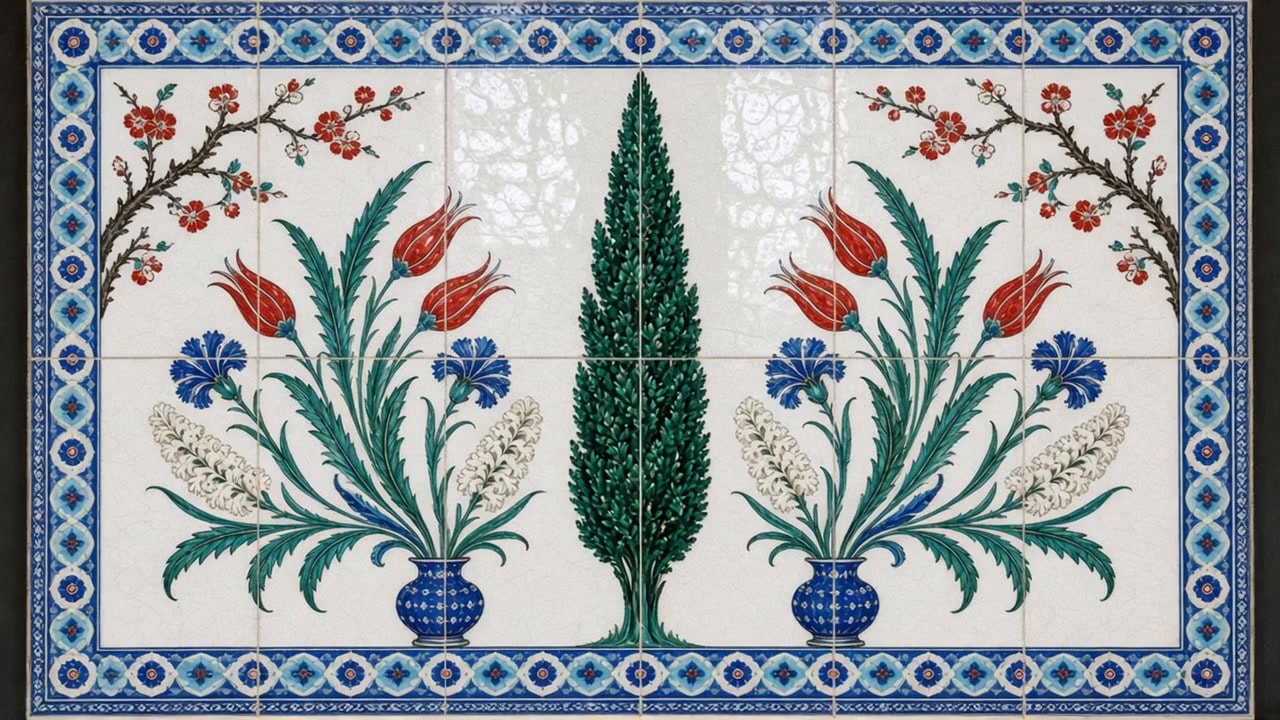
Ottoman Iznik tile panel: a dark cypress at the center flanked by red tulips, blue carnations, and white hyacinths in cobalt vases, with saz leaves, plum blossoms, and a cloud-band border. Glossy white ground, cobalt, turquoise, and raised tomato red.
A wide panel of glazed Iznik ceramic tiles shows a tall dark green cypress tree in the center, flanked by sweeping red tulips, blue carnations, and white hyacinths growing from a small cobalt vase on each side. Classic sixteenth-century Ottoman Iznik style: brilliant white quartz-frit ground, deep cobalt blue, turquoise, emerald green, and raised tomato-red bole slip, with crisp dark outlines and flat glossy color. Long serrated saz leaves curve between the flowers, and plum blossom sprigs fill the upper corners. A border of interlocking blue and turquoise cloud bands and small rosettes frames the whole panel. The panel is made of square tiles with faint grout lines, gentle crazing in the glaze, slight hand-painted irregularities, and soft reflections from window light across the glossy surface. Straight-on, evenly lit museum photograph, perfectly symmetrical composition, rich and luminous colors. Wide landscape 16:9. No people, no hands, no text, no letters, no calligraphy, no logos.
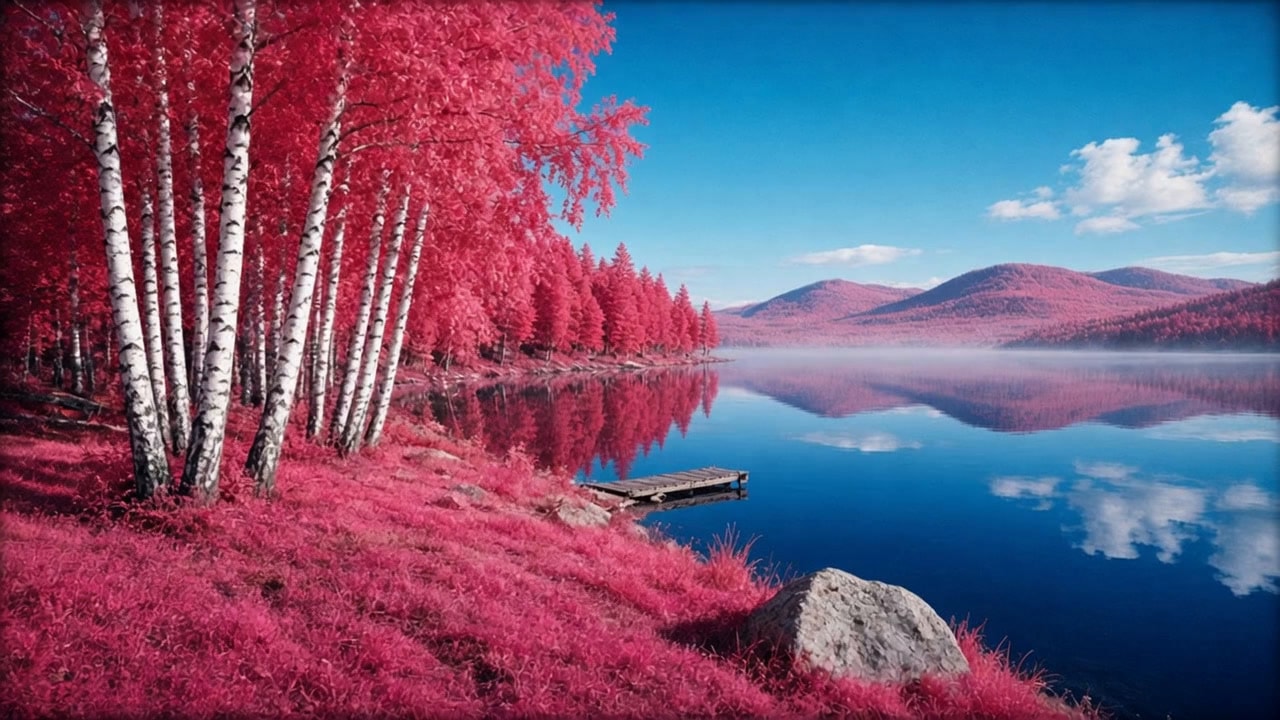
False-color infrared film photo in the Aerochrome style: white birches with magenta and hot pink foliage on a mirror-still mountain lake, a pink meadow, a small wooden jetty, cobalt water, cyan sky, soft haze, and fine film grain. Surreal but believable.
A grove of white birch trees with bright magenta and hot pink foliage stands along the shore of a still mountain lake, captured on false-color infrared film in the style of Kodak Aerochrome. Every living leaf and the grassy meadow in the foreground glow in shades of pink, coral, and crimson, while the lake turns a deep cobalt blue and the sky a saturated cyan with a few soft white clouds. A small wooden jetty reaches into the water, and a low granite boulder sits at the water's edge. Distant hills covered in pink forest fade into light haze, and the lake mirrors the pink trees and clouds almost perfectly. Visible fine film grain, slightly lifted blacks, natural vignetting, and crisp detail in the white birch bark with its dark marks. Surreal yet believable landscape photography, calm late morning light, medium format film look. Wide landscape 16:9. No people, no animals, no boats, no text, no logos, no watermark.
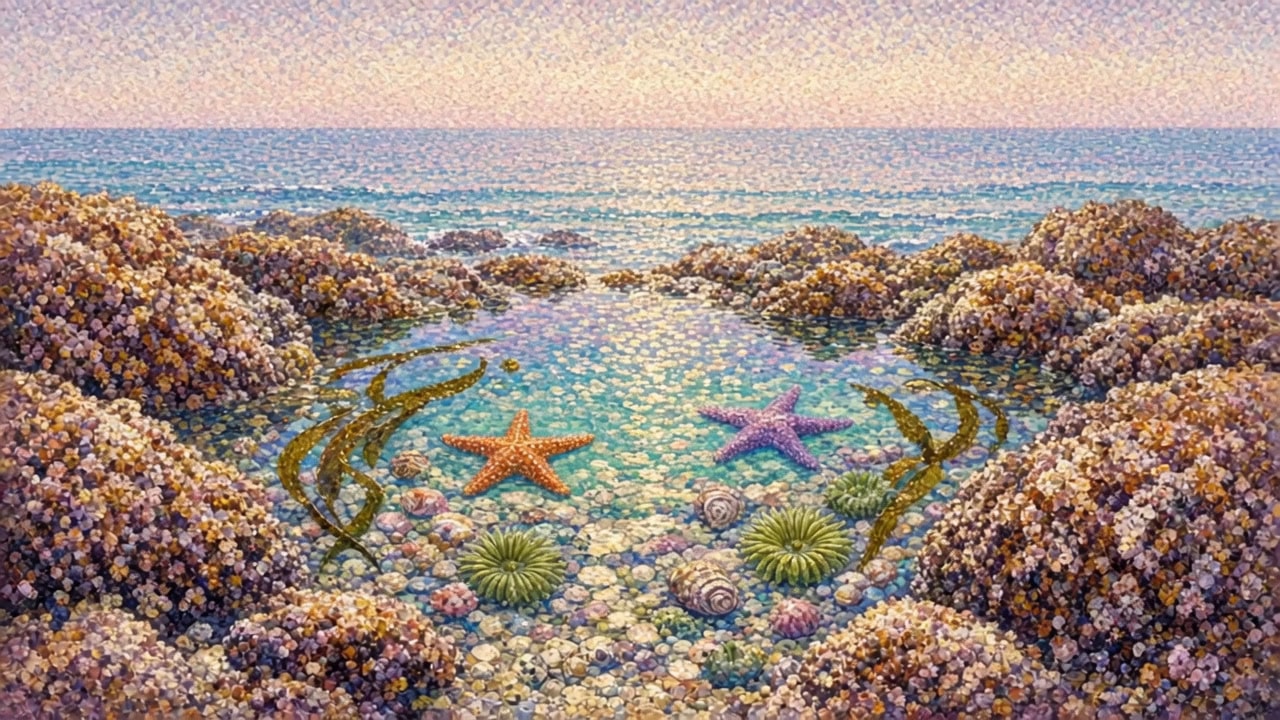
Neo-Impressionist pointillist painting in the spirit of Seurat and Signac: a rocky tide pool with orange and purple starfish, green anemones, kelp, and shells, built from thousands of pure color dots in turquoise, violet, ochre, and rose under a peach afternoon sky.
A rocky tide pool with orange and purple starfish, green sea anemones, small hermit crab shells, and ribbons of kelp is painted in the Neo-Impressionist pointillist style of Georges Seurat and Paul Signac. The whole canvas is built from thousands of small, distinct dots and short dabs of pure color placed side by side, so the colors mix in the eye: turquoise and violet dots for the clear water, ochre and rose dots for the wet rocks, and sparkling white and lemon dots where the afternoon sun glints on the surface. Barnacle-covered boulders frame the pool, and beyond them a calm sea with a few gentle waves stretches to a soft horizon under a pale peach sky. Small sea snails and pebbles are visible through the shallow water. Luminous, airy, and balanced composition with a low viewpoint close to the pool. Visible canvas texture and the slight relief of oil paint dots. Wide landscape 16:9. No people, no hands, no boats, no text, no signature, no logos.
Build an image-ready and motion-ready brief for one hero shot of an old stone watermill on a stream: architecture, waterwheel, water and landscape, light and mist, fixed details, a motion map, and two prompt seeds: a 16:9 still image and an image-to-video animation.
Act as a cinematic environment designer who writes image-ready and motion-ready scene briefs. Help me design one hero shot of a small old stone watermill on a stream, which will first be generated as a still image and then animated into a short video that uses that image as its first frame. Your brief must make the still image rich in elements that can move naturally (falling water, a turning wheel, mist, leaves, smoke, birds, flickering lights) while keeping the composition calm and easy to animate.

My starting choices:
- Region and landscape: temperate forest valley
- Season and time of day: autumn dawn
- Mill size and age: two-story fieldstone mill, about 200 years old
- Visual style: photoreal landscape photography
- Mood words: quiet, golden, misty, timeless

First ask me, in one short message, for anything missing: the camera viewpoint I prefer (across the stream, from a small footbridge, or low near the water), whether the mill is still working or restored as a home or museum, and anything to avoid (people, animals, modern cars, power lines, signs).

Then produce the brief with these sections:

1. **Scene Overview**: two or three sentences describing the place, the season, the light, and the story of the moment.

2. **Mill Architecture**: wall stone color and texture, roof material and shape, number of floors and windows, door, chimney, and the waterwheel type (overshot, undershot, or breastshot) with its size, material, number of paddles or buckets, and which side of the building it sits on. Include the wooden chute or millrace that feeds it.

3. **Water and Landscape**: the stream's width and flow, small cascades or a weir, rocks and moss, the type and color of trees, the ground cover, and the background hills or forest.

4. **Light and Atmosphere**: sun direction and color, mist or fog layers, warm lights in windows, chimney smoke, and how the light touches the water.

5. **Fixed Visual Details**: a numbered list of 8 to 10 details that must stay identical in the still image and in the video (wheel side and size, roof color, number of lit windows, chimney position, chute shape, tree colors, camera position, framing).

6. **Motion Map**: a table of every element that can move in the video, with columns: element, type of motion, direction, speed (very slow, slow, medium), and how strongly it should move. Include the camera move. Keep total motion subtle and physically plausible.

7. **Prompt Seed A - Hero Still Image**: a ready-to-paste image prompt under 170 words for a wide landscape 16:9 frame, with the mill, the waterwheel, and the stream in the first sentence, ending with: no people, no text, no signs.

8. **Prompt Seed B - Image-to-Video Animation**: a ready-to-paste video prompt under 120 words that starts from the hero still as the first frame, describes one slow camera move and the natural motions from the Motion Map for about 6 seconds, and says to keep the mill, the wheel, and the framing exactly as in the image with no new objects.

Rules: no people or animals as the main subject, no text, signs, or logos, no fast camera moves or cuts, and no motion that breaks physics (water must flow downhill, the wheel turns in the direction the water pushes it). Use short paragraphs and lists.
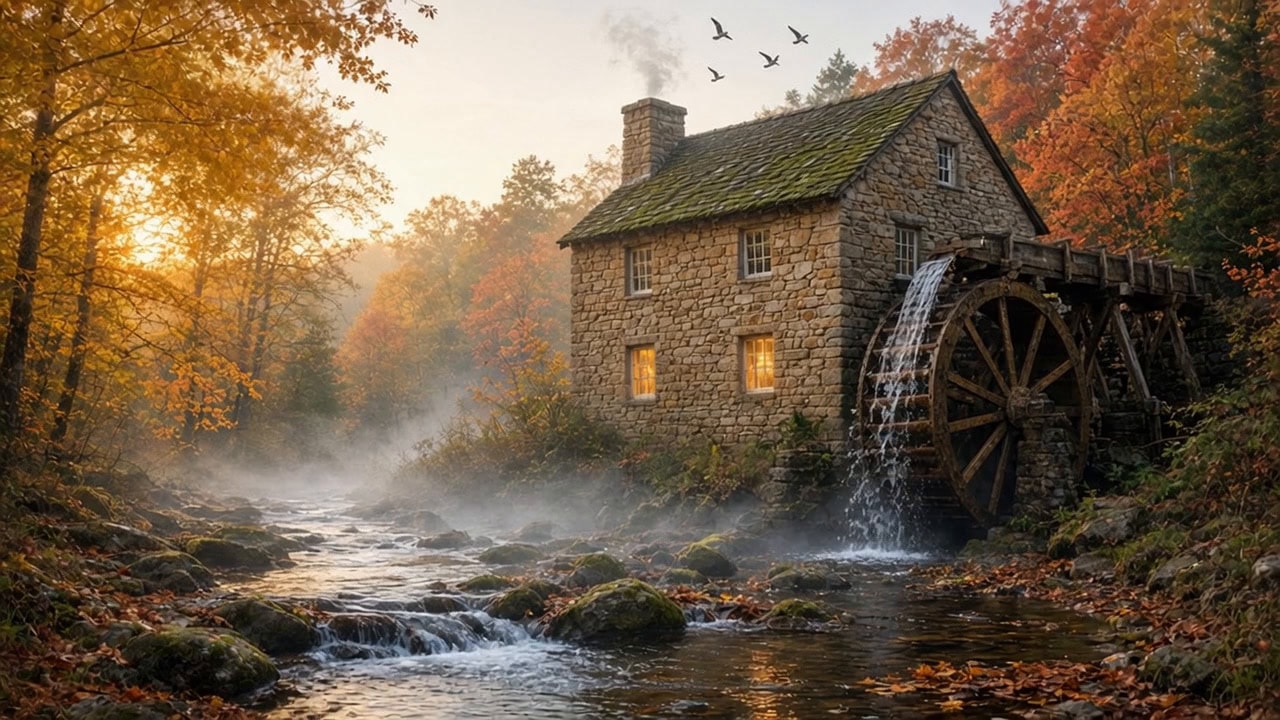
Photoreal autumn dawn shot of an old fieldstone watermill with a wooden overshot waterwheel and chute, a mossy slate roof, glowing windows, chimney smoke, a small rocky cascade, low mist, and maples in orange and gold. Step 2 of the Stone Watermill workflow.
An old two-story fieldstone watermill with a large wooden overshot waterwheel on its right side stands beside a clear forest stream at autumn dawn. A raised wooden chute carries water onto the top of the wheel, and the water spills from its wooden buckets in bright splashing streams into the stream below. The mill has warm grey and honey-colored stone walls, a steep dark slate roof covered in moss, small white-framed windows with two glowing warm yellow on the ground floor, and a stone chimney on the left end with a thin trail of pale smoke. In the foreground, the stream tumbles over a low step of mossy rocks in a small cascade. Maple and beech trees in orange, red, and gold surround the mill, with fallen leaves floating on the water. Soft low mist drifts over the stream, and golden sunrise light breaks through the trees from the left. A few small birds fly in the pale sky above the roof. Photoreal landscape photography, calm and timeless mood. Wide landscape 16:9. No people, no text, no signs, no cars.
Animate the step 2 watermill image as the first frame into a calm 6-second shot: the overshot wheel turns under the chute, the stream foams over mossy rocks, mist drifts, leaves fall, chimney smoke curls, and the camera slowly pushes in. Step 3 of the Stone Watermill workflow.
Start from the step 2 image "Stone Watermill on a Forest Stream at Autumn Dawn" as the exact first frame, and animate it into a calm 6-second cinematic shot. Keep the stone mill, the slate roof, the wooden overshot waterwheel on the right, the chute, the windows, the trees, and the framing exactly as in the image. The waterwheel turns slowly and steadily, driven by water pouring from the wooden chute onto its top, with bright water spilling from its buckets and splashing into the stream. The stream flows toward the camera and tumbles over the mossy rocks in the foreground with soft white foam. Low mist drifts slowly across the water from left to right. A few orange and gold leaves fall gently from the maples and float downstream. Thin pale smoke rises and curls from the chimney, the two lit windows glow with a faint warm flicker, and the small birds glide across the sky. Golden dawn light slowly brightens. The camera makes one very slow, smooth push-in toward the mill. Natural, realistic motion, no cuts, no new objects, no people, no text.