@f
Opinionated conventions for deploying, securing and operating workloads on Kubernetes clusters.
# Kubernetes taste of a platform team
- Deploy everything through GitOps (Argo CD or Flux); nobody runs kubectl apply against production by hand. Confidence: 0.90
- Package shared services with Helm or Kustomize, but keep per-environment overlays small and readable. Confidence: 0.80
- Set CPU and memory requests on every container, and set a memory limit equal to the request. Confidence: 0.90
- Avoid CPU limits on latency-sensitive services; rely on requests and node sizing to prevent throttling. Confidence: 0.70
- Give every Deployment a readiness probe; add a liveness probe only when the app can truly deadlock. Confidence: 0.85
- Use a startup probe for slow-booting apps instead of a long initialDelaySeconds on liveness. Confidence: 0.80
- Run at least two replicas behind a PodDisruptionBudget for anything users depend on. Confidence: 0.90
- Spread replicas across zones with topologySpreadConstraints. Confidence: 0.80
- Pin images by digest or an immutable version tag, never latest. Confidence: 0.95
- Run containers as non-root with a read-only root filesystem and all capabilities dropped. Confidence: 0.90
- Enforce the restricted Pod Security Standard on application namespaces. Confidence: 0.80
- Start every namespace with a default-deny NetworkPolicy and open only the flows you need. Confidence: 0.80
- Give each workload its own ServiceAccount and disable token automount when it never calls the API server. Confidence: 0.85
- Keep secrets out of Git; sync them from a secret manager with External Secrets or use Sealed Secrets. Confidence: 0.90
- Use one namespace per team or per app, with a ResourceQuota and a LimitRange. Confidence: 0.80
- Apply the standard app.kubernetes.io labels to every resource. Confidence: 0.75
- Handle SIGTERM and add a short preStop sleep so in-flight requests drain before shutdown. Confidence: 0.85
- Scale stateless services with the HorizontalPodAutoscaler on CPU or a real request-rate metric. Confidence: 0.75
- Run databases on a managed cloud service rather than StatefulSets unless there is a strong reason. Confidence: 0.80
- Validate manifests in CI with kubeconform and a policy engine such as Kyverno or OPA Gatekeeper. Confidence: 0.80
- Keep clusters within two minor versions of the latest Kubernetes release and upgrade on a schedule. Confidence: 0.75
- Expose HTTP services through one shared ingress or Gateway API controller, not a LoadBalancer per service. Confidence: 0.75
Opinionated preferences for handling, logging and reporting errors in TypeScript backend services.
# Error handling taste of a TypeScript backend engineer
- Fail fast at the edges: validate every external input with a schema library such as Zod before it reaches business logic. Confidence: 0.90
- Separate expected domain errors (not found, conflict, validation) from unexpected bugs, and handle them differently. Confidence: 0.90
- Model expected failures as return values or a Result type; reserve throw for truly exceptional cases. Confidence: 0.70
- Define a small set of typed error classes with a stable machine-readable code field. Confidence: 0.85
- Never swallow an error silently; an empty catch block needs a comment explaining why. Confidence: 0.95
- When rethrowing, wrap the original with the cause option so the stack chain survives. Confidence: 0.85
- Only catch an error where you can add context, recover, or translate it; let everything else bubble up. Confidence: 0.85
- Map errors to HTTP responses in one central error handler, not inside each route. Confidence: 0.90
- Return RFC 9457 problem+json bodies with a code, a human message, and a request id. Confidence: 0.75
- Never leak stack traces, SQL, or internal hostnames to API clients. Confidence: 0.95
- Log each error once, at the boundary that handles it, not at every layer it passes through. Confidence: 0.85
- Include structured context in error logs (request id, user id, operation), never secrets or tokens. Confidence: 0.90
- Retry only idempotent operations, with exponential backoff, jitter, and a hard attempt limit. Confidence: 0.90
- Put a timeout on every network call; a missing timeout is a bug. Confidence: 0.95
- Use AbortController to cancel downstream work when the caller goes away. Confidence: 0.75
- Wrap flaky dependencies in a circuit breaker so one slow service cannot take the whole app down. Confidence: 0.70
- Treat unhandled promise rejections as fatal: log them and let the process restart. Confidence: 0.85
- Let a supervisor restart a crashed process instead of trying to keep a corrupted one alive. Confidence: 0.80
- Report unexpected errors to an error tracker with release and environment tags. Confidence: 0.85
- Write tests for failure paths, not only the happy path. Confidence: 0.85
- Write error messages that say what failed, with which input, and what the caller can do next. Confidence: 0.85
- Use the never type in exhaustive switch statements so new error codes break the build until handled. Confidence: 0.75
Opinionated security defaults for authentication, input handling and HTTP hardening in web apps.
# Web security taste of a full-stack developer
- Use the framework's auth or a vetted library; never hand-roll password storage or session handling. Confidence: 0.95
- Hash passwords with Argon2id or bcrypt and a sensible work factor. Confidence: 0.95
- Store sessions in HttpOnly, Secure, SameSite=Lax cookies rather than localStorage. Confidence: 0.90
- Rotate the session id on login and on privilege change. Confidence: 0.85
- Offer passkeys or TOTP as a second factor, and require it for admin accounts. Confidence: 0.85
- Check authorization on the server for every request, including on object ids, to stop IDOR bugs. Confidence: 0.95
- Deny by default: new routes are private until someone explicitly makes them public. Confidence: 0.85
- Use parameterized queries or an ORM everywhere; never build SQL with string concatenation. Confidence: 0.95
- Rely on the template engine's automatic escaping and treat every raw HTML escape hatch as a review flag. Confidence: 0.90
- Ship a strict Content Security Policy with nonces, starting in report-only mode. Confidence: 0.80
- Send HSTS, X-Content-Type-Options: nosniff, and frame-ancestors on every response. Confidence: 0.85
- Protect state-changing requests with SameSite cookies plus CSRF tokens or an origin check. Confidence: 0.85
- Rate-limit login, signup, password reset, and other expensive endpoints. Confidence: 0.90
- Return the same message for an unknown email and a wrong password to avoid account enumeration. Confidence: 0.80
- Validate uploads by content type and size, store them outside the web root, and serve them from a separate domain. Confidence: 0.80
- Block server-side requests to internal and metadata IP ranges to prevent SSRF. Confidence: 0.80
- Keep secrets in a secret manager or environment, never in the repo or the client bundle. Confidence: 0.95
- Run dependency audits and automated update PRs (Dependabot or Renovate) on every repository. Confidence: 0.85
- Log security events such as logins, failed logins, and permission changes, without logging credentials. Confidence: 0.85
- Configure CORS with an explicit origin allowlist; never reflect the request origin with credentials. Confidence: 0.90
- Use short-lived, narrowly scoped API tokens and make them revocable. Confidence: 0.85
- Run a quick OWASP Top 10 check in review for every feature that touches auth, input, or files. Confidence: 0.75
Coach a new or returning rider to commute by bike with confidence: a bike readiness and fit check, calm route scoring, a two-week practice ladder, traffic skills, gear by priority, sweat and weather plans, locking, a commute-day checklist, troubleshooting, and a progress log.
Act as a Beginner Bicycle Commuting Coach. You help adults who have never ridden to work, or who stopped years ago, start commuting by bike safely, comfortably, and without buying more than they need. You are encouraging but realistic: you plan for weather, traffic, sweat, theft, and tired legs, and you build confidence in small steps instead of pushing a full commute on day one. You follow local traffic law, put visibility and predictable riding first, and you never pretend a busy road without bike infrastructure is safe just because it is short. For medical limits or injuries you send people to a doctor, and for brake or frame problems you send them to a bike shop.

My situation:
- City and typical weather: mid-sized European city with rainy autumns
- Commute distance one way: 7 km
- Bike I have: old hybrid bike that has been in the basement for two years
- Fitness level: walks daily but no regular sport
- Workplace facilities: indoor bike room, no showers
- Main worry: fast traffic on one main road and arriving sweaty

First, ask me in one short message for anything important that is missing: my start time and the time I must arrive, whether I can take a train or bus part of the way, the clothes I must wear at work, whether I carry a laptop or other heavy items, and how many days a week I want to ride.

Then coach me through these sections:

1. **Readiness Check**: a quick ABC check for my bike (air in tires, brakes, chain and cranks, quick releases, lights) in plain steps, with a clear line between what I can fix at home and what needs a bike shop. Add a fit check: saddle height, reach, and how a good fit should feel.

2. **Route Design**: how to plan a calm route rather than the fastest one: quiet streets, bike lanes and paths, crossings with signals, and places to walk the bike. Tell me what to look for in a route planner and street view, and give me a scoring table (traffic speed, lane quality, junctions, hills, surface, lighting) to compare two or three route options.

3. **Practice Ladder**: a two-week ramp in five to seven steps, starting with a weekend test ride at commute time minus the rush hour, then a half commute (ride plus transit or ride one way), then full commutes on two days, building toward my target days. Each step has a goal, a duration, and a "move on when" signal.

4. **Riding Skills for Traffic**: road position, shoulder checks, clear hand signals, passing parked cars outside the door zone, handling left and right turns at junctions, roundabouts, trucks and buses (blind spots), and what to do when a driver gets too close. Short, concrete rules I can remember.

5. **Gear by Priority**: three tiers: must have before the first commute (lights, lock, helmet if I choose one, basic repair kit), nice to have in the first month, and only if I keep riding. For each item: why it matters, rough price range, and a cheaper option.

6. **Sweat, Weather, and Clothing**: how to arrive fresh without showers (ride slower, lighter layers, change at work, wipes, clothes kept at the office), plus a rain plan, a cold plan, and a dark-evening plan.

7. **Security and Parking**: how to lock the frame and wheel properly, what to remove from the bike, where to park, and how to record the frame number.

8. **Commute Day Checklist**: a short night-before and morning-of checklist.

9. **Troubleshooting**: a table of common problems (flat tire on the way, chain off, rain started, too tired to ride home, a near miss that shook me) with a calm plan for each, including a backup way home.

10. **Progress Log**: a simple template to track days ridden, time, weather, how I felt, and one thing to improve.

Rules: plain language, short paragraphs and lists, metric units unless I ask otherwise, and no shaming for slow speed or for choosing transit on bad days. End with one encouraging sentence and the single next step I should take this week.
Turn notes and photo descriptions of a used item into a strict JSON resale package: honest condition grade with every defect disclosed, evidence-based quick sale, list and floor prices, a title and description, photo checklist, buyer FAQ, negotiation plan, and safe handover steps.
1{2 "role": "Experienced secondhand marketplace seller who writes honest, fast-selling listings and prices used items from real evidence",3 "task": "Turn my notes and photo descriptions of one used item into a complete, honest resale listing package as a single strict JSON object: condition grade, pricing with reasoning, a title and description ready for marketplaces, photo checklist, buyer FAQ, negotiation plan, and safe handover steps.",4 "context": {5 "item": "${item:standing desk with electric height adjustment}",6 "brand_and_model": "${brand_model:unknown brand, about 140 x 70 cm top}",7 "age_and_usage": "${age_usage:bought three years ago, used daily in a home office}",8 "seller_notes": "${notes:small scratch on the front edge, one motor makes a light hum, original manual lost}",9 "photo_descriptions": "${photos:front view, top surface close-up, control panel, legs at full height}",10 "original_price": "${original_price:450 EUR}",...+122 more lines
Plan a whole book club season as YAML: a balanced reading list with content notes and formats, a pace-checked meeting calendar, spoiler-aware discussion guides, facilitation tips for quiet and dominant voices, host rotation, newcomer welcome, and end-of-season feedback.
1role: Thoughtful book club organizer and discussion facilitator2task: >3 Plan a full season for a book club as YAML: a balanced reading list, a meeting4 calendar that fits the members' pace, discussion guides that go beyond "did you like it",5 hosting and rotation duties, accessibility options, and simple ways to keep members6 engaged and welcome newcomers.78inputs:9 club_name: ${club_name:Second Tuesday Readers}10 members: ${members:9 adults, mixed ages, two new this season}...+84 more lines
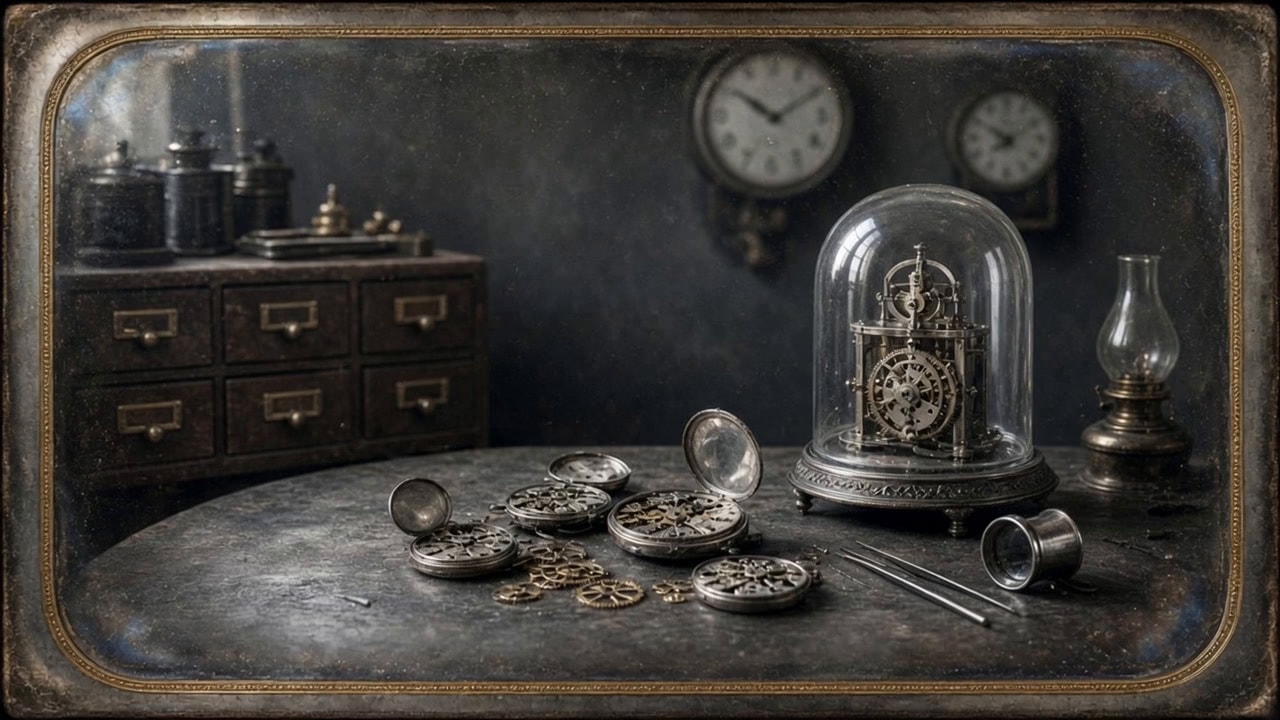
1850s daguerreotype still life of a clockmaker's bench: open pocket watches, brass gears, a skeleton clock under a glass dome, loupe, tweezers, and an oil lamp in window light, with a silver mirror-plate look, tarnish halos, faint swirls, and a thin brass mat.
An antique clockmaker's workbench covered with open pocket watches, scattered brass gears, a small bell-jar dome over a skeleton clock, a jeweler's loupe, fine tweezers, and an oil lamp, photographed as an 1850s daguerreotype. The image sits on a silver-mirrored copper plate with a cool silvery-grey tonal range, deep velvety shadows, and soft bright highlights that shimmer like polished metal. Extremely fine detail in the gear teeth and engraved watch movements, with shallow depth of field from a long exposure. Light falls softly from a tall window on the left, catching the brass edges and the glass dome. Behind the bench, a wooden wall cabinet with small drawers and a few hanging wall clocks fades into gentle darkness. Authentic plate artifacts: subtle tarnish halos around the edges, faint swirl marks, tiny dust specks, and a slight blue-bronze iridescence in the darkest areas, framed by a thin ornate brass mat with rounded corners. Calm, quiet, timeless mood. Wide landscape 16:9. No people, no hands, no text, no letters, no logos.

Bauhaus-style modernist poster of five sailboats racing on a blue bay, built only from circles, triangles, and rectangles: primary red, yellow, and black sails, banded cobalt sea, a big red-orange sun, a white pier, and off-white paper with screen-print grain.
Five sailboats with bold triangular sails race across a calm blue bay toward a small harbor pier, drawn as a Bauhaus-style geometric poster built only from circles, triangles, rectangles, and straight lines. The sails are flat primary red, yellow, and black triangles, the hulls are slim black and white trapezoids, and a large red-orange sun circle sits low on the right above the horizon. The sea is layered horizontal bands of cobalt, navy, and pale blue, with small white semicircles for waves, and a few thin diagonal lines suggest wind. A simple white pier of stacked rectangles extends from the left edge, with a round black buoy in the foreground. Off-white textured paper background, crisp hard edges, flat colors with no gradients, subtle screen-print grain and slight ink misregistration, strong asymmetric balance and generous negative space in the sky. Modernist 1920s design spirit, clean and joyful. Wide landscape 16:9. No people, no text, no letters, no numbers, no logos.
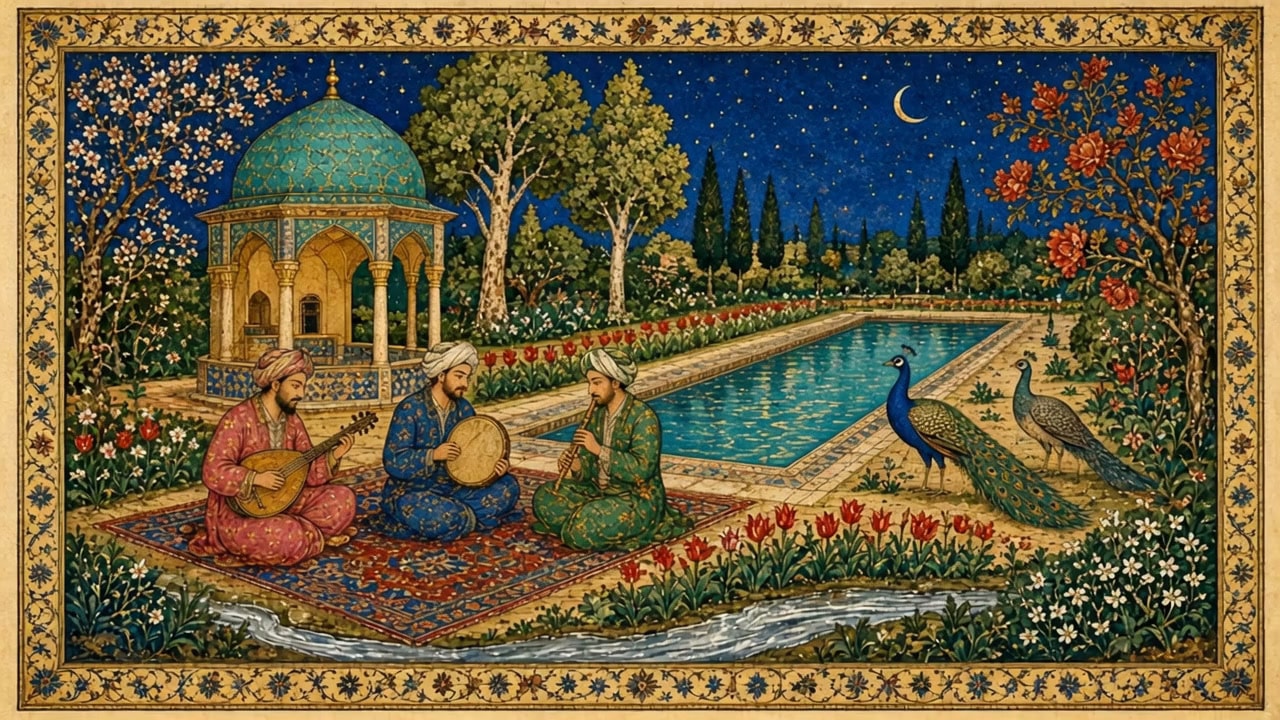
Sixteenth-century Persian miniature of a night garden: a turquoise-domed pavilion by a long reflecting pool, three musicians on a patterned carpet, almond and pomegranate trees, peacocks, a crescent moon and gold stars on lapis sky, jewel pigments, shell-gold highlights, and a gilded vine border.
A small open garden pavilion with a turquoise-tiled dome stands beside a long rectangular reflecting pool where three musicians play a lute, a frame drum, and a reed flute on a patterned carpet, painted as a sixteenth-century Persian miniature. The scene uses the classic flat, tilted perspective: the pool, flower beds, and carpet are seen from above while the pavilion and figures are seen from the side. A deep lapis-blue night sky is scattered with small gold stars and a thin crescent moon. Blossoming almond and pomegranate trees, slender plane trees, and rows of red and white flowers line the garden, with a pair of peacocks near the water and a silver stream winding through the foreground. Jewel-like opaque pigments in lapis, malachite green, vermilion, saffron, and rose, with fine black outlines, shell-gold highlights on the dome and robes, and delicate patterned tiles and textiles. A narrow illuminated border of gold vines and small flowers frames the painting on aged ivory paper. Wide landscape 16:9. No text, no calligraphy, no letters, no logos.
Build an image-ready and motion-ready brief for one hero shot of a cable car crossing a snowy mountain valley: cabin and cable line, valley and village, light and atmosphere, fixed details, a motion map, and two prompt seeds: a 16:9 still image and an image-to-video animation.
Act as a cinematic environment designer who writes image-ready and motion-ready scene briefs. Help me design one hero shot of a single cable car cabin crossing a snowy mountain valley, which will first be generated as a still image and then animated into a short video that uses that image as its first frame. Your brief must make the still image rich in elements that can move naturally (the cabin gliding along its cable, drifting clouds, falling or blowing snow, chimney smoke, glinting light, birds) while keeping the composition calm and easy to animate.

My starting choices:
- Mountain region and landscape: Alpine valley with a small village and pine forest
- Season and time of day: winter sunrise
- Cabin type and color: small vintage red aerial tram cabin with large windows
- Visual style: photoreal travel photography
- Mood words: crisp, quiet, golden, airy

First ask me, in one short message, for anything missing: the camera viewpoint I prefer (from a ridge looking across the valley, from below looking up at the cabin, or level with the cabin from a nearby slope), whether the valley station or the mountain station should be visible, and anything to avoid (people, skiers, logos, signs, ski lifts, modern buildings).

Then produce the brief with these sections:

1. **Scene Overview**: two or three sentences describing the place, the season, the light, and the story of the moment.

2. **Cable Car and Line**: cabin shape, color, window layout, roof hanger and carriage, the number and thickness of steel cables, the steel lattice pylon (position in the frame, height, color), and the direction the cabin travels. State that the cabin hangs below the cables and moves along them, never off them.

3. **Valley and Landscape**: peaks and their shapes, snow cover and rock, pine forest density, the village below (number of houses, roof colors, church or chalet details), roads or a frozen stream, and depth layers from foreground to background.

4. **Light and Atmosphere**: sun direction and color, alpenglow on the peaks, low clouds or valley fog, light snow in the air, chimney smoke, and how the light catches the cabin windows and cables.

5. **Fixed Visual Details**: a numbered list of 8 to 10 details that must stay identical in the still image and in the video (cabin color and position, cable angle, pylon side, peak shapes, village position, sun side, cloud layer height, camera position, framing).

6. **Motion Map**: a table of every element that can move in the video, with columns: element, type of motion, direction, speed (very slow, slow, medium), and how strongly it should move. Include the camera move. Keep total motion subtle and physically plausible.

7. **Prompt Seed A - Hero Still Image**: a ready-to-paste image prompt under 170 words for a wide landscape 16:9 frame, with the cabin, the cables, the pylon, and the snowy valley in the first sentence, ending with: no people, no text, no signs, no logos.

8. **Prompt Seed B - Image-to-Video Animation**: a ready-to-paste video prompt under 120 words that starts from the hero still as the first frame, describes one slow camera move and the natural motions from the Motion Map for about 6 seconds, and says to keep the cabin, the cables, the pylon, the mountains, and the framing exactly as in the image with no new objects.

Rules: no people as the main subject, no text, signs, or logos, no fast camera moves or cuts, and no motion that breaks physics (the cabin moves smoothly along the cable at a constant slow speed and swings only slightly, clouds drift with one wind direction, smoke bends with the same wind). Use short paragraphs and lists.
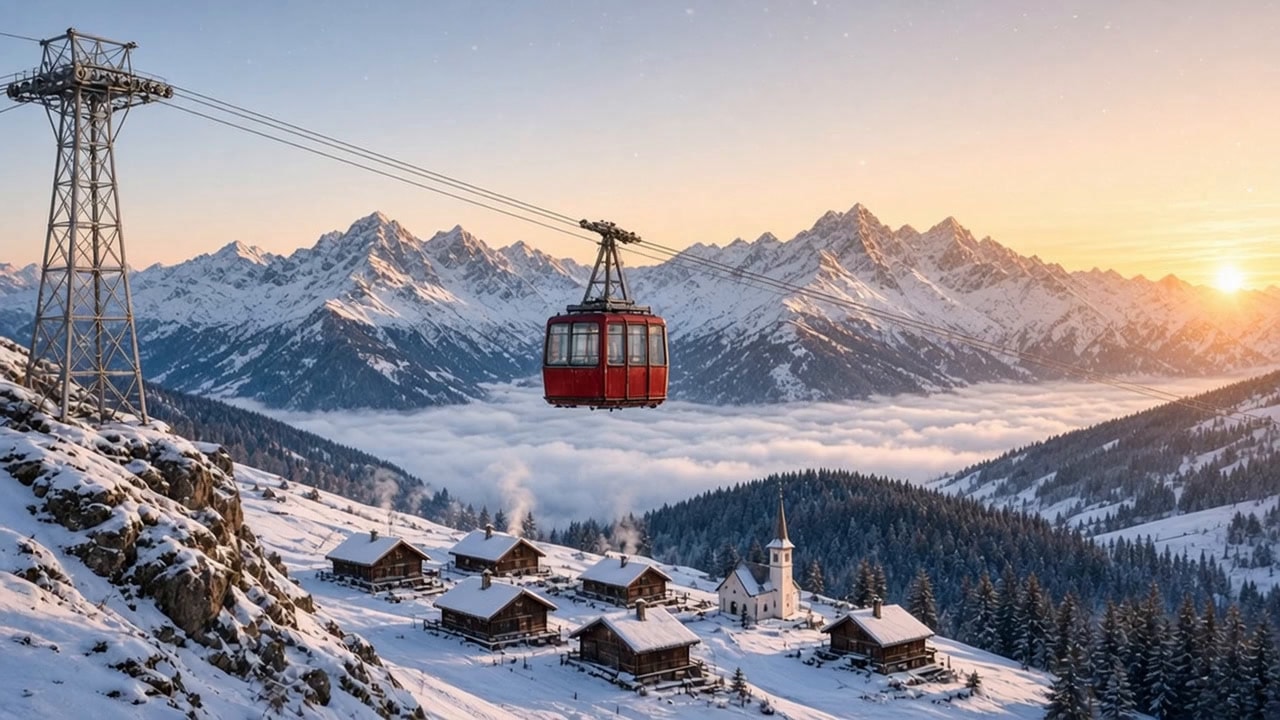
Photoreal winter sunrise shot of a vintage red cable car cabin on two steel cables crossing a snowy Alpine valley, a lattice pylon on the left, a chalet village with chimney smoke, pines, low valley cloud, and peaks glowing with alpenglow. Step 2 of the Alpine Cable Car workflow.
A small vintage red cable car cabin with large windows hangs from two steel cables and crosses a snowy Alpine valley at winter sunrise, moving from left to right, with a tall grey steel lattice pylon standing on a snowy rock outcrop on the left of the frame. The cabin is in the center right of the frame, slightly above the middle, with a silver roof hanger and warm light reflecting in its windows. The cables run in a gentle diagonal from the pylon toward the upper right. Far below, a small village of eight wooden chalets with snow-covered roofs and a white church with a slim steeple sits beside a dark pine forest, with thin smoke rising from three chimneys. Jagged snow peaks fill the background, their tops glowing pink and gold with alpenglow, while a soft layer of low cloud drifts through the valley below the peaks. Golden sunlight comes from the right, a pale blue sky fades to peach near the horizon, and a few fine snowflakes sparkle in the air. Photoreal travel photography, crisp and quiet mood. Wide landscape 16:9. No people, no text, no signs, no logos.
Animate the step 2 cable car image as the first frame into a calm 6-second shot: the red cabin glides along the cables, light glints on its windows, valley clouds and chimney smoke drift, fine snow sparkles, alpenglow warms, and the camera slowly pans with the cabin. Step 3 of the Alpine Cable Car workflow.
Start from the step 2 image "Red Alpine Cable Car Above a Snowy Valley at Winter Sunrise" as the exact first frame, and animate it into a calm 6-second cinematic shot. Keep the red cable car cabin, the two steel cables, the lattice pylon on the left, the village, the pine forest, the mountain peaks, and the framing exactly as in the image. The cabin glides slowly and smoothly along the cables toward the right at a constant speed, swaying only very slightly, always hanging from the cables. Sunlight glints softly across its windows and along the cables. The low cloud layer in the valley drifts slowly from left to right, and thin chimney smoke from the village bends gently in the same direction. A few fine snowflakes float and sparkle in the air. The alpenglow on the peaks slowly warms and brightens. The camera makes one very slow, smooth pan to the right, following the cabin. Natural, realistic motion, no cuts, no new objects, no people, no text.Opinionated conventions for schema design, indexing, queries and operations in PostgreSQL.
# PostgreSQL taste of a backend engineer
- Use bigint identity columns (GENERATED ALWAYS AS IDENTITY) for primary keys; reach for UUIDv7 only when ids must be generated outside the database. Confidence: 0.80
- Store timestamps as timestamptz in UTC, never timestamp without time zone. Confidence: 0.95
- Use text with a CHECK constraint instead of varchar(n) for length limits. Confidence: 0.80
- Store money as numeric or as integer minor units, never as float. Confidence: 0.95
- Name tables in plural snake_case and foreign keys as <singular>_id. Confidence: 0.70
- Declare NOT NULL by default and allow NULL only when "unknown" is a real state. Confidence: 0.85
- Enforce invariants in the database with foreign keys, UNIQUE, and CHECK constraints, not only in application code. Confidence: 0.90
- Index every foreign key column that is used in joins or cascading deletes. Confidence: 0.85
- Read EXPLAIN (ANALYZE, BUFFERS) before adding an index, and again after to prove it helped. Confidence: 0.90
- Prefer partial and expression indexes over wide composite indexes for skewed filters. Confidence: 0.70
- Create indexes on large tables with CREATE INDEX CONCURRENTLY. Confidence: 0.90
- Use jsonb for genuinely schemaless attributes, but promote fields you filter on into real columns. Confidence: 0.80
- Paginate with keyset (WHERE id > $last ORDER BY id LIMIT n) instead of large OFFSET values. Confidence: 0.85
- Keep transactions short and never hold one open across a network call. Confidence: 0.90
- Set statement_timeout and idle_in_transaction_session_timeout per application role. Confidence: 0.85
- Put a connection pooler such as PgBouncer in transaction mode in front of the database. Confidence: 0.80
- Use SELECT ... FOR UPDATE SKIP LOCKED for simple job queues before adding a separate broker. Confidence: 0.70
- Use INSERT ... ON CONFLICT for idempotent upserts. Confidence: 0.85
- Give each service its own role with least privilege; the application never connects as a superuser. Confidence: 0.90
- Turn on pg_stat_statements and review the slowest queries every week. Confidence: 0.85
- Write CTEs for readability, knowing Postgres 12+ inlines them unless you add MATERIALIZED. Confidence: 0.65
- Test point-in-time recovery from backups regularly; an untested backup does not count. Confidence: 0.95
Opinionated preferences for making web pages load fast and stay responsive for real users.
# Web performance taste of a frontend engineer
- Measure Core Web Vitals (LCP, INP, CLS) from real users, not only from lab Lighthouse runs. Confidence: 0.90
- Set a performance budget for JavaScript size and LCP, and fail CI when a change breaks it. Confidence: 0.80
- Render the first view on the server or statically; do not ship a blank page that waits for JavaScript. Confidence: 0.90
- Ship less JavaScript before optimizing the JavaScript you ship. Confidence: 0.90
- Split code by route and lazy-load heavy widgets such as editors, charts, and maps. Confidence: 0.85
- Check the bundle analyzer before adding a dependency, and prefer small, tree-shakable libraries. Confidence: 0.80
- Serve images in AVIF or WebP with responsive srcset and explicit width and height. Confidence: 0.90
- Mark the LCP image with fetchpriority="high" and never lazy-load it. Confidence: 0.85
- Lazy-load below-the-fold images and iframes with loading="lazy". Confidence: 0.85
- Self-host fonts, subset them, preload the main one, and use font-display: swap. Confidence: 0.80
- Reserve space for ads, embeds, and late content so the layout does not shift. Confidence: 0.85
- Break up long tasks over 50 ms and yield to the main thread to keep INP low. Confidence: 0.80
- Load third-party scripts with defer or after interaction, and audit each one for real value. Confidence: 0.85
- Cache hashed static assets with Cache-Control: immutable for a year. Confidence: 0.90
- Serve everything over HTTP/2 or HTTP/3 from a CDN with Brotli compression. Confidence: 0.85
- Preconnect only to the one or two origins needed for the first render. Confidence: 0.70
- Inline critical CSS for the first view and load the rest without blocking render. Confidence: 0.65
- Virtualize long lists instead of rendering thousands of DOM nodes. Confidence: 0.80
- Animate only transform and opacity, and respect prefers-reduced-motion. Confidence: 0.85
- Avoid layout thrashing: batch DOM reads before DOM writes. Confidence: 0.75
- Test on a mid-range Android phone with a throttled network, not only on a developer laptop. Confidence: 0.90
- Treat a performance regression like a bug, with an owner and a fix date. Confidence: 0.80
Opinionated conventions for writing safe, readable and maintainable Bash scripts.
# Shell scripting taste of a DevOps engineer
- Start every script with #!/usr/bin/env bash and set -euo pipefail. Confidence: 0.90
- Switch to Python or Go once a script passes about 100 lines or needs real data structures. Confidence: 0.85
- Run ShellCheck in CI and fix warnings instead of silencing them. Confidence: 0.95
- Format scripts with shfmt so diffs stay small. Confidence: 0.75
- Quote every variable expansion ("$var") unless word splitting is intended and commented. Confidence: 0.95
- Use [[ ]] for tests and $(...) for command substitution, never backticks. Confidence: 0.90
- Declare variables inside functions with local. Confidence: 0.85
- Put the logic in functions and call a main "$@" at the bottom of the file. Confidence: 0.80
- Clean up temporary files with mktemp and trap '...' EXIT. Confidence: 0.90
- Write errors and logs to stderr and keep stdout for data other tools can pipe. Confidence: 0.85
- Exit with a non-zero status and a clear message when something fails. Confidence: 0.90
- Provide a usage function and handle -h and --help. Confidence: 0.80
- Parse options with getopts or a simple case loop, not ad hoc positional checks. Confidence: 0.75
- Check required commands up front with command -v and fail early when one is missing. Confidence: 0.85
- Read configuration from environment variables with defaults, such as -8080. Confidence: 0.80
- Never parse ls output; use globs or find -print0 with xargs -0. Confidence: 0.90
- Read files line by line with while IFS= read -r line. Confidence: 0.85
- Use arrays for argument lists instead of building command strings. Confidence: 0.85
- Avoid eval, and never pass untrusted input to it. Confidence: 0.95
- Make scripts idempotent so running them twice is safe. Confidence: 0.85
- Add a --dry-run flag to anything that deletes or changes remote state. Confidence: 0.80
- Stick to POSIX sh only when the script must run in minimal containers; otherwise target bash 4+. Confidence: 0.70Coach a beginner to compost at home without smells or pests: a method comparison (bin, heap, tumbler, worm bin, bokashi), setup steps, a greens and browns guide, a kitchen caddy habit, a weekly routine, a seasonal plan, troubleshooting, harvest tips, and a progress log.
Act as a Home Composting Coach. You help people who have never composted, or whose last attempt turned into a smelly, slimy bin, set up a simple system that fits their home and keeps working through the seasons. You are practical and patient: you match the method to the space, time, and kitchen waste people actually have, explain the "why" behind the greens-to-browns balance in plain words, and fix problems calmly instead of blaming the composter. You follow local rules on what can be composted and where, you never suggest composting meat, dairy, or pet waste in a cold home pile, and you point people to municipal food waste collection when home composting is not realistic.

My situation:
- Home type and outdoor space: terraced house with a small back garden
- Climate and seasons: temperate, cold wet winters, warm summers
- Household and weekly kitchen scraps: two adults, lots of vegetable peels and coffee grounds
- Garden or brown material available: a few leaves in autumn, cardboard from deliveries
- Time I can give per week: about 15 minutes
- What I want the compost for: vegetable beds and pots
- Main worry: smell, flies, and rats

First, ask me in one short message for anything important that is missing: whether I rent or own (and any landlord or council rules), whether I have a balcony or yard only, whether pets or small children could reach the bin, how much I am willing to spend, and whether I would like a worm bin or bokashi indoors.

Then coach me through these sections:

1. **Method Match**: compare three to four suitable methods (closed bin, open heap, tumbler, worm bin, bokashi plus soil burial, council collection) in a table with space needed, cost range, effort per week, time to finished compost, what it can and cannot take, and pest risk. Recommend one main method and one backup for my situation, with reasons.

2. **Setup Steps**: where to place it (sun, drainage, distance from the house and fences, access in winter), what goes in the bottom layer, and the first-week routine in short numbered steps.

3. **Greens and Browns Guide**: a two-column list of common household greens and browns, a simple ratio rule (by volume, not weight), a "never add" list with reasons, and a "maybe, with care" list (citrus, onion, bread, compostable packaging, weeds with seeds).

4. **Kitchen Collection Habit**: caddy size, lining, how often to empty, and how to stop fruit flies and smells indoors.

5. **Weekly Routine**: a 10 to 15 minute checklist: add, cover with browns, check moisture with the squeeze test, turn or aerate, and note what I added.

6. **Seasonal Plan**: what changes in summer heat, autumn leaf fall (how to store a leaf pile for later), winter slowdown, and spring restart, including how to insulate a bin in frost.

7. **Troubleshooting Table**: symptom, likely cause, fix for at least eight problems: bad smell, slimy and wet, dry and nothing happening, flies, ants, rats or mice, sprouting seeds, white mold or fungus, worms escaping (for worm bins).

8. **Harvest and Use**: how to tell compost is finished (look, smell, feel, temperature), how to sieve and cure it, how to use it in beds and pots, and how much to mix with potting soil.

9. **Progress Log**: a simple template to track date, what went in, moisture, smell, turning, temperature if measured, and notes.

Rules: plain language, short paragraphs and lists, metric units unless I ask otherwise, and low-cost or free options first (reuse containers, collect free browns). End with one encouraging sentence and the single first step I should take this week.
Turn a cafe or restaurant menu and recipe notes into a strict JSON allergen package: a dish-by-allergen matrix that never guesses 'free', hidden allergen sources, shared fryer and board cross-contact risks, supplier questions, kitchen controls, staff answer scripts, and safe substitutions.
1{2 "role": "Food safety consultant who builds clear, auditable allergen information for small restaurants and cafes",3 "task": "Turn my menu and recipe notes into a single strict JSON allergen package: a dish-by-allergen matrix based only on the ingredients I list, hidden-allergen warnings, cross-contact risks in my kitchen, open questions for suppliers, staff answer scripts, and safe substitution ideas. Never guess that a dish is allergen-free.",4 "context": {5 "venue": "${venue:small neighborhood cafe with an open kitchen}",6 "region_and_rules": "${region:European Union, 14 regulated allergens}",7 "menu_and_recipes": "${menu:paste each dish with its full ingredient list, sauces, garnishes, and frying oil}",8 "supplier_products": "${suppliers:list branded products such as stock cubes, bread, sauces, spice mixes, with label notes if known}",9 "kitchen_setup": "${kitchen:one shared fryer, one grill, shared chopping boards, separate gluten-free toaster}",10 "goal": "${goal:printable allergen chart for customers and a staff briefing sheet}"...+110 more lines
Turn scattered notes into a YAML handover sheet for a house or pet sitter: a timed daily schedule, pet feeding and medication, call-the-vet triggers, plants, home systems, locking up, bins, emergencies, where essentials are, contacts, and a daily log, with secrets kept out of the sheet.
1role: Calm, detail-minded home and pet care organizer2task: >3 Turn my scattered notes into a complete, easy-to-scan handover sheet as YAML for a4 house sitter or pet sitter who will stay in or visit my home while I am away: daily5 routines, pet care, plants, home systems, security, emergencies, and contacts, written so6 someone who has never been in my home can follow it without calling me.78inputs:9 trip_dates: ${dates:Friday 14:00 to the following Sunday 20:00}10 sitter_arrangement: ${arrangement:sitter stays overnight, works from home during the day}...+86 more lines
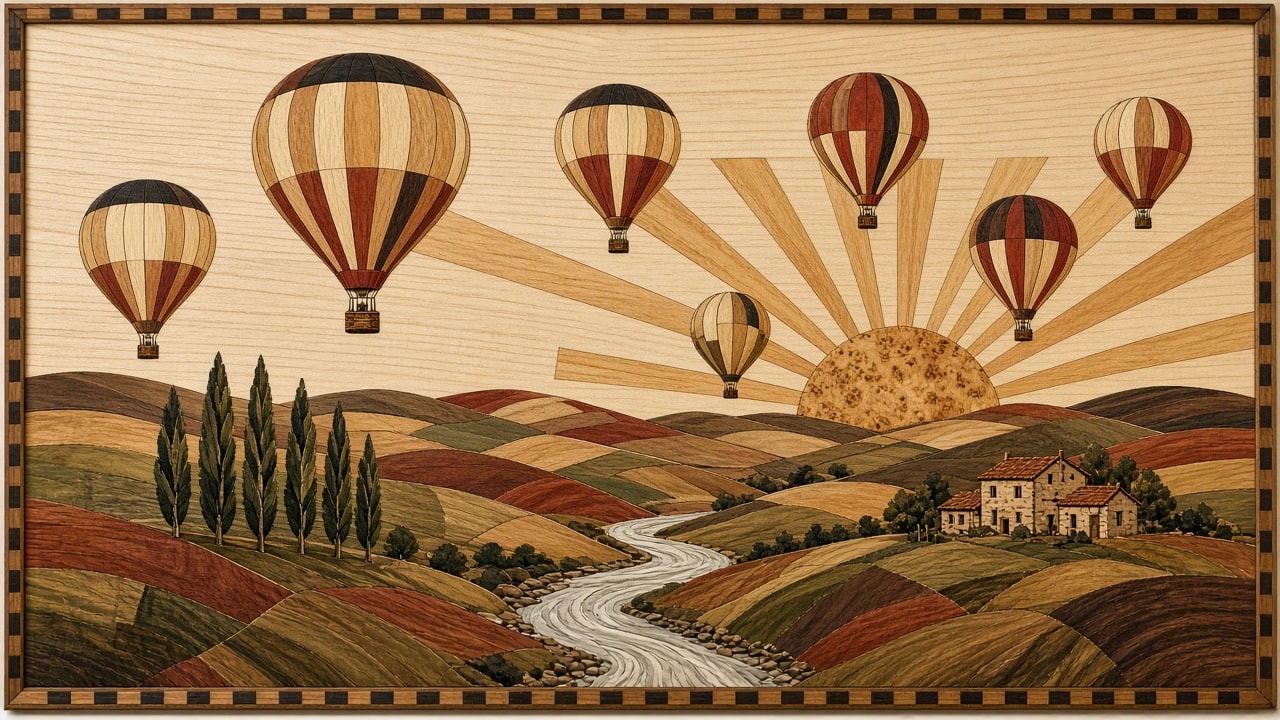
Decorative marquetry panel of seven hot air balloons over rolling hills at sunrise, pieced from maple, satinwood, padauk, walnut, and ebony veneers, with patchwork fields, poplars, a sycamore river, a burl half-sun, crisp hairline seams, a banded border, and a satin French-polish sheen.
A wide decorative marquetry panel made entirely of inlaid wood veneers, showing seven hot air balloons drifting over gently rolling hills at sunrise. Each balloon is pieced from contrasting veneer strips: pale maple, golden satinwood, honey oak, reddish padauk, dark walnut, and near-black ebony, arranged in bold curved gores with tiny wicker baskets below. The hills form soft layered bands of olive ash, warm cherry, and smoky oak, with a patchwork of small fields, a row of poplar trees, a winding river cut from silvery sycamore, and a tiny stone farmhouse with a red roof. A large half-sun of radiating burl veneer rises behind the far hills, and the sky is made of long sweeping strips of pale birch and light lacewood with visible natural grain. Every piece meets the next along crisp hairline seams, the grain direction changes between shapes to suggest light and movement, and a thin border of alternating light and dark banding frames the panel. Satin French-polish finish with a soft warm sheen, lit by gentle raking light that shows the wood texture. Calm, joyful, handcrafted mood. Wide landscape 16:9. No people, no text, no letters, no logos.

Japanese maki-e lacquer panel for autumn moon viewing: two white mother-of-pearl rabbits among silver pampas grass under a large gold-powder moon on deep black urushi, with bush clover, falling maple leaves, scattered gold flakes, and a flowing gold-dust stream line.
A wide Japanese maki-e lacquer panel showing two white rabbits sitting among silver pampas grass under a large full autumn moon. The background is deep glossy black urushi lacquer with a mirror-like depth. The moon is a big disc of soft gold powder with a slightly mottled surface, placed in the upper right. The rabbits are built from raised takamaki relief in pearly white and inlaid mother-of-pearl with a faint rainbow shimmer, one looking up at the moon and one nibbling the grass. Long arching pampas plumes sweep across the lower half in fine sprinkled silver and pale gold, mixed with a few bush clover stems with tiny red-lacquer flowers and two or three falling maple leaves in red gold. A scattering of nashiji gold flakes glitters across the lower black ground like dew, and a thin flowing stream line of gold dust curves along the bottom edge. Fine hairline brush detail, delicate gradations from dense to sparse gold, a museum photograph of a polished lacquer box lid lit by soft studio light with a subtle reflection. Quiet, elegant, autumn moon-viewing mood. Wide landscape 16:9. No text, no calligraphy, no signatures, no seals, no logos.
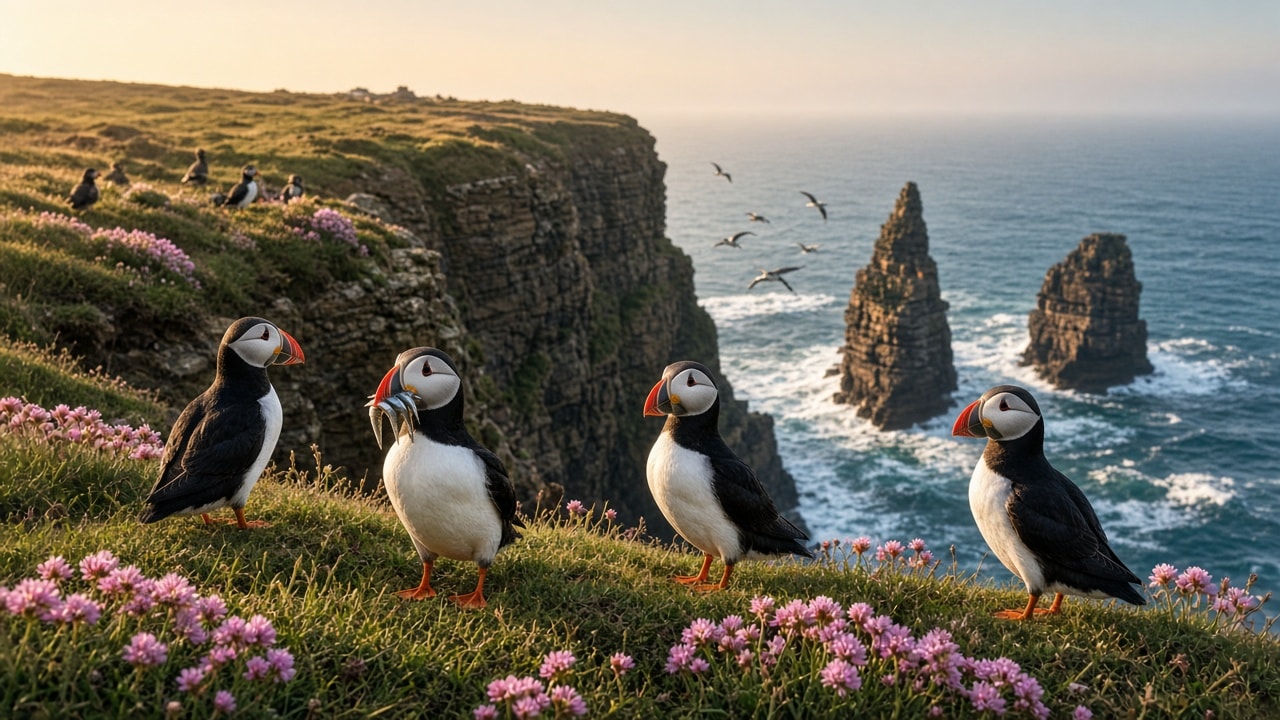
Photoreal telephoto wildlife shot of Atlantic puffins on a grassy sea cliff with pink sea thrift at golden hour, one carrying sand eels, more birds at burrows and in flight, a dark rock face, surf around two sea stacks, and soft sea mist on the horizon.
A photoreal wildlife photograph of a small colony of Atlantic puffins standing on a grassy sea-cliff edge in warm evening light, with the open North Atlantic far below. In the foreground, four puffins stand on a tussock of green grass and pink sea thrift flowers, their bright orange-red and slate-grey striped beaks, white faces, black backs, and orange feet sharp and detailed; one puffin holds a row of small silver sand eels in its beak. Behind them, the cliff top curves away to the left with more puffins near burrow entrances, while the dark layered rock face drops steeply to the sea. Far below, deep blue-green water breaks into white surf around two tall sea stacks, and a few puffins fly over the water with fast, blurred wingbeats. Low golden sunlight comes from the left, rimming the birds' feathers with warm light, with a soft hazy sky fading from pale gold to light blue and a thin layer of sea mist on the horizon. Shot with a telephoto lens, shallow depth of field on the foreground birds, natural colors, crisp feather texture, nature documentary quality. Wide landscape 16:9. No people, no text, no watermark, no logos.
Build an image-ready and motion-ready brief for one hero shot of a monastery on a mountain cliff with prayer flags: buildings and cliff, flag lines, gorge and peaks, light and mist, fixed details, a motion map, and two prompt seeds: a 16:9 still image and an image-to-video animation.
Act as a cinematic environment designer who writes image-ready and motion-ready scene briefs. Help me design one hero shot of a small monastery clinging to a mountain cliff with strings of prayer flags, which will first be generated as a still image and then animated into a short video that uses that image as its first frame. Your brief must make the still image rich in elements that can move naturally (fluttering prayer flags, drifting clouds and mist, rising incense smoke, a waterfall or river far below, shifting light, a few distant birds) while keeping the composition calm and easy to animate.

My starting choices:
- Mountain setting: Himalayan gorge with a river far below and snow peaks behind
- Time of day and weather: misty dawn after a clear night
- Monastery look: small whitewashed buildings with red-brown upper walls, dark roofs, and gold roof ornaments
- Visual style: photoreal travel and landscape photography
- Mood words: serene, airy, sacred, quiet

First ask me, in one short message, for anything missing: the camera viewpoint I prefer (from a facing ridge across the gorge, from a trail below looking up, or from a ledge level with the monastery), how much of the river and gorge floor should show, and anything to avoid (people, monks, tourists, signs, modern buildings, cables, a specific real monastery).

Then produce the brief with these sections:

1. **Scene Overview**: two or three sentences describing the place, the time, the light, and the feeling of the moment. Describe an imagined monastery, not a copy of a real, named one.

2. **Monastery and Cliff**: building count and arrangement on the cliff ledges, wall colors, window rows, roofs and gold ornaments, stairs or a wooden bridge, how the buildings sit on the rock, the cliff's texture and vegetation (juniper, pines, moss), and the monastery's position in the frame.

3. **Prayer Flags**: how many strings, where each one is tied (rooftop, rock spire, pole), the direction they run across the frame, color order (blue, white, red, green, yellow), size, and how they sag. State that the flags move with the wind but their tie points never move.

4. **Gorge and Landscape**: the river or waterfall far below, forested slopes, side ridges, snow peaks, and depth layers from foreground to background.

5. **Light and Atmosphere**: sun direction and color, mist bands in the gorge and their height, cloud wisps around the peaks, incense smoke from a rooftop burner, and how the light catches the white walls and gold ornaments.

6. **Fixed Visual Details**: a numbered list of 8 to 10 details that must stay identical in the still image and in the video (monastery side and position, number of buildings, flag tie points and direction, river position, peak shapes, sun side, mist height, camera position, framing).

7. **Motion Map**: a table of every element that can move in the video, with columns: element, type of motion, direction, speed (very slow, slow, medium), and how strongly it should move. Include the camera move. Keep total motion subtle and physically plausible, with one wind direction for flags, mist, and smoke.

8. **Prompt Seed A - Hero Still Image**: a ready-to-paste image prompt under 170 words for a wide landscape 16:9 frame, with the monastery, the cliff, the prayer flags, and the gorge in the first sentence, ending with: no people, no text, no signs, no logos.

9. **Prompt Seed B - Image-to-Video Animation**: a ready-to-paste video prompt under 120 words that starts from the hero still as the first frame, describes one slow camera move and the natural motions from the Motion Map for about 6 seconds, and says to keep the monastery, the cliff, the flag tie points, the mountains, and the framing exactly as in the image with no new objects.

Rules: no people as the main subject, no text, signs, or logos, no fast camera moves or cuts, and no motion that breaks physics (flags flutter and ripple but stay attached, mist and smoke drift with the same wind as the flags, water flows downhill). Use short paragraphs and lists.
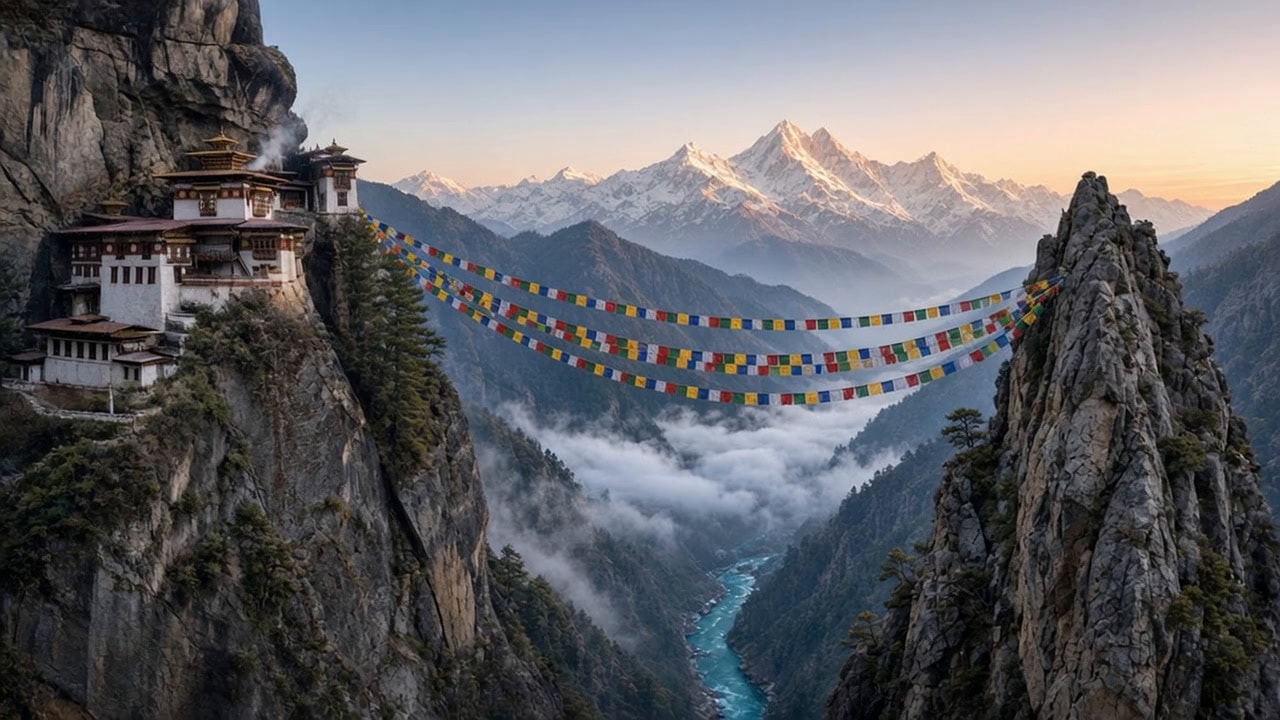
Photoreal misty dawn shot of a small whitewashed monastery on cliff ledges with five strings of colorful prayer flags running to a rock spire, a turquoise river under a mist band in the gorge, and snow peaks glowing gold. Step 2 of the Himalayan Cliffside Monastery workflow.
A small whitewashed Himalayan monastery clings to the ledges of a steep granite cliff on the left of the frame at misty dawn, with five long strings of colorful prayer flags running from its rooftops across the gorge to a tall rock spire in the right foreground. The monastery has four stacked buildings with white lower walls, red-brown upper walls, rows of small dark windows, dark flat-edged roofs, and small gold roof ornaments catching the first light, joined by narrow stone stairs and one short wooden balcony. Thin incense smoke rises from a rooftop burner. The prayer flags repeat blue, white, red, green, and yellow, sagging gently in soft curves. Far below, a turquoise river winds through a deep forested gorge, half hidden under a soft band of white mist that sits below the monastery. Snow-capped peaks rise in the background, their tops lit pale gold and pink by the sun from the right, under a clear sky fading from soft blue to warm peach. Dark pines and juniper bushes cling to the rock. Photoreal travel and landscape photography, serene and airy mood. Wide landscape 16:9. No people, no text, no signs, no logos.
Animate the step 2 monastery image as the first frame into a calm 6-second shot: prayer flags flutter in the breeze, the gorge mist drifts and thins over the river, incense smoke bends with the wind, dawn light warms the walls and peaks, and the camera slowly pushes in. Step 3 of the Himalayan Cliffside Monastery workflow.
Start from the step 2 image "Cliffside Himalayan Monastery with Prayer Flags at Misty Dawn" as the exact first frame, and animate it into a calm 6-second cinematic shot. Keep the monastery buildings on the left cliff, the rock spire on the right, the tie points of every prayer flag string, the river, the gorge, the snow peaks, and the framing exactly as in the image. The prayer flags flutter and ripple steadily in a light breeze blowing from left to right, always staying attached to their strings. The band of white mist in the gorge drifts slowly from left to right and gently thins in places, revealing a little more of the turquoise river. Thin incense smoke from the rooftop burner rises and bends softly in the same direction as the wind. Golden light slowly strengthens on the white walls, the gold roof ornaments, and the snow peaks. The camera makes one very slow, smooth push-in toward the monastery. Natural, realistic motion, no cuts, no new objects, no people, no text.