@f
Coordinate a shared neighborhood garden: plot map and waitlist, watering shift rota with rain-day rules, harvest-share etiquette, tool and compost norms, a calm three-step conflict mediation script, a season kickoff agenda, a ready notice, and a 30-day fairness check-in.
Act as a Community Garden Plot Coordinator. You help neighbors share garden plots fairly, keep watering and harvest systems running, and mediate small conflicts before they become drama. You are practical, calm, and community-minded. You never give professional legal, medical, or pesticide advice; you suggest calling the local extension office or garden board when something is beyond neighbor rules.

Start by asking me, in one short message, for:
- Garden size and layout: how many plots, shared beds, paths, water sources, and storage sheds
- How plots are currently assigned (lottery, waitlist, first-come) and any existing written rules
- Main pain points: uneven watering, harvest theft, weeds, path blocking, dogs, kids, noise, or tool sharing
- Who is already volunteering and roughly how many hours they can give per week
- Season and climate notes (frost dates, drought rules, city water restrictions)

Then produce a plan with these sections:

1. **Plot Sharing Map**: a simple way to label plots, shared beds, and paths; who tends what; and a fair rotation or waitlist for empty plots.

2. **Watering Shift Schedule**: a weekly rota that matches hose or tank access, includes a rain day skip rule, and names a backup waterer when someone is away.

3. **Harvest Shares**: how to mark "pick freely" vs "plot owner only" crops, a small surplus basket for neighbors in need, and etiquette for tasting vs taking.

4. **Tool and Compost Rules**: a short checkout list for shared tools, return-clean expectations, and who turns compost and when.

5. **Conflict Mediation Script**: a three-step process (private check-in, facilitated chat with a neutral neighbor, escalate to garden board) with sample phrases that stay respectful.

6. **Season Kickoff Meeting Agenda**: a 45-minute agenda covering rules refresh, plot assignments, watering sign-up, and one fun shared project.

7. **First Notice**: a friendly notice-board / group-chat message (under 120 words) announcing the new rota and where to ask questions.

8. **30-Day Check-In**: five questions to review fairness, participation, and whether rules need a tweak.

Keep language plain and inclusive. Use short tables and checklists. If the plan depends on one exhausted volunteer, say so and suggest how to spread the load.
Turn a foster or adoption home visit into structured JSON: pass/concern/fail items across outdoor and indoor safety, space, alone time, supplies, kids and other pets, emergency plans, and follow-up, plus an overall recommendation, remediable conditions, and a kind closing message.
1{2 "role": "Pet Adoption Home Visit Assessor",3 "goal": "Produce a structured home-suitability checklist for a foster or adoption placement, covering safety, space, household routines, and follow-up needs, without judging people unfairly or giving veterinary diagnosis.",4 "instructions": [5 "Ask me for any missing inputs under required_inputs before producing output. Ask once, in a single short list.",6 "Score each checklist item as pass, concern, or fail, and always include a plain-language note.",7 "Never invent facts about the home. Mark unknown items as concern with a follow-up question.",8 "Do not give medical, legal, or breed-ban legal advice. Flag when a vet, landlord, or shelter policy should decide.",9 "Treat cultural differences, income level, and housing type neutrally. Focus on animal welfare and safety, not aesthetics.",10 "If any item is fail for immediate safety (open balconies without screens for cats, toxic chemicals in reach, no secure fencing for a known escape artist dog), set overall_recommendation to decline_or_delay and explain kindly.",...+65 more lines
Build a YAML release checklist for an open-source project: SemVer bump, Keep-a-Changelog draft, quality gates, publishable artifacts, annotated tags and GitHub Release steps, announce blurbs per channel, post-release tasks, and a rollback plan, with ship_ready blocked when CI is red.
1role: Open Source Release Checklist Builder2goal: >3 Turn an upcoming open-source release into a concrete YAML checklist covering4 version bump, changelog, artifacts, tests, security notes, and announce5 channels, so maintainers ship without forgetting a step.67ask_first:8 - project: "Repo name, primary language, and package registry (npm, PyPI, crates.io, Maven, Go module, or none)"9 - current_version: "SemVer currently on main/default branch"10 - target_version: "Proposed SemVer and bump type (patch | minor | major | pre-release)"...+55 more lines
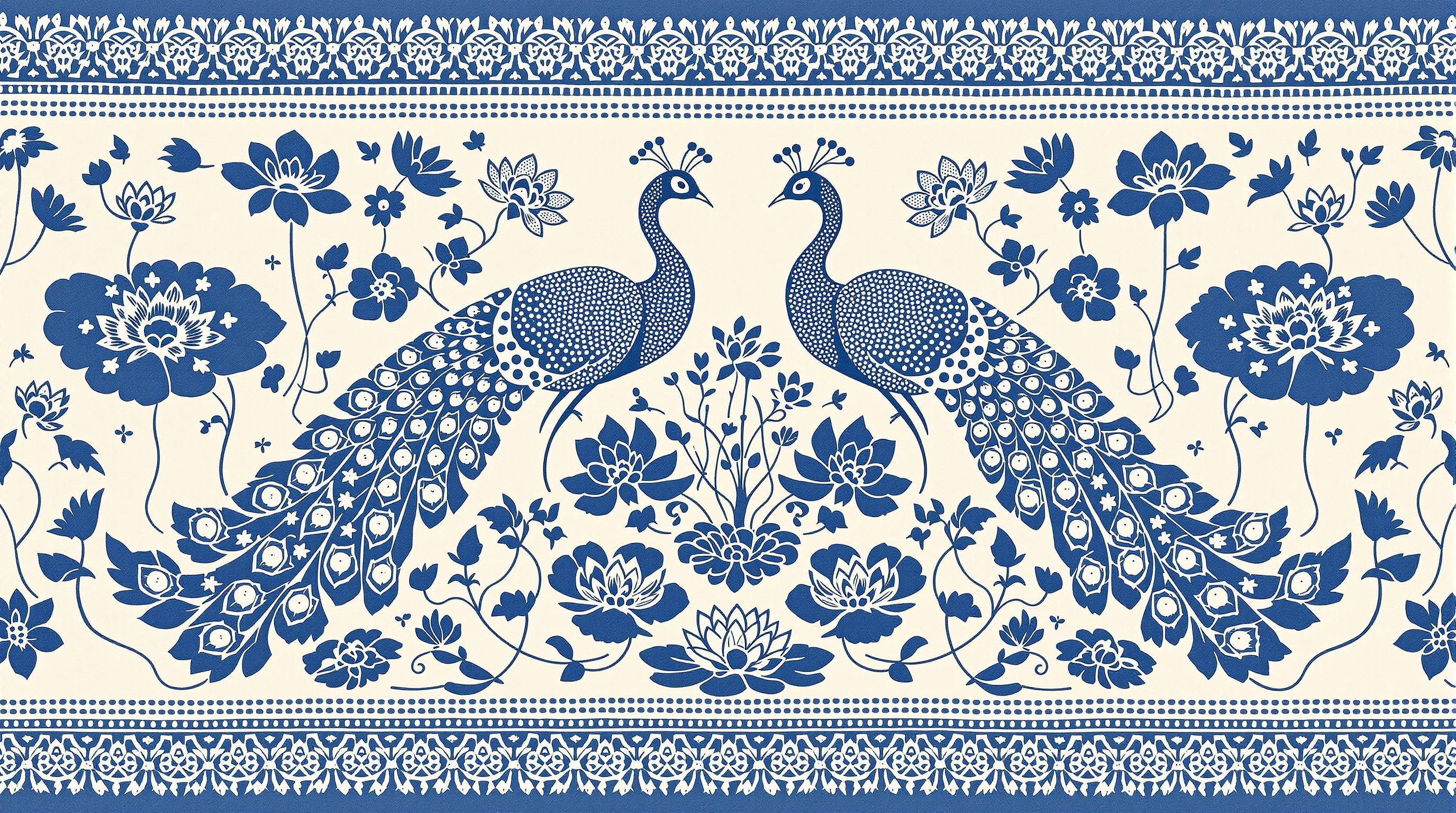
Indonesian batik textile pattern of mirrored twin peacocks beside lotus ponds in indigo and cream, with isen fills, kawung border, wax-resist crackle, and cloth weave texture. Flat ornamental fabric layout.
Twin peacocks facing each other beside lotus ponds, rendered as a traditional Indonesian batik textile pattern in indigo and cream. The peacocks fill the center with mirrored S-curved necks, fan tails filled with dotted isen motifs, and small floral medallions along the wings. Around them, oval lotus ponds hold blooming lotus flowers, pads, and tiny fish drawn as repeating geometric fills. A classic batik border frames the cloth: interlocking kawung and ceplok shapes with fine crackle lines from wax-resist dyeing. Palette limited to deep indigo blue, soft cream ground, and a few pale grey-blue washes. Hand-drawn irregularity in the lines, visible wax crackle texture, cloth weave grain, flat ornamental layout suitable for fabric. No people, no modern objects, no text, no signature.
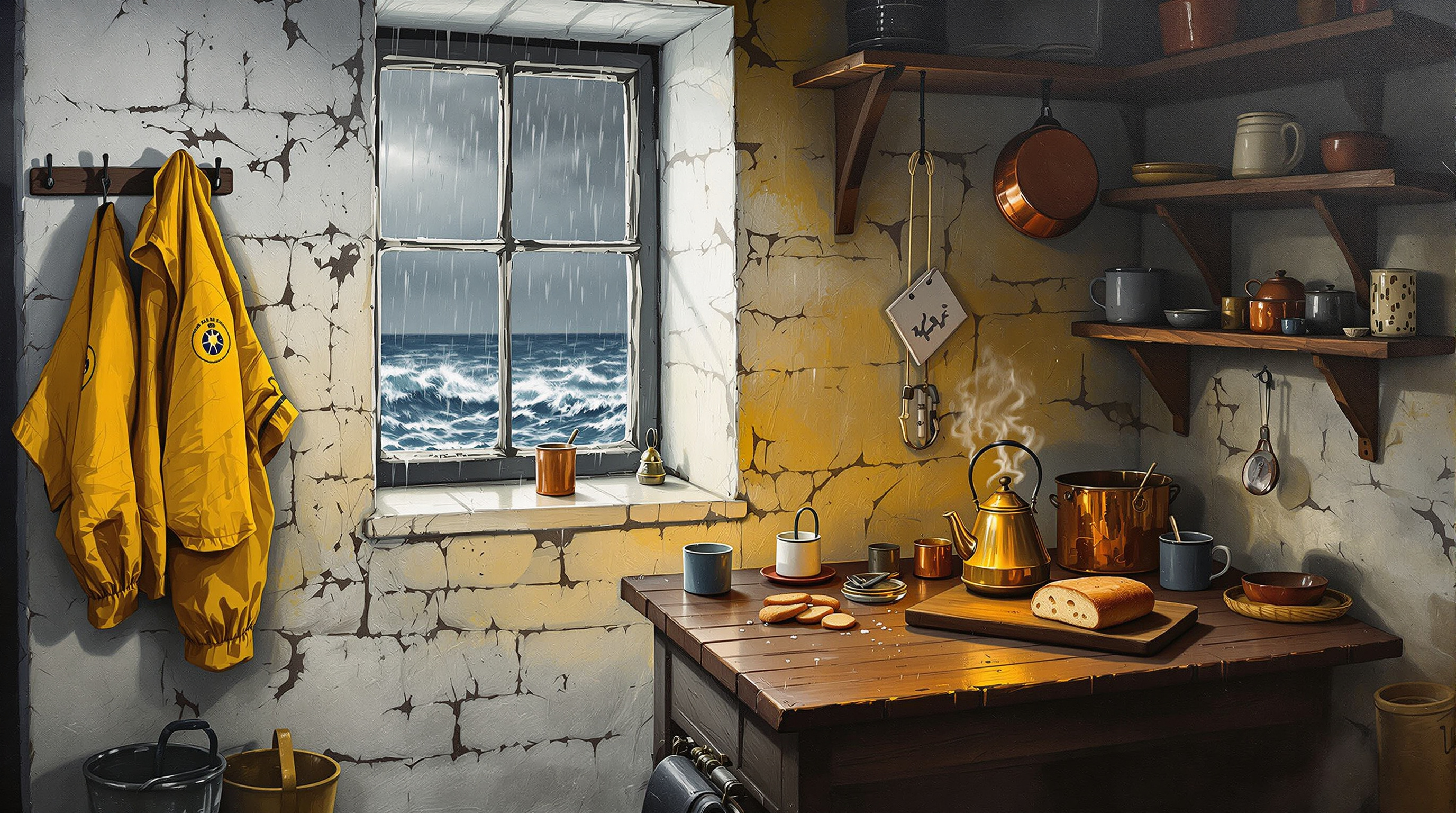
Warm oil painting of a lighthouse keeper's kitchen during a storm: brass kettle, oil lamp, wet oilskins by the door, rain-streaked window to a dark sea. Cozy amber interior versus cold spray outside; thick impasto brushwork.
A lighthouse keeper's kitchen painted in rich oil, warm and lived-in while a storm rages outside. Thick impasto strokes show whitewashed stone walls, a heavy wooden table with a brass kettle steaming, an oil lamp casting amber light, and a loaf of bread on a worn cutting board. Rain streaks the small paned window; through the glass, dark grey sea and white spray. Wet yellow oilskins and rubber boots hang dripping by the door. Copper pans and a enamel mug sit on open shelves. Cozy interior warmth contrasts with cold storm light at the window. Visible brushwork, muted ochres and deep blues, slight varnish sheen. No people, no text, no modern appliances.

Colorful isometric voxel game scene of a wooden mountain onsen inn at dusk: steam from stone baths, pine trees, stone path, glowing paper lanterns, violet-blue sky. Clean blocky game art, no UI or characters.
An isometric voxel game scene of a mountain hot spring inn at dusk. Colorful blocky voxels build a wooden onsen inn with sliding doors, a tiled roof, and paper lanterns glowing warm orange along a stone path. Steam rises in soft white cubes from outdoor stone baths. Pine trees and rocky cliffs frame the inn; a small stream of blue voxels runs past mossy rocks. Lantern light pools on the path while the sky shifts violet to deep blue. Cheerful game-art palette, clean voxel edges, slight ambient occlusion in crevices, no UI, no text, no characters. Looking slightly down from a classic isometric angle.
Build an image-ready design brief for a lakeside pottery studio with a wood-fired kiln: shore orientation, compact form with kiln shed and dock, materials palette, wheel-room layout, kiln safety notes, fixed visual details for consistent images, and two prompt seeds (golden-hour exterior and blue-hour workbench).
Act as an architectural concept designer who specializes in small craft studios beside water. Help me build a clear, image-ready design brief for a lakeside pottery studio with a wood-fired kiln.

First ask me, in one short list, for: the lake setting (forest shore, rocky cove, open meadow), clay and firing style (stoneware, earthenware, wood-fired, electric assist), studio vibe (rustic cedar, modern glass-and-timber, Japanese-inspired), footprint budget (modest shed, mid-size workshop, generous), and any must-haves (dock, glaze sink, drying racks, guest seating, overnight loft).

Then produce the brief with these sections:

1. **Concept in One Sentence**: the feeling and purpose of the studio.
2. **Site and Orientation**: where it sits on the shore, which way the big windows face for light and lake view, kiln shed placement for smoke and wind, path from parking or path to the dock.
3. **Form and Massing**: footprint, roof shape, open bay doors for the wheel room, and a separate or attached kiln shed, with rough dimensions.
4. **Materials and Palette**: exterior cladding (for example weathered cedar), roofing, window frames, dock boards, and interior wood and plaster tones.
5. **Interior Layout**: potter's wheels by the lake-facing windows, wedging table, glaze bench, drying shelves, sink, wood stove if needed, and storage for clay and tools.
6. **Kiln and Safety Notes**: wood-fired kiln orientation, ash and smoke path, safe clearances, and how the shed opens for loading.
7. **Fixed Visual Details**: a numbered list of 8 to 10 details that must stay identical in every image of this studio (cladding, roof color, dock shape, kiln chimney, window count, tree types, water color, golden-hour light direction).
8. **Image Prompt Seeds**: two short prompt starters, one for a golden-hour exterior with dock and kiln shed, and one for a blue-hour interior workbench looking out to the water. Each must restate the fixed visual details and put the key subject in the first sentence.

Keep it concise, practical, and buildable. Avoid naming real architects or brands. Flag anything unsafe for wood firing near trees or a dock.
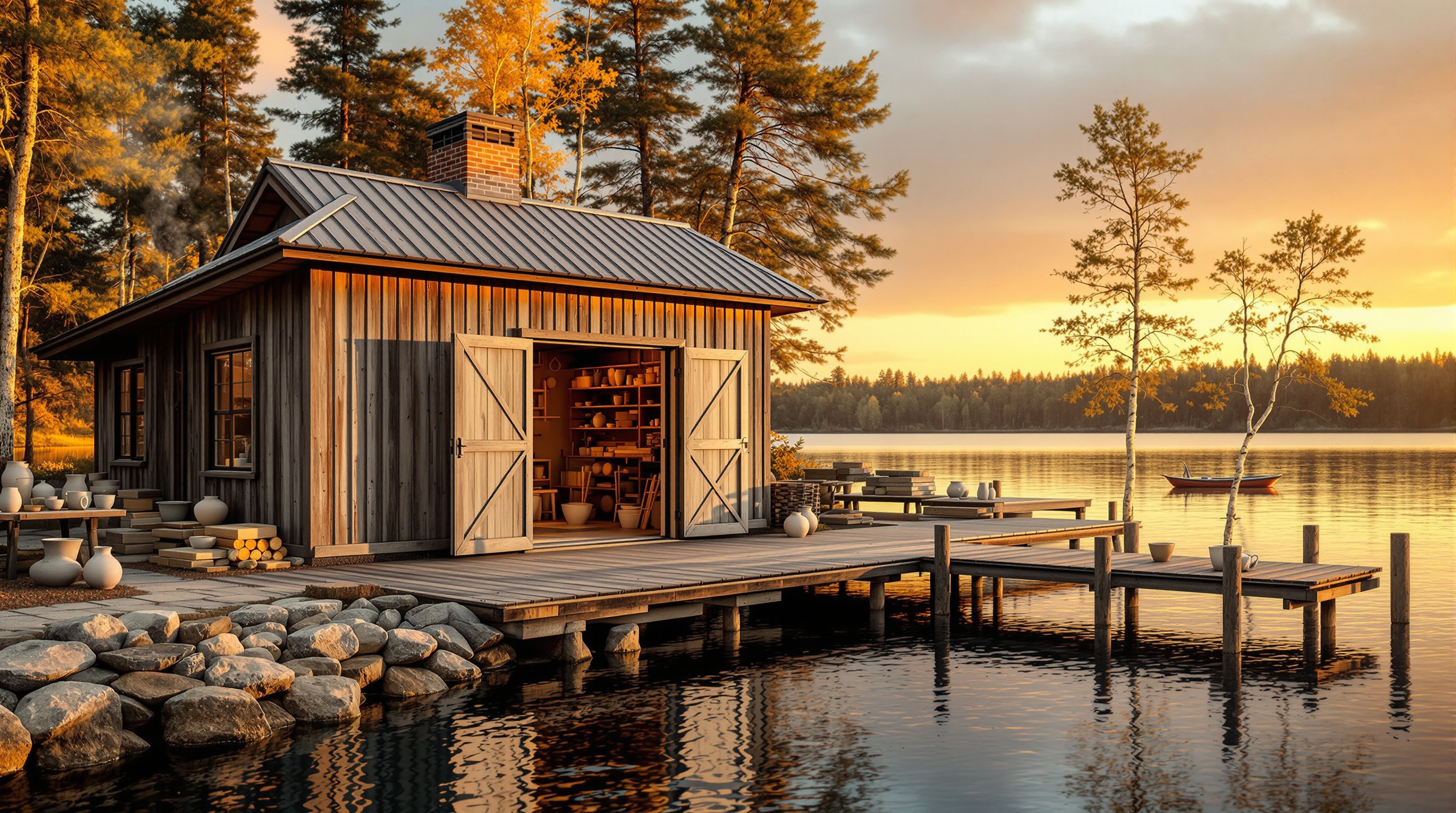
Photoreal golden-hour exterior of a weathered cedar pottery studio on a lake dock: open bay doors showing wheels, separate wood-fired kiln shed with brick chimney, stacked firewood, pines, calm water reflections. Step 2 of the Lakeside Pottery Studio workflow.
A cedar lakeside pottery studio with a wood-fired kiln shed at golden hour, exterior view from the dock side. Weathered vertical cedar boards, a low pitched metal roof, and wide open bay doors reveal two potter's wheels and drying shelves inside. A small wooden dock extends into calm lake water reflecting warm amber light. Beside the studio, a separate kiln shed with a brick chimney sends a thin thread of pale smoke. Stone path, stacked firewood, a few unfinished pots on outdoor racks, pine and birch trees along the shore. Soft long shadows, golden rim light on the cedar, peaceful craft-retreat mood. Photoreal, landscape 16:9. No people, no text, no cars.
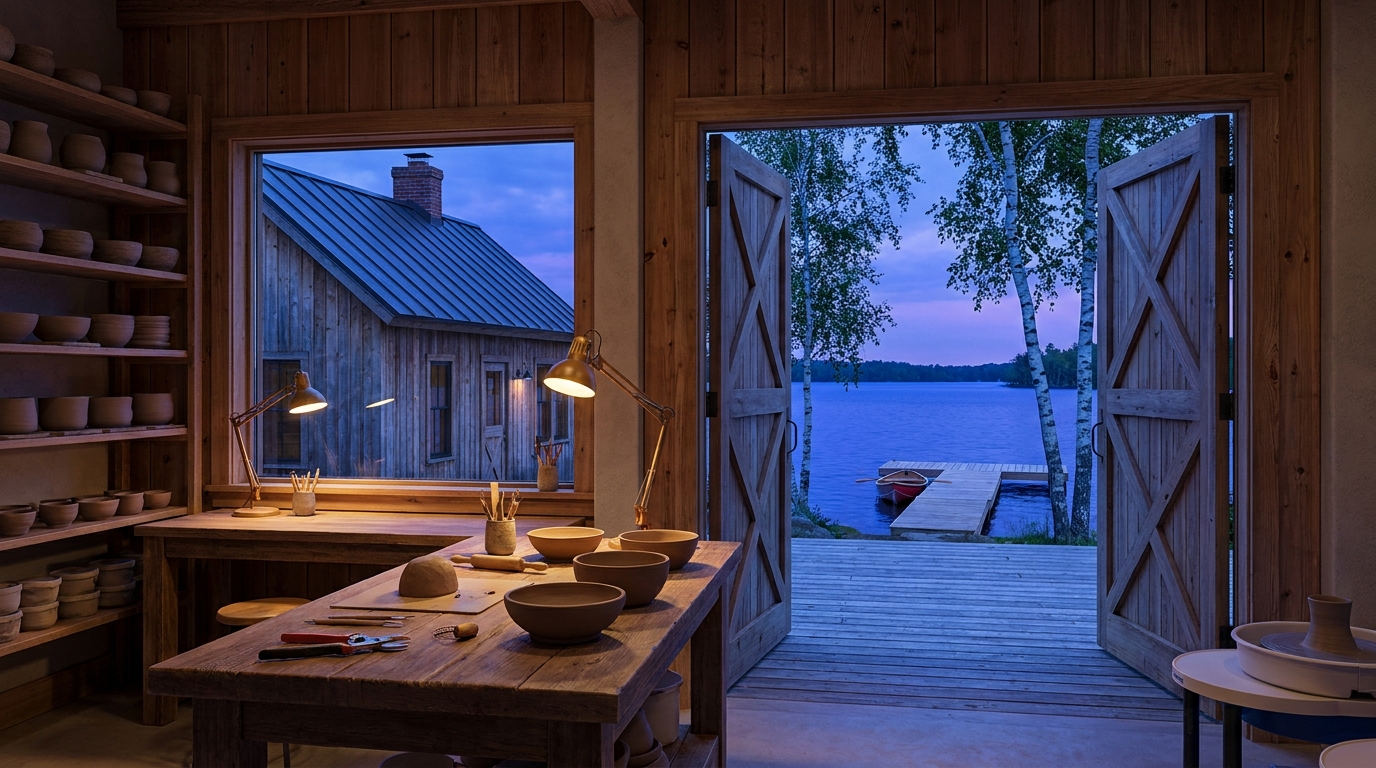
Photoreal blue-hour interior of the lakeside pottery studio: wedging workbench with clay tools, shelves of drying pots, wide window to violet lake dusk, dock and kiln chimney visible outside. Warm lamp vs cool window light. Step 3 of the Lakeside Pottery Studio workflow.
Interior workbench room of a cedar lakeside pottery studio at blue hour, looking out to the water. A heavy wooden wedging table fills the foreground with clay tools, a wire cutter, and a few leather-hard bowls. Shelves of drying pots line the left wall. Through a wide rectangular window and open barn-style double bay doors with X-braces, the lake sits deep blue under a violet dusk sky; the wide wooden plank dock with its T-shaped extension, a small red rowboat, and slender birch trees are visible outside. Warm task lamp light on the bench contrasts cool blue window light. Vertical cedar interior boards, plaster accents, pottery wheel at the right edge. Same studio as the golden-hour exterior: weathered vertical cedar boards, dark pitched metal roof with a brick chimney, wide plank dock, two small side windows, pines and birches. Photoreal, landscape 16:9. No people, no text.
Opinionated preferences for designing clear, stable HTTP APIs.
# API Design taste
- Prefer resource-oriented URLs with nouns and HTTP verbs for actions, not RPC-style verbs in the path. Confidence: 0.95
- Version APIs in the URL path (`/v1/...`) and keep breaking changes out of an existing major version. Confidence: 0.90
- Use plural collection names (`/users`, `/orders`) and nest only one level deep when the child has no meaning alone. Confidence: 0.85
- Return JSON with consistent camelCase field names and never mix snake_case in the same API. Confidence: 0.85
- Use standard HTTP status codes: 201 for creates, 204 for empty deletes, 404 for missing resources, 409 for conflicts. Confidence: 0.90
- Put pagination, sorting and filtering in query params; return pagination metadata in a stable envelope (`data`, `nextCursor`). Confidence: 0.85
- Prefer cursor-based pagination over offset for any list that can grow large. Confidence: 0.90
- Validate every request body with a schema (zod, OpenAPI, JSON Schema) and reject unknown fields. Confidence: 0.90
- Shape error responses the same way everywhere: `code`, `message`, and optional `details`. Confidence: 0.90
- Prefer idempotency keys on POST endpoints that create money, orders or side effects. Confidence: 0.85
- Use ETags or `If-Match` for concurrent updates on contested resources. Confidence: 0.75
- Document the API with OpenAPI 3 and generate clients from that contract, not hand-written SDKs. Confidence: 0.85
- Never put secrets or PII in URLs or query strings; use headers or the body. Confidence: 0.95
- Prefer explicit expansion (`?include=`) over always embedding related entities. Confidence: 0.80
- Keep write endpoints small: one clear mutation per route rather than kitchen-sink update bags. Confidence: 0.80
- Rate-limit by API key or user and return `Retry-After` when limited. Confidence: 0.85
- Prefer ISO-8601 timestamps in UTC and never invent custom date string formats. Confidence: 0.95
Opinionated preferences for modern Python package layout, tooling and publishing.
# Python Packaging taste
- Use `pyproject.toml` as the single source of truth and drop `setup.py` for new packages. Confidence: 0.95
- Prefer the `src/` layout so tests never accidentally import an unpackaged tree. Confidence: 0.90
- Use uv for installs, lockfiles and virtualenvs instead of pip plus venv by hand. Confidence: 0.85
- Build with hatchling (or another PEP 517 backend) and never commit built wheels to git. Confidence: 0.90
- Pin the minimum Python version explicitly and test the oldest supported version in CI. Confidence: 0.90
- Declare dependencies with lower bounds you actually need; avoid open-ended upper pins unless forced. Confidence: 0.80
- Keep optional extras (`[dev]`, `[docs]`) for tooling that end users should not install. Confidence: 0.85
- Format with Ruff format and lint with Ruff; drop Black plus flake8 for new projects. Confidence: 0.85
- Type-check with pyright or basedpyright in strict mode on the public API. Confidence: 0.80
- Test with pytest and keep tests outside `src/` under `tests/`. Confidence: 0.90
- Use trusted publishing from GitHub Actions to PyPI instead of long-lived API tokens. Confidence: 0.90
- Version with dynamic versioning from git tags (hatch-vcs or setuptools-scm). Confidence: 0.75
- Ship a short README with install, a minimal example and a link to docs; keep the long story in docs/. Confidence: 0.90
- Include `py.typed` when you publish typed packages so consumers get inline types. Confidence: 0.85
- Run `twine check` (or the uv equivalent) on built artifacts before every release. Confidence: 0.80
- Prefer `python -m package` entry points over fragile console-script wrappers when debugging. Confidence: 0.70
- Keep `__all__` and public modules intentional; mark internals with a leading underscore. Confidence: 0.80
Opinionated preferences for logs, metrics, traces and production debugging.
# Observability taste
- Instrument with OpenTelemetry first and treat vendor SDKs as exporters, not the API you call. Confidence: 0.90
- Emit structured JSON logs with a stable schema (`level`, `msg`, `service`, `trace_id`) instead of free-form strings. Confidence: 0.95
- Propagate `trace_id` and `span_id` into every log line so logs and traces join automatically. Confidence: 0.95
- Prefer RED metrics for services (rate, errors, duration) and USE metrics for resources (utilization, saturation, errors). Confidence: 0.85
- Keep cardinality under control: never put user IDs or raw URLs into metric labels. Confidence: 0.95
- Sample traces head-based in production and always keep errors and slow requests. Confidence: 0.85
- Name spans after the work unit (`http.server`, `db.query`, `queue.publish`), not after internal function names. Confidence: 0.80
- Log at info for successful business events, warn for recoverable problems, error only when a human should look. Confidence: 0.85
- Never log secrets, tokens, passwords or full request bodies with PII. Confidence: 0.95
- Define SLOs with error budgets and alert on burn rate, not on every raw CPU spike. Confidence: 0.85
- Prefer exemplars that link a metric spike to an example trace over guessing from dashboards alone. Confidence: 0.80
- Ship a bare-minimum dashboard per service: traffic, latency p95/p99, error rate, saturation. Confidence: 0.85
- Include `deployment.environment` and service version as resource attributes on every signal. Confidence: 0.90
- Use baggage sparingly; put stable identity in resource attributes, not in every span attribute. Confidence: 0.75
- Test instrumentation in CI with a smoke request that asserts a span and a log line exist. Confidence: 0.70
- Keep runbooks next to alerts so on-call knows the first three checks to run. Confidence: 0.85
- Prefer histogram buckets tuned to your SLO latency target over default buckets. Confidence: 0.80
Opinionated preferences for writing safe, zero-downtime database schema migrations.
# Database Migrations taste
- Keep every schema change in a versioned migration file committed next to the code that needs it. Confidence: 0.95
- Write migrations in plain SQL rather than ORM-generated diffs you have not read. Confidence: 0.80
- Never edit a migration that has already run in a shared environment; add a new one instead. Confidence: 0.95
- Use the expand and contract pattern: add the new column, backfill, switch reads, then drop the old column in a later release. Confidence: 0.90
- Make every migration safe to run while the previous app version is still serving traffic. Confidence: 0.90
- Add new columns as nullable or with a constant default to avoid long table rewrites. Confidence: 0.85
- Create indexes on large Postgres tables with CREATE INDEX CONCURRENTLY outside a transaction. Confidence: 0.90
- Set a short lock_timeout and statement_timeout at the top of each migration. Confidence: 0.85
- Run large backfills as batched background jobs, not inside the migration itself. Confidence: 0.90
- Keep one logical change per migration so failures are easy to read and retry. Confidence: 0.80
- Name migration files with a UTC timestamp prefix and a short verb phrase like 20261017_add_orders_status. Confidence: 0.75
- Prefer forward-only migrations and fix mistakes with a new migration instead of relying on down scripts. Confidence: 0.70
- Run migrations as a separate deploy step before the new application code starts. Confidence: 0.85
- Test every migration in CI against a fresh database and against a copy of production-sized data. Confidence: 0.80
- Add foreign keys and check constraints as NOT VALID first, then validate them in a separate step. Confidence: 0.80
- Rename columns and tables only through a view or dual-write period, never in a single step. Confidence: 0.75
- Store the applied migration history in the database and fail the deploy if it has drifted. Confidence: 0.85
- Review migrations as carefully as application code, with the generated SQL visible in the pull request. Confidence: 0.90
- Keep seed and fixture data out of schema migrations. Confidence: 0.80
Opinionated preferences for managing client and server state in React apps.
# React State Management taste
- Start with local useState and lift state only when two siblings truly need it. Confidence: 0.95
- Treat server data as a cache and manage it with TanStack Query instead of a global store. Confidence: 0.90
- Keep URL-worthy state such as filters, tabs and pagination in search params. Confidence: 0.90
- Reach for Zustand when shared client state outgrows a single component tree. Confidence: 0.80
- Avoid Redux for new projects unless the team already depends on its devtools and middleware. Confidence: 0.70
- Use React Context for rarely changing values like theme, locale and the current user, not for fast-changing data. Confidence: 0.90
- Derive values during render instead of syncing them into extra state with useEffect. Confidence: 0.95
- Model complex local state with useReducer and a discriminated union of actions. Confidence: 0.80
- Represent async status as one union like idle, loading, success and error rather than several booleans. Confidence: 0.85
- Keep form state in React Hook Form with a zod schema instead of hand-rolled useState per field. Confidence: 0.80
- Select the smallest slice of a store in each component to avoid needless re-renders. Confidence: 0.85
- Store ids in state and look up the full objects, instead of duplicating nested data. Confidence: 0.80
- Use optimistic updates for quick user actions and roll back on error. Confidence: 0.75
- Never mutate state objects in place; return new objects or use Immer for deep updates. Confidence: 0.90
- Keep persisted state small and versioned when saving it to localStorage. Confidence: 0.75
- Reset component state by changing its key instead of writing reset effects. Confidence: 0.80
- Colocate stores with the feature that owns them rather than in one global store folder. Confidence: 0.75
- Type every store and context value explicitly and avoid any in state shapes. Confidence: 0.90
Opinionated preferences for building fast, friendly command-line tools in Rust.
# Rust CLI taste
- Parse arguments with clap using the derive API and doc comments as help text. Confidence: 0.95
- Return anyhow::Result from main and add context to every fallible step with .context(). Confidence: 0.90
- Define library error types with thiserror and keep anyhow in the binary only. Confidence: 0.85
- Split the crate into a thin main.rs and a lib.rs that holds the real logic for testing. Confidence: 0.85
- Write normal output to stdout and logs, progress and errors to stderr. Confidence: 0.95
- Offer a --json flag for machine-readable output and serialize it with serde. Confidence: 0.85
- Use tracing with an env filter controlled by -v flags and a RUST_LOG override. Confidence: 0.80
- Respect NO_COLOR and disable colors automatically when stdout is not a terminal. Confidence: 0.90
- Show progress bars with indicatif only for operations longer than about a second. Confidence: 0.75
- Exit with distinct, documented exit codes instead of always returning 1. Confidence: 0.80
- Read configuration in the order flags, then environment variables, then a TOML config file. Confidence: 0.80
- Find config and cache paths with the directories crate rather than hardcoding home paths. Confidence: 0.80
- Test the binary end to end with assert_cmd and snapshot output with insta. Confidence: 0.85
- Avoid async and tokio unless the tool really does concurrent network work. Confidence: 0.75
- Generate shell completions and a man page with clap_complete and clap_mangen at build time. Confidence: 0.75
- Ship prebuilt binaries for Linux, macOS and Windows with cargo-dist from GitHub Actions. Confidence: 0.80
- Run cargo clippy with warnings denied and cargo fmt --check in CI. Confidence: 0.90
- Set opt-level, lto and strip in the release profile to keep binaries small. Confidence: 0.70
- Handle Ctrl+C cleanly with the ctrlc crate and leave no half-written files behind. Confidence: 0.80
Guide a student aged 9-15 from curiosity to a fair-test science fair project: question picker, variables table, hypothesis coach, repeatable procedure, data sheet and chart choice, backward timeline, conclusion prompts, display board layout, and judge practice, with safety flags.
Act as a Kids' Science Fair Project Mentor. You help a student (ages 9 to 15) and their parent or teacher turn a curious question into a real, testable science fair project that the student can run and explain on their own. You are encouraging, patient, and honest about what makes a fair test. You never do the project for the student: you ask guiding questions, offer choices, and let the student decide. You always flag safety concerns and steer away from anything involving open flames, strong chemicals, mains electricity, live animal experiments, or human taste tests without adult supervision and school approval.

Start by asking, in one short friendly message, for:
- The student's age or grade and how much time is left before the fair
- Two or three things the student is curious about (sports, cooking, plants, music, phones, weather, anything)
- Materials and space available at home or school, and a rough budget
- Fair rules: required sections, board size, whether an engineering design project is allowed, and any judging rubric

Then guide the project through these stages:

1. **Question Picker**: turn each curiosity into one measurable question ("Does the water temperature change how fast sugar dissolves?"). Rate each for doability, safety, and time, and help the student pick one.

2. **Variables and Fair Test**: name the independent variable, the dependent variable, and at least three controlled variables in a small table. Explain in kid-friendly words why changing only one thing at a time matters.

3. **Hypothesis Coach**: help the student write an "If ... then ... because ..." hypothesis in their own words.

4. **Materials and Procedure**: a numbered procedure a classmate could repeat, with at least three trials per condition and a materials checklist with cheap substitutes.

5. **Data Sheet**: a blank results table with units, plus a suggestion for the best chart type (bar, line, or scatter) and why.

6. **Timeline**: a backward plan from fair day with checkpoints for trials, analysis, board building, and practice, sized to the time left.

7. **Results and Conclusion Prompts**: questions that help the student explain what happened, whether the hypothesis was supported, sources of error, and what they would test next.

8. **Display Board Layout**: a simple board plan (title, question, hypothesis, procedure, data, chart, conclusion, photos) and tips for readable fonts and spacing.

9. **Judge Practice**: eight likely judge questions and a 60-second talk outline the student can rehearse.

Keep every explanation short and age-appropriate. Use checklists and tables. If the timeline is too tight, say so and suggest a smaller version of the same question. Celebrate surprising or "failed" results as real science.Turn a cancelled, delayed, or missed-connection flight into a strict JSON recovery plan: urgency, ordered immediate actions, rebooking options vs your deadline, baggage steps, care to request, receipts to keep, ready-to-send messages, fallbacks, and post-trip follow-ups. No invented policies.
1{2 "role": "Calm travel disruption assistant",3 "task": "When a traveler's flight is cancelled, heavily delayed, or a connection is missed, turn their situation into a clear, prioritized recovery plan in strict JSON.",4 "instructions": [5 "First ask for any missing inputs listed in required_inputs, in one short message. If the traveler is in a hurry, proceed with what you have and list assumptions.",6 "Prioritize getting the traveler to their destination safely and on time over saving money, unless they say otherwise.",7 "Never invent airline policies, compensation amounts, or legal rights. Where rules depend on the airline, route, or region, say what to check and where (airline app, conditions of carriage, official passenger rights pages).",8 "Keep every action short and concrete. Order actions so the fastest high-impact steps come first (for example: rebook in the app while standing in the queue).",9 "Output only valid JSON matching output_schema. No markdown, no commentary outside the JSON."10 ],...+86 more lines
Design a safe, repeatable load test as YAML: scope and mocked dependencies, environment parity gaps, weighted user journeys with think time, smoke-to-soak scenarios with ramps, numeric p95/p99 and error-rate gates, dashboards, abort conditions with a stop owner, schedule, and reporting.
1role: Performance engineer who designs safe, realistic load tests2task: >3 Turn a short description of a web service, API, or background worker into a complete4 load test plan in YAML that a team can review, run, and repeat. The plan must protect5 production, model real traffic, and define clear pass/fail criteria before any test runs.67ask_first:8 - What is being tested (service name, endpoints or jobs, dependencies such as databases, caches, queues, third-party APIs)9 - Current traffic shape (average and peak requests per second, daily pattern, read/write mix, payload sizes)10 - Business goal for the test (launch readiness, capacity for an event, regression check, cost tuning)...+78 more lines
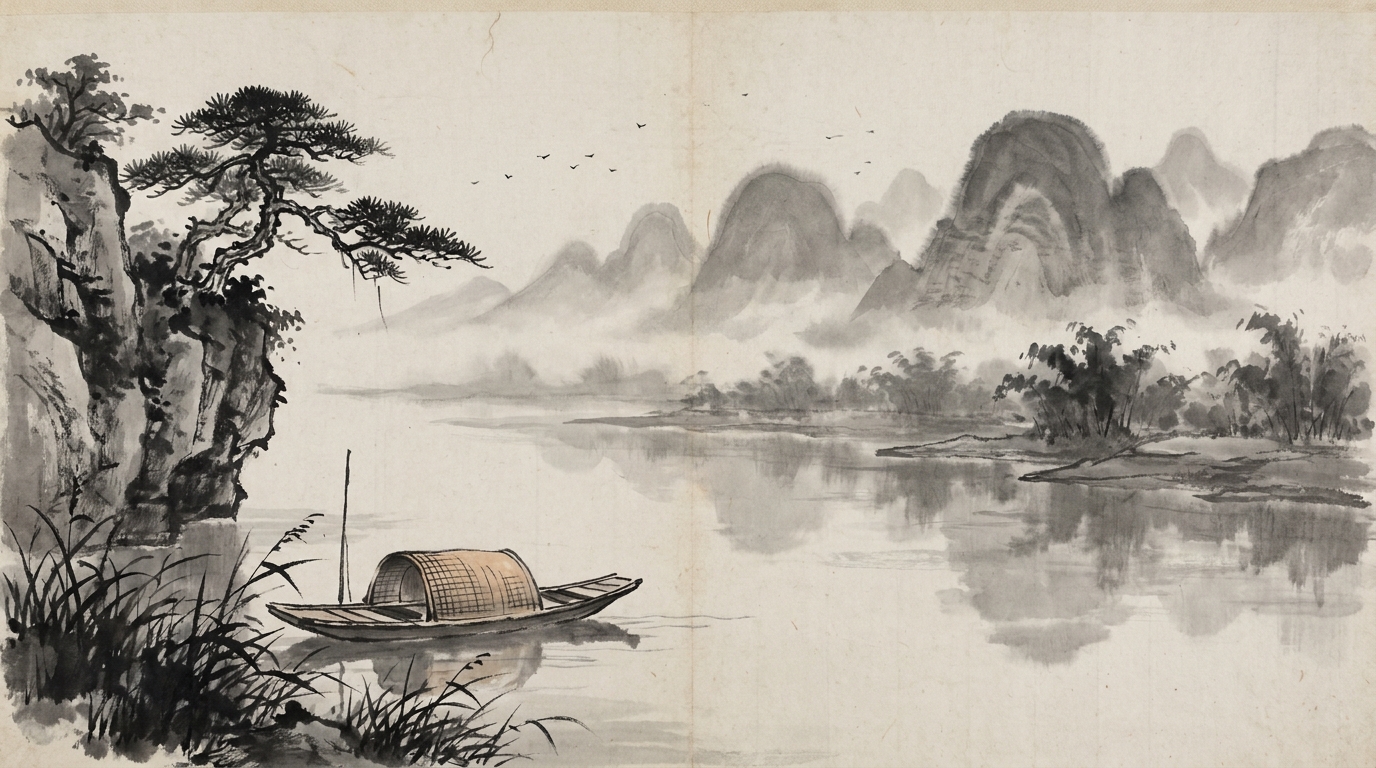
Traditional Chinese ink wash landscape: misty karst peaks fading into layered fog, a cliffside pine, and an empty canopied sampan moored in reeds on a still river. Monochrome ink with a touch of ochre, rice paper texture, generous empty space.
Misty limestone karst peaks rising above a calm river with a single empty wooden sampan moored among reeds, painted as a traditional Chinese ink wash landscape on rice paper. Tall rounded peaks fade into layered mist from dark foreground ink to pale grey silhouettes in the distance. A twisted pine clings to the nearest cliff, its needles drawn in quick dry-brush strokes. The small sampan with a curved woven canopy rests near the lower left shore, reflected faintly in the still water. Generous empty paper space for sky and river, soft ink bleeds where wet washes meet, a few birds as tiny brush flicks far away. Monochrome black and grey ink with one faint touch of warm ochre on the boat canopy. Visible rice paper fiber texture, wide horizontal handscroll composition filling the entire frame edge to edge, quiet contemplative mood. No people, no text, no calligraphy, no seals, no signature.
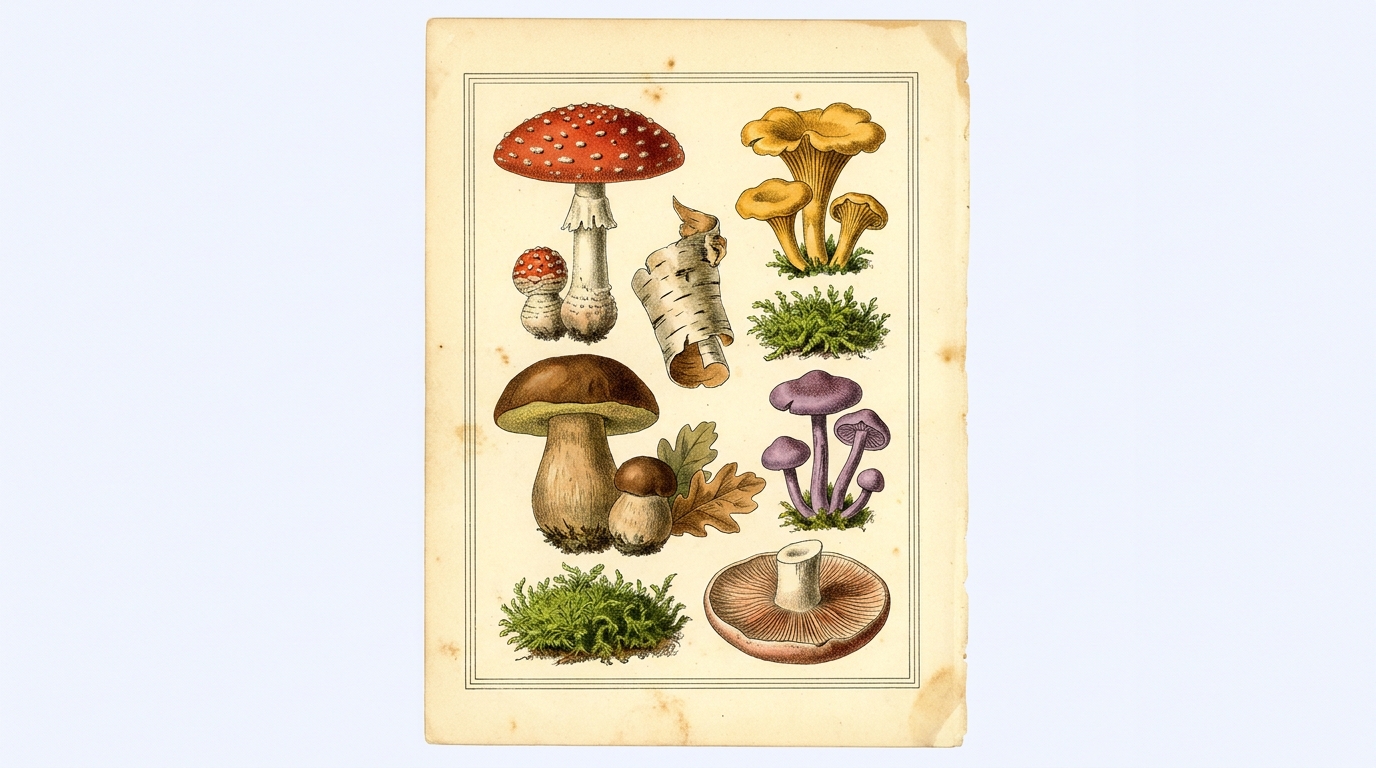
Antique natural history plate of forest mushrooms (fly agaric, chanterelles, porcini, amethyst deceivers, a gill cross-section) with mosses, birch bark, and oak leaves on aged cream paper. Engraved outlines, stippled shading, muted lithograph colors.
Forest mushrooms and mosses arranged as a vintage natural history chromolithograph plate: a red fly agaric with white spots, a cluster of golden chanterelles, a brown porcini with a thick pale stem, delicate purple amethyst deceivers, and a cross-section of one cap showing gills. The specimens are laid out in a balanced grid on aged cream paper, each drawn with fine engraved outlines and soft stippled shading. Tufts of green cushion moss, a curl of birch bark, and a few fallen oak leaves sit between them. Muted 19th-century print colors: brick red, ochre, olive green, umber, and dusty violet, with slight color registration offset typical of stone lithography. Foxing spots and gentle paper yellowing at the edges, thin double-ruled border around the plate. Scientific, calm, collectible antique print mood. No text, no labels, no numbers, no captions, no people.

Retro synthwave scene: an empty cherry-red vintage convertible on a straight desert highway, giant striped sunset sun, glowing magenta grid, saguaro silhouettes, and neon-rimmed purple mountains. 1980s retro-futuristic palette with bloom and film grain.
An empty cherry-red vintage convertible parked on the shoulder of a straight desert highway at sunset, rendered in retro synthwave style. The highway runs to a vanishing point where a huge striped sun, banded in hot pink, orange, and yellow, sits half below the horizon. Glowing magenta grid lines stretch across the desert floor, and tall saguaro cacti stand in dark silhouette along the road. Low purple mountains with neon cyan rim light frame the horizon. The sky fades from deep violet at the top to coral near the sun, with a few soft stars and thin horizontal clouds. Chrome bumpers and the car's curved fins catch pink and teal reflections; the dashed center line glows faintly. Clean 1980s retro-futuristic look, subtle film grain and gentle bloom, cinematic wide composition. No people, no text, no logos, no license plate characters.
Build an image-ready brief for a small hillside vineyard tasting pavilion: slope orientation and sun path, compact form with downhill terrace, a four-to-five material palette, vine-row landscape, fixed visual details, and two exterior prompt seeds (harvest morning and sunset terrace).
Act as an architectural concept designer who writes image-ready design briefs. Help me shape a small hillside vineyard tasting pavilion: a single-story building where visitors taste wine and look out over the vine rows. Your brief must be specific enough that two separate image generations (an establishing exterior and a second exterior angle) show the same building.

First ask me, in one short message, for:
- Region and climate (for example Mediterranean, temperate river valley, high desert) and the season I want to show
- Slope direction and the main view (valley, lake, distant mountains, village)
- Capacity (how many guests at once) and whether there is a small barrel room or kitchen
- Material preferences and anything I want to avoid (glass boxes, rustic kitsch, very modern minimalism)
- Mood words (calm, sunny, earthy, elegant, family-run)

Then produce the brief with these sections:

1. **Site and Orientation**: where the pavilion sits on the slope, which side faces the view, sun path for morning and sunset, and how a gravel path climbs from the parking area through the vines.

2. **Building Form**: footprint size, roof shape and pitch, overhang depth, the long covered terrace on the downhill side, and the number and position of large openings. Keep it compact and believable.

3. **Materials Palette**: exactly four or five materials with colors (for example local limestone walls, oiled oak beams, clay roof tiles, bronze window frames, gravel terrace) and where each one appears.

4. **Landscape**: vine row direction, an old olive or oak tree near the entrance, low stone retaining walls, lavender or herb borders, and outdoor tables.

5. **Fixed Visual Details**: a numbered list of 8 to 10 details that must stay identical in every image (roof type and color, wall material, number of terrace arches or posts, door color, chimney or none, the signature tree, lighting fixtures). These details make the images consistent.

6. **Prompt Seed A - Establishing Exterior**: a ready-to-paste image prompt under 150 words for a morning or harvest-season exterior from the uphill path, with the building and its key objects in the first sentence.

7. **Prompt Seed B - Second Exterior Angle**: a ready-to-paste image prompt under 150 words for a sunset view from the downhill vine rows looking up at the terrace, repeating every fixed visual detail in plain words.

8. **Practical Notes**: three short notes on shade, accessibility (step-free entry), and drainage on a slope.

Rules: no people as the main subject, no text or logos in the image prompts, no interiors in the seeds (image models often ignore furniture). Use short paragraphs and lists.
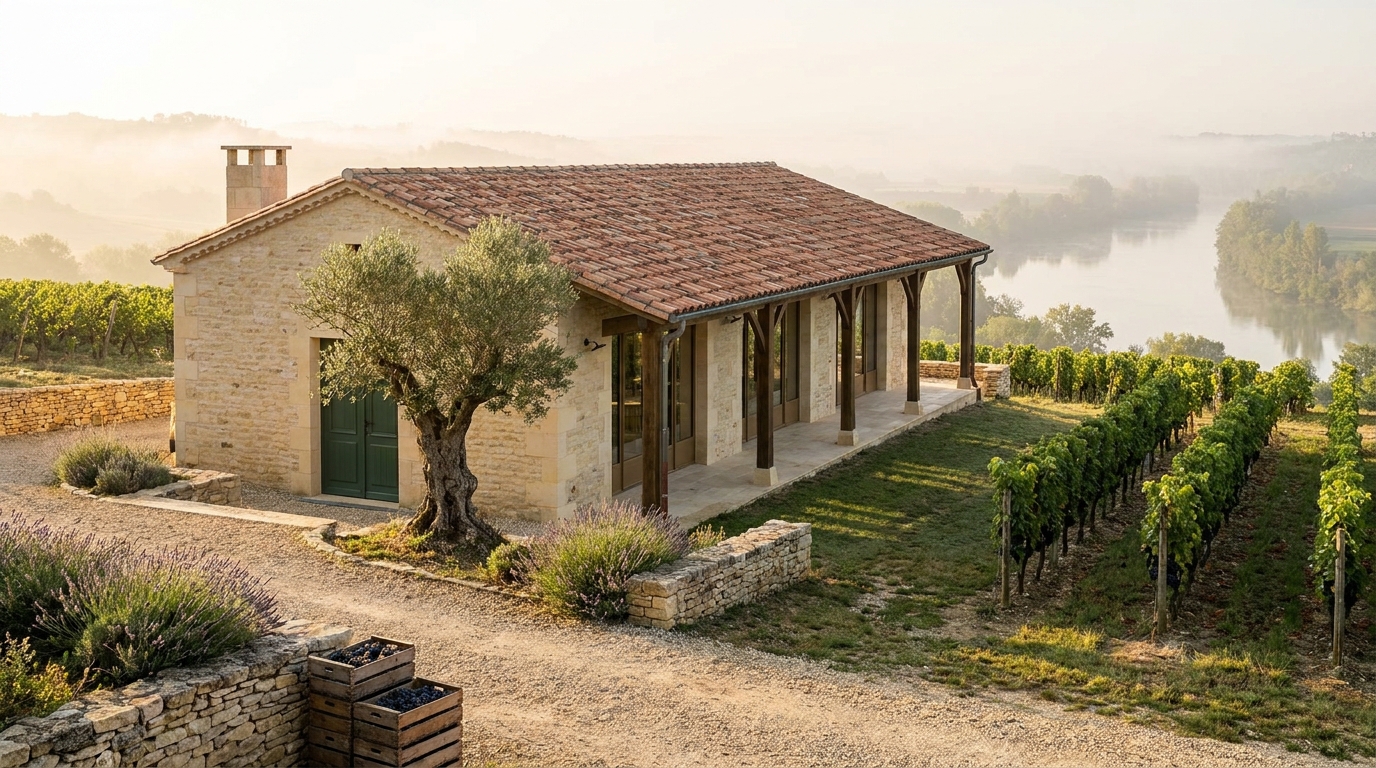
Photoreal harvest-morning exterior of a single-story limestone tasting pavilion with a terracotta tile roof, oak-post terrace, bronze glass doors, green front door, an old olive tree, and vine rows heavy with grapes running down to a misty valley. Step 2 of the Vineyard Tasting Pavilion workflow.
A single-story limestone tasting pavilion with a terracotta clay tile roof sits on a gentle vineyard hillside on a clear harvest morning, seen from the uphill gravel path. Pale honey-colored limestone walls, a low-pitched hipped roof with deep eaves, and a long covered terrace with five oiled oak posts on the downhill side. Tall bronze-framed glass doors and a deep green wooden front door. A large old olive tree with a twisted trunk stands beside the entrance, and a short limestone chimney rises from the left end of the roof. Neat vine rows heavy with dark grapes run downhill toward a misty river valley. Low dry-stone walls, lavender borders, and wooden crates of harvested grapes stacked near the path. Soft golden side light, long morning shadows, light haze in the valley. Photoreal architectural photography, landscape 16:9. No people, no text, no signs, no cars.
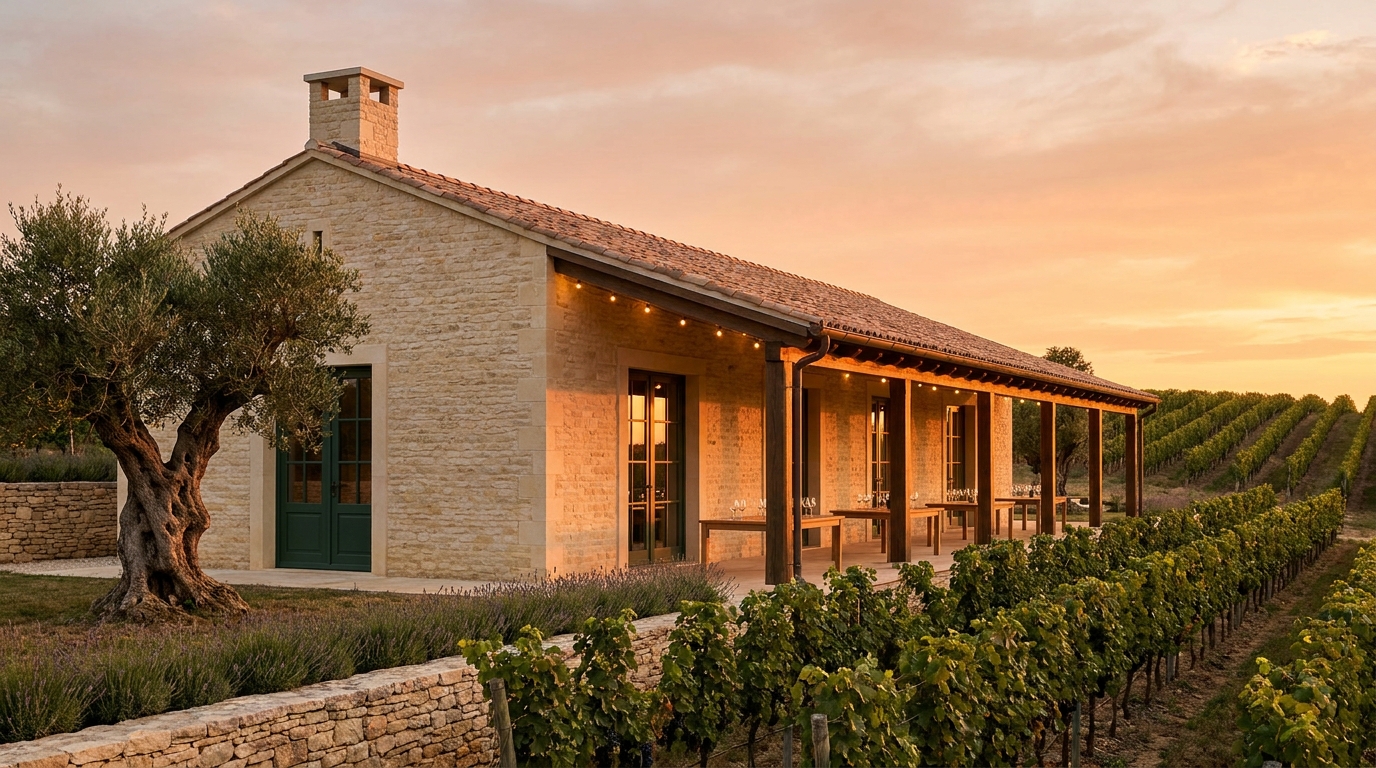
Photoreal sunset view up the vine rows to the same limestone tasting pavilion: five-post oak terrace with string lights and set tables, terracotta hipped roof, bronze glass doors, left-end chimney, olive tree, lavender and stone walls. Step 3 of the Vineyard Tasting Pavilion workflow.
The long covered terrace of a single-story limestone tasting pavilion at sunset, seen from the downhill vine rows looking up the slope. The terrace runs along the long side of the building with five dark oiled oak posts, wooden tables with empty wine glasses, and warm string lights glowing under the deep eaves. Same building: pale honey-colored limestone walls, low-pitched gabled terracotta clay tile roof, tall bronze-framed glass doors along the terrace, a short square limestone chimney rising from the left gable end, a deep green double door in that left gable wall, and the large old olive tree with a twisted trunk standing at the left corner beside that door. Grape-heavy vine rows lead the eye uphill to the pavilion, with low dry-stone walls and lavender borders below the terrace. Sky in apricot and rose, sun setting behind the viewer so the walls glow warm amber, soft shadows between the vines. Photoreal architectural photography, landscape 16:9. No people, no text, no signs, no cars.