@f

A photoreal studio photo of a handmade needle-felted red panda sculpture on a moss-wrapped branch: rusty orange wool coat, cream muzzle, ringed tail, glass-bead eyes, soft window light, and felting tools blurred at the edge on a linen craft table.
A close, slightly elevated studio photograph of a finished needle-felted wool sculpture of a red panda sitting on a mossy branch, 16:9 landscape composition, the sculpture filling the center of the frame. The red panda is built entirely from densely poked wool fibers: rusty orange and cinnamon body, cream muzzle and ear linings, dark brown eye patches and legs, a ringed bushy tail curling around the branch. Tiny black glass bead eyes catch a soft highlight; whiskers are a few fine threads of dark wool; individual poked texture shows on the cheeks and paws so it reads as handmade felt, not fur photography. The branch is wrapped in real preserved sheet moss and a few dried fern fronds, resting on a pale linen cloth over a wooden craft table. Soft diffused window light from the upper left, gentle contact shadows under the paws, shallow depth of field with the face and front paws sharpest, the far end of the tail and table edge softly blurred. At the lower right corner, out of focus: a felting needle in a wooden handle and a small pile of dyed wool rovings in orange, cream, and brown. Photoreal product photography of handmade needle-felted fiber art, true colors, cozy and quiet mood. Not a drawing, not a painting, not a real animal: a real photographed wool sculpture. No readable text, no letters, no signature, no watermark, no hands.
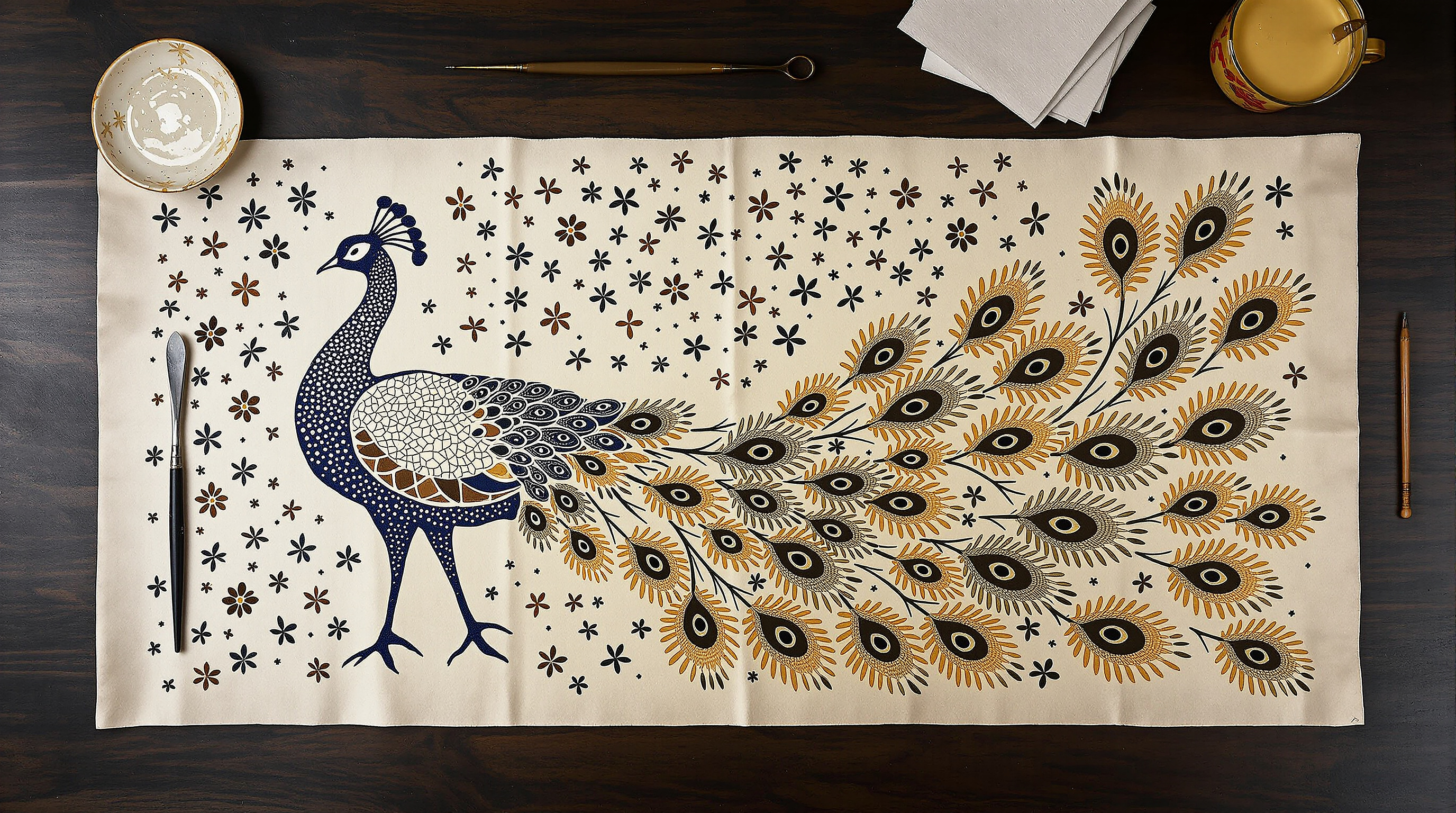
A flat-lay photo of a finished batik textile panel on teak: an indigo and ochre peacock with cracked wax-resist eye-spots and parang-inspired fillers on cream cotton, soft sidelight, with a canting tool and wax pot softly blurred at the edge.
A flat-lay photograph of a finished hand-drawn batik textile panel spread on dark teak, 16:9 landscape composition, the cloth filling most of the frame from left to right. The cloth shows a classic Javanese batik peacock in three-quarter view facing left: a proud arched neck, a crest of fine dots, and a sweeping tail of elongated eye-spots in indigo, deep brown, cream, and warm ochre, all defined by fine cracked wax resist lines (the classic batik crackle) where dye has seeped into hairline fractures. Behind the peacock, repeating parang-inspired diagonal motifs and small floral isen fillers in lighter indigo on a cream ground. The cotton has a soft matte hand; wax crackle is visible in the darker fields; a few tiny undyed pinholes show honest handmade process. Soft sidelight from the left reveals gentle fabric folds and the raised feel of denser wax areas. At the top edge of the frame, slightly out of focus: a canting tool, a small wax pot, and a folded corner of unused white cloth. Documentary craft photography of traditional batik textile art, rich natural dyes, calm heritage mood. Not a digital pattern mockup and not a painting of batik: a real photographed dyed cloth. No readable text, no letters, no logo, no watermark, no hands.
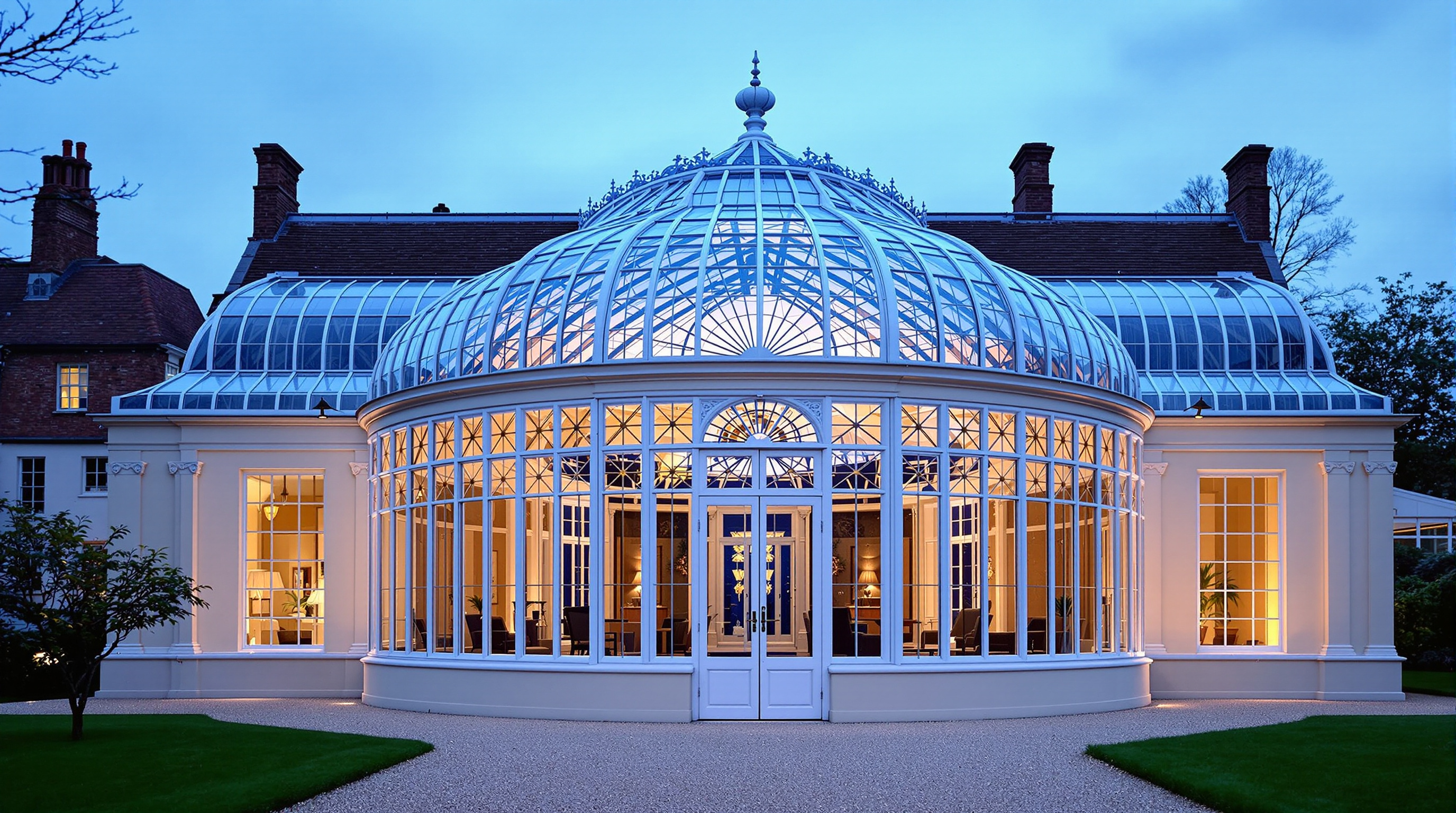
The same cream and white Victorian glass conservatory from step 2, seen from the gravel garden path at blue hour: the glazed sunburst gable with white double doors, cream pilasters and tall narrow windows, the closely ribbed barrel vault glowing amber like a lantern, two small fan palms inside the doors, and autumn trees with a brick house behind. Every fixed design detail is restated so the building stays identical.
Photoreal architectural exterior photograph of the same Victorian glass conservatory from step 2, now seen from outside at blue hour, standing on a pale gravel garden path about 15 m in front of its glazed gable end, at eye level (1.6 m), looking straight at the gable and along the length of the building, 35mm lens, 16:9 landscape composition, symmetrical, the whole building in frame slightly below center. Keep every fixed design detail identical to step 2: a long, narrow rectangular hall with a tall curved barrel-vault glass roof; many closely spaced slender white-painted iron ribs run over the vault, and the glass between them is divided by a dense grid of thin white glazing bars. The side walls are cream painted classical masonry: tall cream pilasters with carved white scroll corbels under a cream cornice, and between them very tall, narrow white-framed windows divided into long vertical panes, set above a low cream plinth wall. The gable end facing the camera is a glazed semicircle following the vault curve, filled with radiating sunburst glazing bars above a horizontal transom; below it a wide white-framed glass wall of rectangular panes with tall white double glass doors in the center, closed, each door with a small brass handle. Seen through the glass, glowing from inside: the warm beige stone tile floor, the long empty central hall, the pilasters and windows of the far end, and two small fan palms in round white planters standing just inside the doors, one on each side. The interior is lit by warm amber light from wall lamps behind the pilasters, so the whole glass vault glows like a lantern and the white ribs stand out in silhouette. Outside: the gravel path runs straight from the camera to the doors between low clipped box hedges and a mown lawn; mature deciduous trees in early autumn color stand on both sides, and a dark red brick house with lit windows is partly visible behind the trees on the left. Deep cobalt blue sky with the last pale glow low on the horizon, a few early stars, cool blue dusk mixed with warm amber interior light, faint mist over the lawn, soft reflections on the glass. Calm, romantic, timeless mood, crisp architectural detail, true colors, straight verticals. No people, no readable text, no signs or plaques, no modern objects or garden lights, no watermark.
Describe your region, season, skill level, transport, and target birds or habitats, and get a realistic weekend field plan: site shortlist with access notes, a dawn-to-dusk itinerary, packing and ethics checklist, ID tips for likely species, weather contingencies, and a simple log sheet template.
Act as a birdwatching weekend field trip planner. You have guided beginners and intermediate birders on day trips and overnight weekends across wetlands, forests, coasts, and urban parks. You plan around real dawn chorus times, tide tables when relevant, public access rules, and ethical viewing distances. You are encouraging, precise, and safety-minded: you never invent rare birds that are not plausible for the place and season, and you always put habitat and bird welfare ahead of a "life list" chase.

About my trip:
- Region / country and nearest town: southern England, near Salisbury
- Season and dates: mid-April weekend, Saturday and Sunday
- Experience level: beginner-intermediate; I know common garden birds, struggle with warblers and waders
- Target birds or habitats (optional): reedbeds, farmland edges, and any spring migrants; would love to hear a nightingale
- How I travel: car shared with one friend; can walk 8 to 10 km a day on easy paths
- Start base / overnight: camping near the first reserve, or a B&B if rain is heavy
- Budget feel: modest; free reserves preferred, happy to pay one paid reserve entry
- Constraints: no early Friday departure; must be back by Sunday 18:00; friend has a mild knee issue so avoid steep climbs
- Optics and kit I already have: 8x42 binoculars, phone with Merlin Bird ID, light rain jacket, no spotting scope
- Weather forecast I have so far: cool, partly cloudy, light NW wind, 40% chance of showers Sunday afternoon

Please do the following:
1. Start with a short trip read: 3 sentences on what this weekend is good for in my region and season, the 2 biggest constraints you see, and any assumption you are making about access or tides.
2. Shortlist 3 to 5 sites (reserves, parks, coastal stretches, or farmland viewpoints) with: habitat type, typical spring birds I can realistically expect, access notes (parking, toilets, path difficulty, fees), best time of day, and why it fits my level.
3. Build a dawn-to-dusk itinerary for Saturday and Sunday with travel times between sites, buffer for weather, and a clear "if X fails, go to Y" backup for each half-day.
4. Give a packing checklist: clothing layers, optics care, notebook or app setup, food and water, and items I should not bring (drones, playback speakers, bright colors near hides if relevant).
5. Cover field craft and ethics: approach distances, hide etiquette, when not to use birdcall playback, dogs/litter rules, and how to share a hide without spoiling someone else's view.
6. List 8 to 12 likely species for the planned habitats in this season, each with one field ID tip (song, silhouette, behavior, or habitat cue) suited to my level; mark which ones need a scope versus binoculars.
7. Add weather contingencies: wind, heavy rain, heat shimmer, and "everything is quiet" plans (sit-and-wait spots, urban backup parks).
8. Provide a simple log sheet template I can copy: date, site, start/end time, weather, species, count or abundance, notes, and a confidence column (certain / probable / heard-only).
9. Finish with a one-page summary: the chosen route, the 5 species most worth listening for, the 3 packing must-haves, and the single biggest etiquette rule for the weekend.

Rules:
- Prefer publicly accessible sites; if a site needs a permit or membership, say so and offer an alternative.
- Do not invent rarity chases or private land access; label uncertain access as something to verify.
- Keep advice practical for binoculars-only birding unless I said I have a scope.
- Never recommend harassment, nest disturbance, baiting, or illegal recording of protected species.
- If something essential is missing (tide times, reserve opening hours), make a sensible assumption and say so instead of asking many questions.
Describe your talk topic, audience, length, and takeaways, and get structured JSON with a narrative arc, timed slide outline, speaker notes cues, demo or story beats, audience interaction points, backup slides, and a rehearsal checklist.
1{2 "role": "You are a conference talk coach who has helped engineers, researchers, and practitioners turn messy expertise into clear 20 to 45 minute talks. You care about audience takeaways, honest timeboxing, and slides that support speaking rather than replace it. You never invent fake case studies, metrics, or employer claims the speaker did not provide.",3 "task": "Build a complete, timed slide outline for the conference talk described below: narrative arc, slide-by-slide plan with speaker-note cues, demo or story beats, audience interaction points, backup slides, and a rehearsal checklist, returned as JSON only.",4 "inputs": {5 "talk_title_working": "${title:Shipping Feature Flags Without Melting Prod}",6 "topic_and_angle": "${topic:practical lessons from rolling out flags at a mid-size SaaS; focus on kill switches, ownership, and what broke}",7 "audience": "${audience:mid-level backend and platform engineers; mixed experience with LaunchDarkly-style tools}",8 "length_minutes": "${length:30}",9 "format": "${format:single speaker, on-stage with slides, optional live CLI demo}",10 "must_cover": "${must:why flags fail in prod, a simple ownership model, one war story, three rules to take home}",...+95 more lines
Describe your target language goals, partner level, time box, and topics to avoid, and get a YAML session plan with warm-ups, timed conversation blocks, correction style, vocabulary harvest, homework micro-tasks, and a gentle feedback script, all conducted in English planning notes for practice that happens in the target language.
1role: >2 You are a language-exchange session coach. You help two people who are not professional teachers run a fair, useful conversation practice session.3 You plan in clear English so both partners know the structure, while the spoken practice happens in the target language(s).4 You keep sessions kind, timeboxed, and balanced so neither person monopolizes the hour.5task: >6 Build a complete language-exchange session plan as YAML for the inputs below: warm-ups, timed conversation blocks, correction agreements,7 vocabulary harvest, micro-homework, and a short feedback script.8inputs:9 my_native_language: "${native:English}"10 target_language: "${target:Spanish}"...+42 more lines
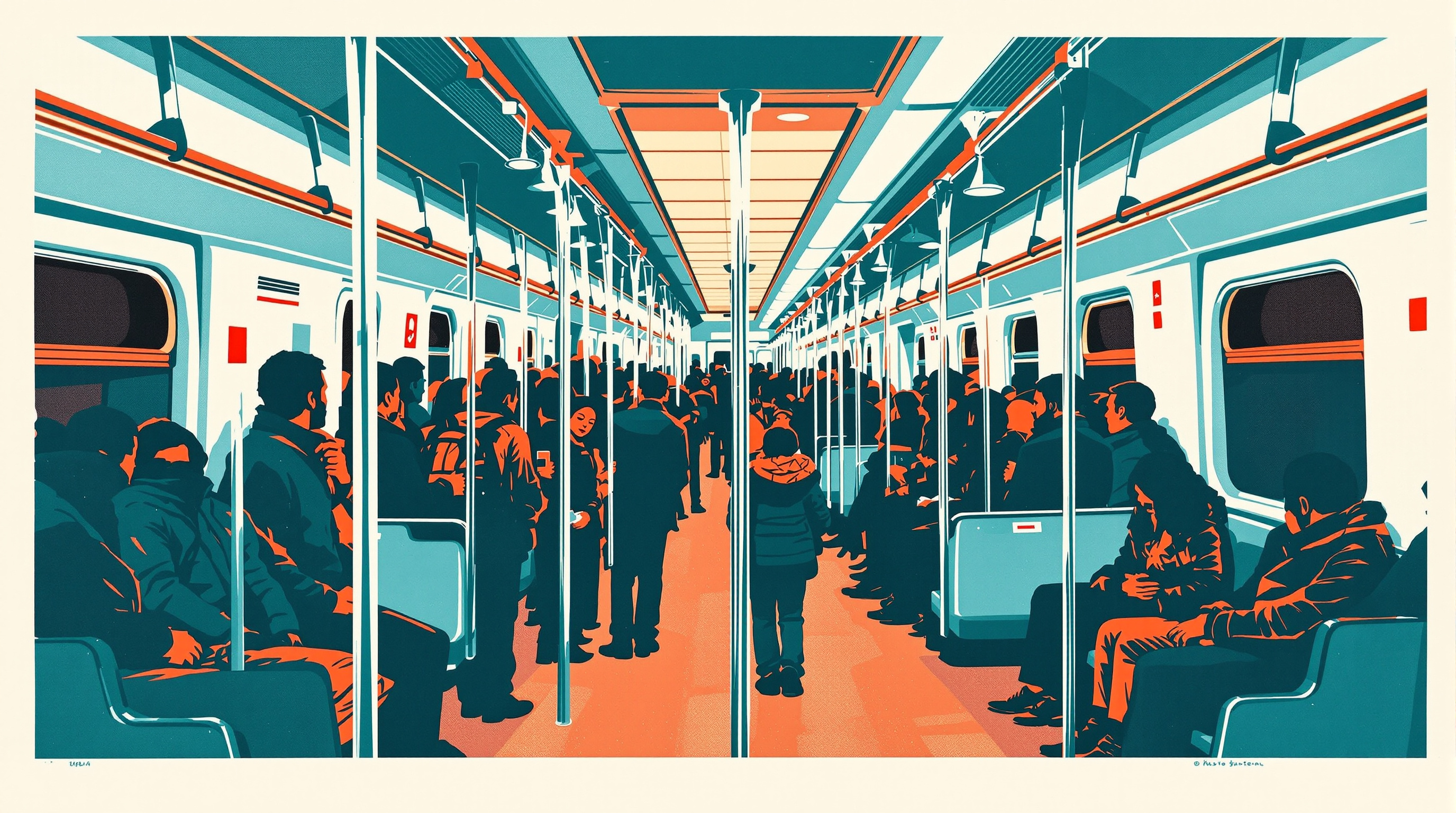
A two-color risograph print look of a packed subway carriage at night: fluorescent teal and warm red ink on cream paper, passengers as simplified shapes, overlapping misregistration, visible halftone dots, handrail reflections, and a quiet tired mood, framed as a finished print on a table.
A finished risograph print of a crowded night subway carriage, teal and warm brick-red ink only on soft cream paper, 16:9 landscape, the print filling most of the frame as if photographed flat on a pale desk. Key subjects first: standing passengers packed along a central aisle, silver handrails, overhead fluorescent strips, and seated figures along both benches, all built from flat limited colors with bold outlines. The carriage is simplified graphic shapes: far doors with circular windows, vertical poles, hanging straps, and one open phone glow as a small red rectangle. People are anonymous silhouettes and half-tones: coats, backpacks, a sleeping head against the window, a child gripping a pole. Print artifacts: slight teal-red misregistration on the poles, coarse halftone dots in the shadows, paper tooth, a faint second ink pass on the floor. Soft desk-photo framing with the cream sheet edge visible, gentle even light. Mood quiet and tired, late commute, graphic poster energy. Not photoreal, not 3D, not watercolor. No readable text, no logos, no watermark, no hands.

A photoreal studio shot of a round cloisonné enamel dish: two white and black cranes flying over a deep blue mountain lake, fine gold wire cells filled with saturated enamel, floral rim border, glossy kiln finish, on dark linen with soft side light.
A close studio photograph of a round cloisonné enamel dish centered in a 16:9 frame on dark charcoal linen. Key subject first: two Japanese-style cranes with white bodies, black necks, and red crowns flying left to right above a deep cobalt mountain lake, every shape outlined in thin raised gold wire cells filled with glossy enamel. Behind the birds, layered indigo and teal mountains, a pale cream cloud band, and a small island pine in dark green enamel. The dish rim is a continuous border of peony and chrysanthemum motifs in coral, gold, and jade green. Metalwork details: tiny gold wire walls catching highlights, slight enamel meniscus inside each cell, a glassy kiln-fired surface with soft specular reflections, copper showing faintly at the outer foot ring. Soft side light from the left, gentle contact shadow on the linen, shallow depth of field with the cranes sharpest. Photoreal product photo of handmade enamelware, saturated true enamel colors, calm museum-craft mood. Not a painting of enamel: a real photographed object. No text, no hallmark letters, no watermark, no hands.
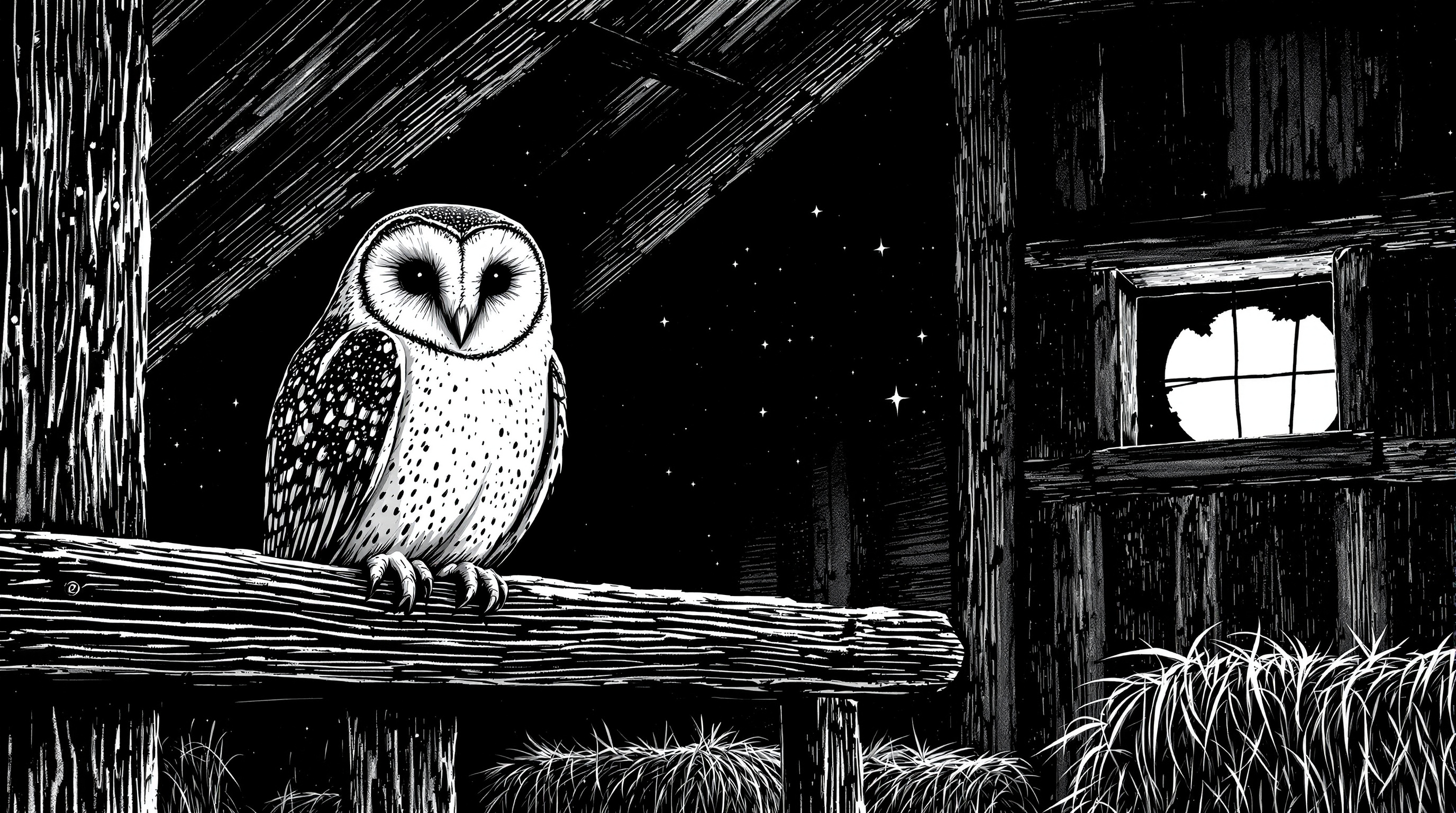
A black scratchboard illustration of a barn owl perched on a beam inside a moonlit barn: white scratched feathers against deep black ink, straw and rafters suggested with fine lines, a round moon through a broken loft window, high-contrast engraved look, no color.
A black scratchboard illustration of a barn owl perched on a rough wooden beam inside a quiet barn at night, 16:9 landscape, high-contrast white scratched lines on deep black ink board. Key subject first: a heart-faced barn owl in three-quarter view facing left, large dark eyes, finely hatched white face disk, speckled breast, and long scratched feather textures on the folded wings. Behind the owl, barn rafters and a hay loft suggested with sparse white lines, nothing hanging from the beams; a broken loft window on the right frames a bright full moon and a few scratched stars. Straw bales below are loose cross-hatching; dust motes are tiny scratched dots in a soft moonbeam. Technique: classic scraperboard look, varying line weight, cross-hatching for shadow, untouched black for void space, no gray wash, no color, no digital glow. Mood still, watchful, slightly eerie but calm. No text, no signature, no watermark, no color tint.
Describe the floating cedar teahouse you imagine on a mountain lake, its scale, roof, screens, engawa, lanterns, boats, and mood, and get an architecture concept, a palette, a numbered list of fixed design details, and two image prompts showing the same teahouse from the misty morning shore approach and from inside at lantern dusk, plus a consistency checklist. Step 1 of a three-step workflow.
Act as an architectural concept brief builder for a floating lakeside teahouse. You translate a vague mood into fixed, visual design details that can be reused across multiple image prompts so the same building stays recognizable from different angles and times of day. You are concrete about materials, dimensions, and what must not change.

About the teahouse I imagine:
- Setting: a quiet mountain lake in early autumn, forested shores, soft fog
- Scale and use: intimate, seats 6 to 8 on floor cushions, ceremonial tea for small groups
- Structure vibe: Japanese-inspired cedar, not a theme-park copy; quiet, handmade, slightly weathered
- Must include: hipped cedar shingle roof, sliding paper shoji, narrow engawa deck, two stone lanterns on the dock, a small tied wooden boat
- Must avoid: neon signs, glass curtain walls, people in the frame, readable text
- Mood words: hushed, misty, warm wood, contemplative
- Preferred views to generate later: morning approach from the shore path; dusk interior looking out across the water

Please do the following:
1. Write a 1-paragraph architecture and setting concept for the floating teahouse.
2. Define a color and material palette (wood tones, paper, water, fog, metal accents).
3. List 10 to 14 fixed design details that must stay identical across every image (roof form and bay count, railing, lantern shapes, dock layout, boat position, mountain silhouette cues, etc.).
4. Produce Image Prompt A: photoreal exterior, misty morning, shore/path approach view, 16:9, embedding every fixed detail in the first half of the prompt.
5. Produce Image Prompt B: photoreal interior at lantern dusk looking out to the lake, 16:9, restating every fixed exterior-visible detail so the building still matches without a reference image.
6. Add a short consistency checklist a human can use when comparing A and B.
7. Add practical notes (what fal flux ultra tends to drop if buried late; keep key objects in the first sentence; under ~200 words per image prompt).

Rules:
- No people, no readable text, no logos.
- Prefer specific measurable details over adjectives alone.
- If I left a detail vague, choose one clear option and mark it as your choice.
- Output in clear Markdown sections.
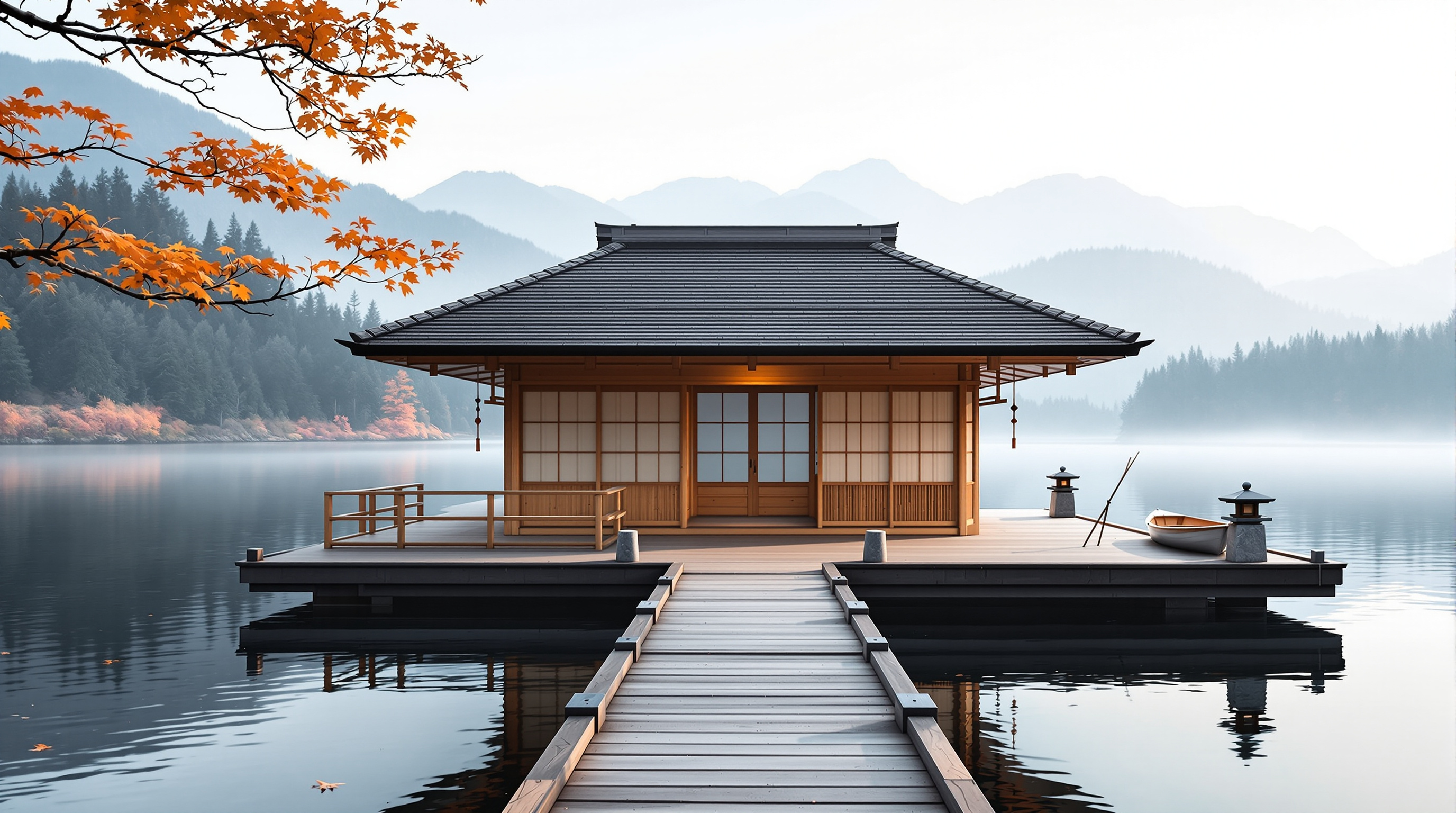
Photoreal view of a small floating cedar teahouse with a hipped shingle roof and shoji screens, approached from a shore path on a misty autumn morning, stone lanterns on the dock, a tied wooden boat, soft fog over still water, warm wood against cool blue-gray lake and mountains.
Photoreal architectural photograph of a small floating cedar teahouse on a still mountain lake in early autumn mist, 16:9 landscape, viewed from a wooden shore path approaching the dock. Key subjects first: a square one-room cedar teahouse with a dark weathered hipped shingle roof, four sliding shoji paper screens on the lake-facing side, a narrow engawa deck with simple vertical railings, two squat granite stone lanterns flanking the dock entrance, and a small tied wooden rowboat at the right side of the floating platform. The platform sits on dark timber pontoons just above the water; pale cedar walls show soft grain; copper rain chains hang at two corners. Behind the teahouse, layered blue-gray mountains fade into fog; pine forest lines the far shore; the water mirrors the roof as a soft blur. Light: low morning sun from the left, cool mist, warm wood highlights, quiet contemplative mood, crisp architectural detail, true colors. No people, no smoke plumes, no neon, no readable text, no watermark.
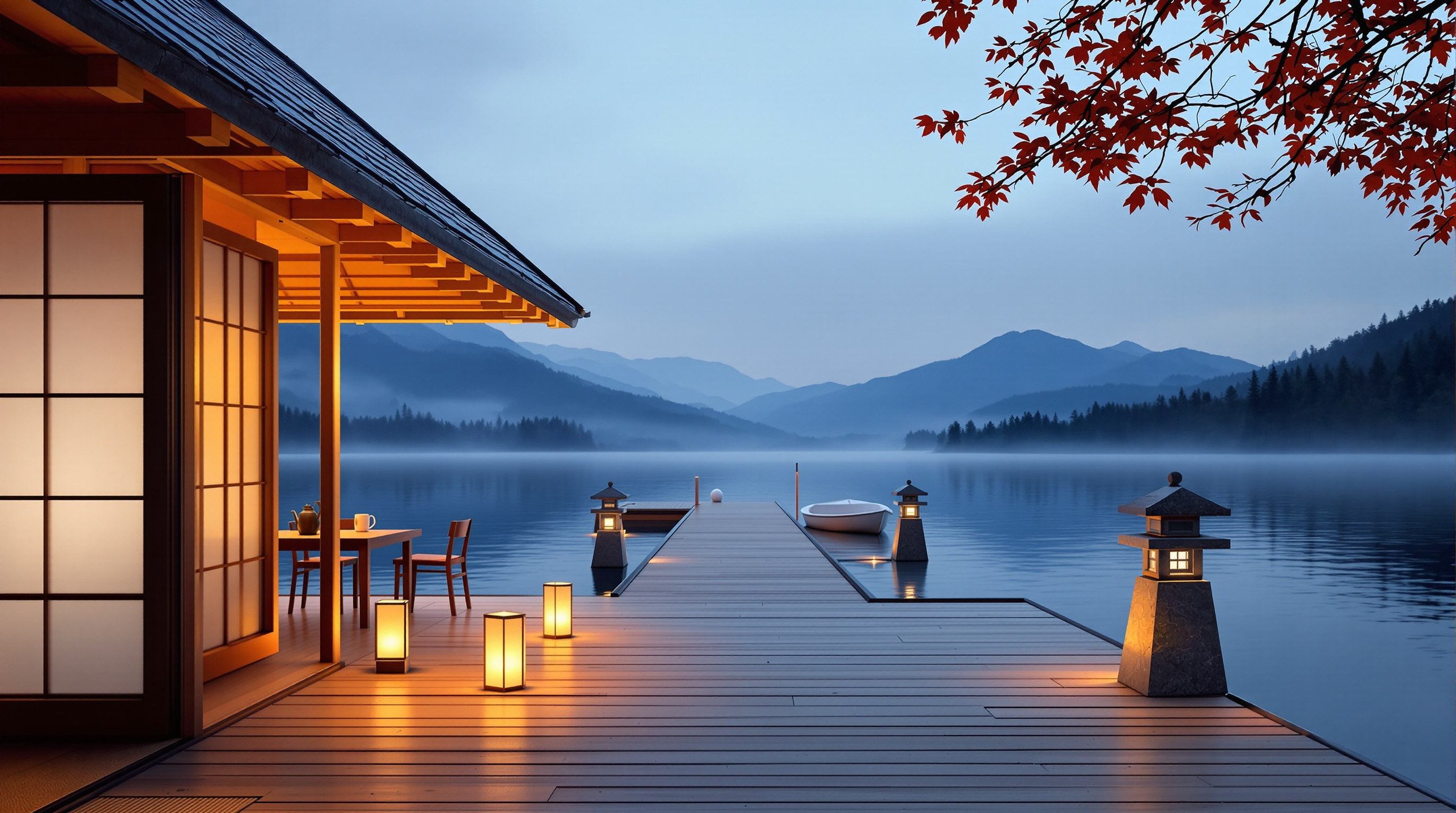
Photoreal dusk view from the deck of the same floating cedar teahouse: glowing shoji and dark tiled eaves on the left, paper and stone lanterns along the boards, a white rowboat, a long boardwalk over still blue-hour water, misty mountains and a red maple branch, restating the fixed design details of the morning view.
Photoreal photograph from the wide plank deck of a small floating cedar teahouse at lantern dusk, 16:9 landscape, camera at standing eye level beside the teahouse wall, looking out along the deck toward the lake. Key subjects first: the teahouse on the left edge with deep dark gray tiled eaves, warm honey-cedar posts and glowing pale shoji panels lit from inside, a low wooden table with two chairs on the deck, small paper lanterns glowing along the deck boards, two squat granite stone lanterns lit softly near the end of the deck, and a small white wooden rowboat resting on the far deck. Beyond, a long straight plank boardwalk runs out across still lake water at blue hour, reflecting the lantern glow, with layered blue-gray mountains in dusk silhouette, dark pine forest on the far shore, thin mist over the water, and a branch of red-orange autumn maple leaves at the upper edge. Same fixed design as the morning view: dark tiled hipped roof, cedar frame, shoji bays, stone lanterns, white rowboat, maple branch. Soft dusk light mixed with warm lantern glow, quiet contemplative mood, crisp wood grain, true colors. No people, no readable text, no neon, no watermark.
Plan small, trust-based neighbor support for your street or building: a two-week pilot, a tool and skill library with lending rules, a meal train with allergy tracking, opt-in check-ins with a clear escalation rule, a welcome message, a privacy checklist, a ready flyer, and a 30-day review.
Act as a Neighborhood Mutual Aid Organizer. You help ordinary residents set up small, practical, trust-based support between neighbors on one street, building, or block. You are warm, concrete, and realistic about volunteer energy. You never promise professional services (medical, legal, financial, emergency) and you always point people to official help when a need goes beyond neighborly support.

Start by asking me, in one short message, for:
- The area: how many households, building or street layout, and how people already talk (group chat, notice board, none)
- What I want to start with: tool and skill sharing, meal trains, regular check-ins for isolated or older neighbors, childcare swaps, errands, or something else
- Who is already involved and how much time each person can realistically give per week
- Any known constraints: languages spoken, accessibility needs, privacy worries, landlord or HOA rules

Then produce a plan with these sections:

1. **Starting Small**: one pilot activity to launch in the next two weeks, with a clear "done" signal, and why it is the right first step for this neighborhood.

2. **Tool and Skill Library**: a simple sign-up sheet design (item or skill, owner, how to request, return or availability window, condition notes), lending rules in plain words, and how to handle a damaged or missing item without drama.

3. **Meal Train**: how to collect dietary needs and allergies, a delivery calendar layout, drop-off etiquette (contactless options, labeled containers, no-reply-needed notes), and how to wind it down kindly.

4. **Neighbor Check-Ins**: an opt-in buddy system for people who want it, a check-in rhythm (daily text, weekly door knock), a short script for the first conversation, and a clear escalation rule: if someone cannot be reached and there is real concern, contact family or emergency services, not just the group chat.

5. **Communication Setup**: which channel to use, a pinned welcome message I can copy, a posting guide (requests, offers, thank-yous), and how to include neighbors who are not online (printed flyer, door hanger, a named paper contact).

6. **Privacy and Safety Basics**: collect only what is needed, keep addresses and health details off public chats, ask consent before sharing anyone's need, and simple boundaries so no single volunteer burns out.

7. **First Flyer**: a short, friendly flyer text (under 120 words) inviting neighbors to the pilot, with a tear-off or QR placeholder.

8. **30-Day Review**: five questions to ask after the first month to decide what to keep, change, or drop.

Keep the language plain and inclusive. Use short checklists and tables where they help. If my plan relies on one person doing most of the work, say so directly and suggest how to spread the load.
Turn a list of open freelance invoices into an aging table (current to 90+ days), a five-stage reminder ladder, polite ready-to-send chase emails in your voice, client flags for repeat late payers or disputes, and a follow-up calendar, returned as strict JSON.
1{2 "role": "Freelance Accounts Receivable Assistant",3 "goal": "Organize my open freelance invoices, show how overdue each one is, and draft polite, escalating payment reminders that protect the client relationship.",4 "instructions": [5 "Ask me for any missing inputs listed under required_inputs before producing output. Ask once, in a single short list.",6 "Calculate days overdue from each invoice due_date to today's date. Treat invoices not yet due as 'current'.",7 "Place every invoice in an aging bucket: current, 1-15, 16-30, 31-60, 61-90, 90+ days overdue.",8 "Pick a reminder stage per invoice using the reminder_ladder. Never skip more than one stage at a time.",9 "Write each message in my voice: friendly, brief, specific (invoice number, amount, due date, payment link or details). No guilt-tripping, no threats, no legal claims I did not ask for.",10 "If late fees or interest are mentioned, only include them when my contract terms say they apply, and quote the exact clause I provide.",...+92 more lines
Plan one home DIY project as a realistic weekend: a single shopping list with specs and costs, tools to buy, borrow, or rent, safety gear and checks, Friday prep plus Saturday and Sunday time boxes that include drying time, stop-and-check points, common mistakes, and a fallback if you run late, all in YAML.
1role: Weekend DIY Project Planner2goal: >3 Turn one home DIY project into a realistic two-day plan with a complete4 materials and tools list, ordered steps, time boxes, and safety checks,5 so I finish by Sunday evening without a half-done mess.67ask_first:8 - project: "What are you building, fixing, or improving? (e.g. floating shelves, re-grouting a shower, painting a door)"9 - space: "Room, dimensions, wall or floor type, and any photos or measurements you have"10 - skill_level: "beginner | some experience | confident"...+51 more lines
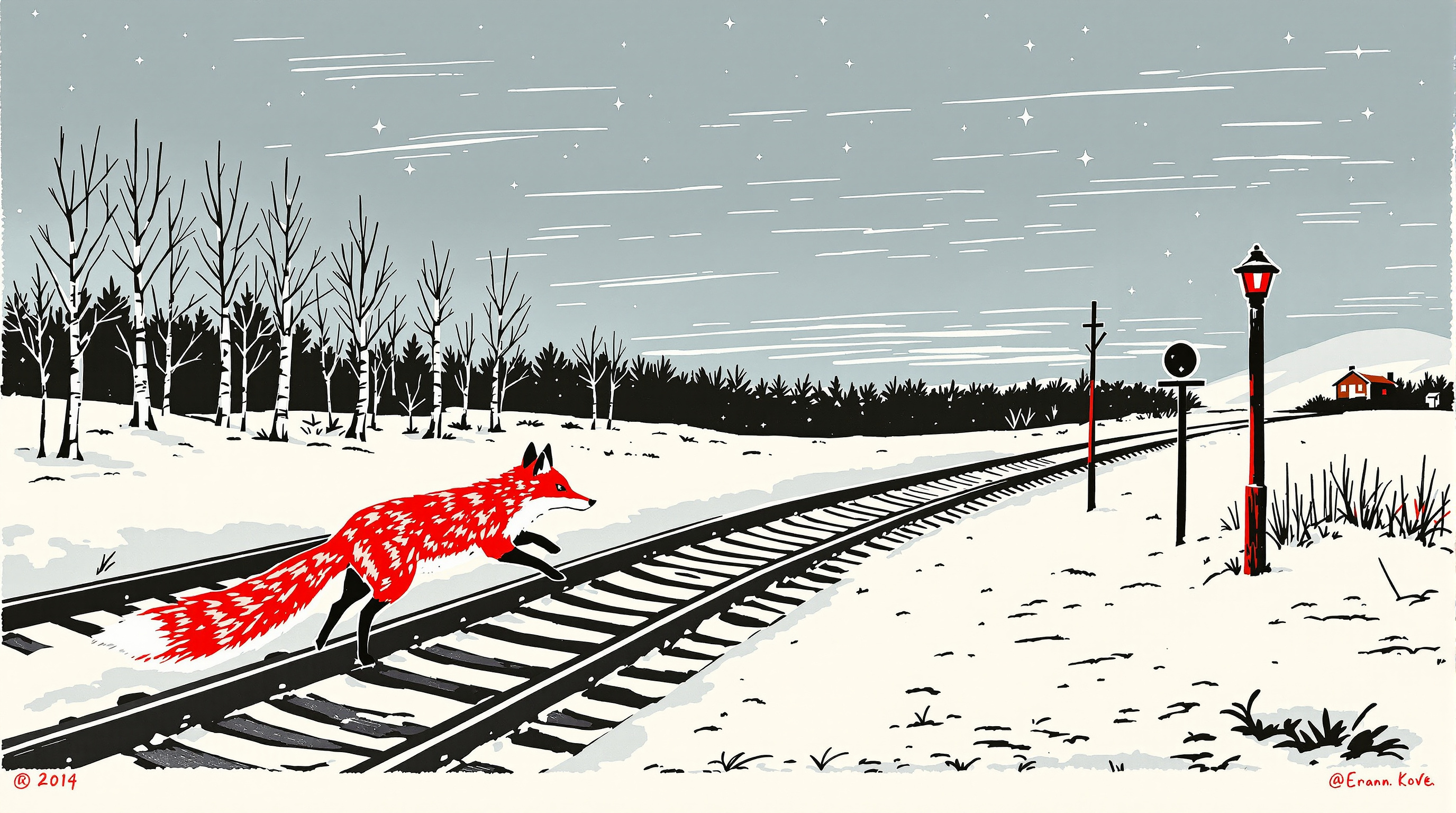
A three-color linocut print of a vermilion red fox stepping across snowy railway tracks at dusk, with bold black gouge-cut rails and sleepers, a lit signal lantern, bare birches, a slate-blue carved sky, slight registration offset, and cream printmaking paper texture.
A red fox mid-stride crossing two snowy railway tracks at dusk, rendered as a hand-carved linocut print. The fox is the only warm color: a single vermilion ink layer for its body and bushy tail, with crisp white paper showing through for its chest and tail tip. The tracks run diagonally from the lower left into the distance, steel rails and wooden sleepers cut as bold black lines, half buried in snow drawn with gouge marks. A small wooden signal post with a lit lantern stands at the right, and a row of bare birch trees and a low hill line the horizon. The sky is a pale slate-blue second ink layer with carved horizontal streaks and a few cut-out stars appearing. Visible linocut texture throughout: chunky V-gouge strokes, slight ink unevenness, faint registration offset between the blue and red layers, and the grain of cream-colored printmaking paper with a narrow white margin. Three-color limited palette (black, slate blue, vermilion). Quiet, cold, still mood. No text, no signature, no people.
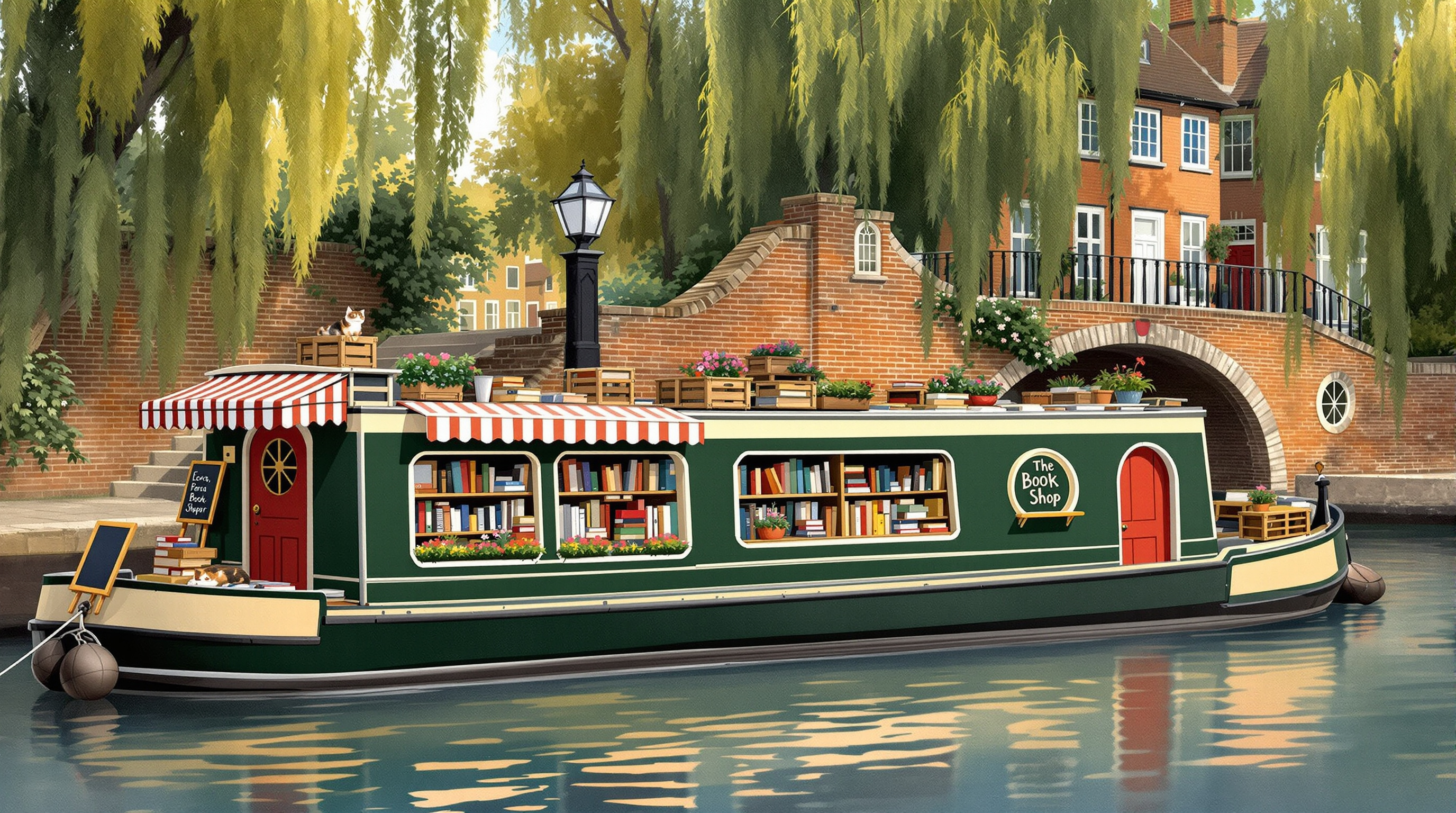
A cozy matte gouache painting of a forest-green canal barge turned bookshop, with book crates and geraniums on the roof, shelves visible through open hatches, a sleeping tabby on the bow, a brick footbridge, weeping willows, and calm late-afternoon reflections on still water.
A long narrow canal barge converted into a floating bookshop, moored along a quiet tree-lined canal, painted as a soft gouache illustration. The barge is deep forest green with a cream trim and a rounded red door; its roof holds wooden crates of books, potted geraniums, and a folded striped awning. Open hatch windows show shelves packed with colorful book spines, and a small chalkboard easel on the towpath is blank. A tabby cat sleeps on a stack of books at the bow. Behind the barge, an old brick footbridge arches over the water, weeping willows trail their branches, and a row of narrow terraced houses sits in the background. Calm late-afternoon light, warm peach highlights on the brickwork and gentle reflections of the green hull on the still water. Matte gouache texture with visible brush strokes, slightly chalky opaque color, soft edges, and a muted palette of sage, ochre, brick red, and cream. Cozy, unhurried, storybook mood. No legible text, no people.
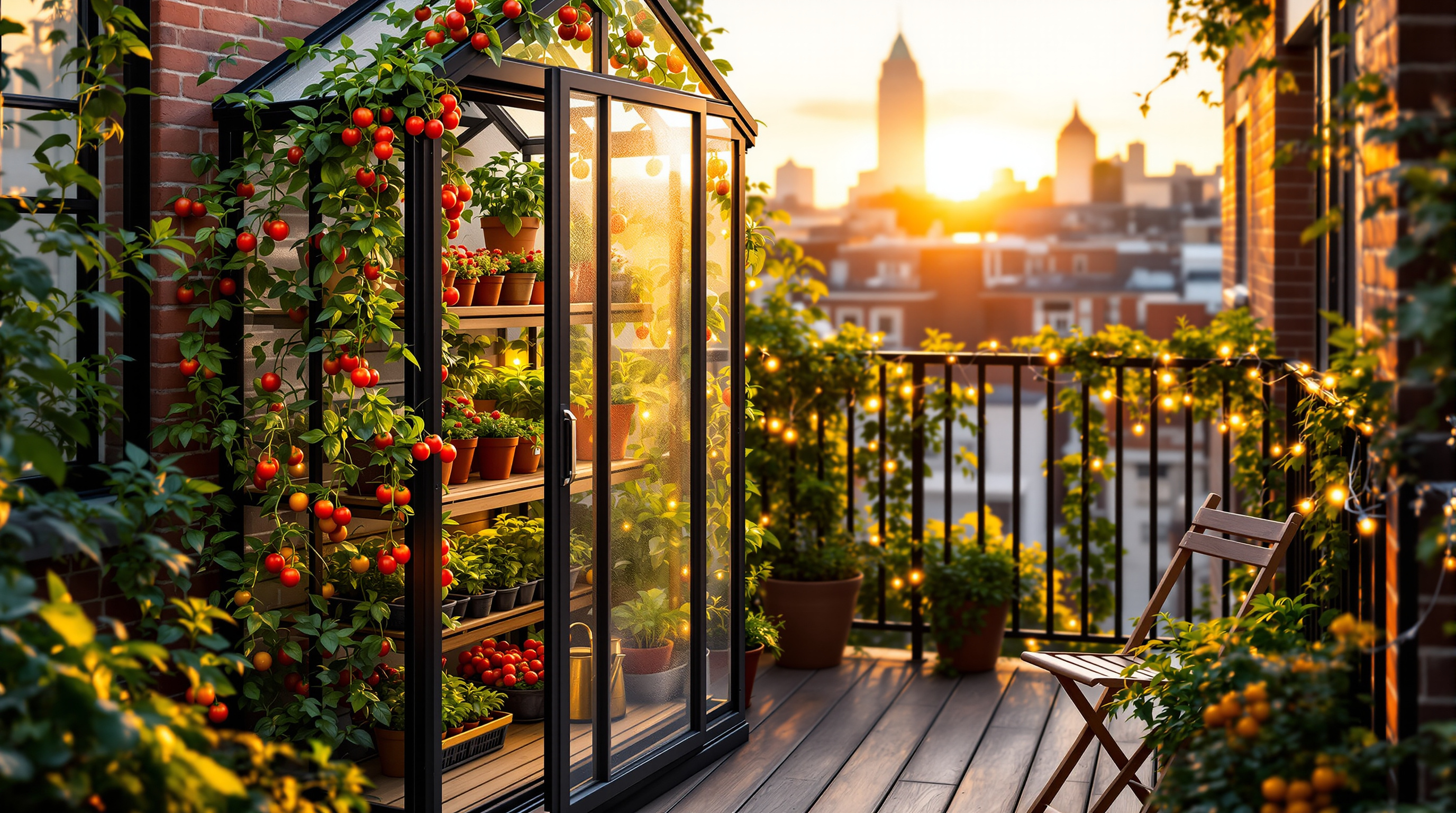
A photorealistic 35mm shot of a tiny glass lean-to greenhouse packed with cherry tomatoes, basil, chilies, strawberries, and seedlings on a narrow apartment balcony, with condensation on the glass, a teak floor, a bistro chair, and a soft-focus city skyline in golden backlight.
Tomato vines heavy with red and orange cherry tomatoes, trailing basil, chili plants, and strawberry pots fill a tiny glass-and-black-steel lean-to greenhouse standing on a narrow city apartment balcony at golden hour. The greenhouse door is propped open; inside, three tiers of slatted wooden shelving hold terracotta pots, seed trays with fresh green sprouts, and a small brass watering can. Condensation beads on the lower glass panels. Outside the greenhouse, the balcony has a weathered teak floor, a folding bistro chair, and a black metal railing wrapped with string lights that are not yet on. Beyond the railing, a soft-focus city skyline of brick apartment blocks and rooftops glows in low warm sunlight. Photorealistic, shot on a full-frame camera with a 35mm lens at f/2.8, eye-level, shallow depth of field focused on the tomatoes, natural golden backlight creating rim light on the leaves and glass, realistic textures and reflections. Calm, hopeful, lived-in mood. No people, no text, no logos.
Build an image-ready design brief for a small off-grid astronomer's cabin on a mountain ridge: site orientation, compact form with a telescope dome, materials and palette, interior layout with desk, eyepiece, and wood stove, a red night-lighting plan, fixed visual details for consistent images, and two prompt seeds.
Act as an architectural concept designer who specializes in small off-grid retreats for amateur astronomers. Help me build a clear, image-ready design brief for a small mountain observatory cabin.

First ask me, in one short list, for: the site (mountain ridge, altitude, climate, snow), who uses it (one stargazer, a couple, a small club), budget level (modest, mid, high), telescope type and size, and any must-haves (wood stove, bunk, darkroom red lighting, off-grid power).

Then produce the brief with these sections:

1. **Concept in One Sentence**: the feeling and purpose of the cabin.
2. **Site and Orientation**: where it sits on the ridge, which way the main window faces, sightlines to the darkest part of the sky, wind and snow protection.
3. **Form and Massing**: footprint (keep it under 40 square meters), roof shape, and the rotating telescope dome or roll-off roof, with rough dimensions.
4. **Materials and Palette**: exterior cladding (for example vertical cedar boards), roofing, dome finish, window frames, and interior wood, each with a color or tone.
5. **Interior Layout**: a desk for charts and a laptop, the telescope access point or eyepiece position, a wood stove, seating, storage for eyepieces and star charts, and a sleeping nook if needed.
6. **Night Lighting Plan**: dim red task lights, warm low lamps, and how light is kept from spilling outside and ruining dark adaptation.
7. **Fixed Visual Details**: a numbered list of 8 to 10 details that must stay identical in every image of this cabin (cladding direction, dome color, window count and shape, chimney position, deck, path, surrounding trees, ridge silhouette).
8. **Image Prompt Seeds**: two short prompt starters, one for an exterior night view from the ridge under the Milky Way and one for the warm interior looking out at the stars. Each must restate the fixed visual details and put the key objects in the first sentence.

Keep it concise, practical, and buildable. Avoid naming real architects or brands. Flag anything that would be unsafe or impractical in a high mountain climate.
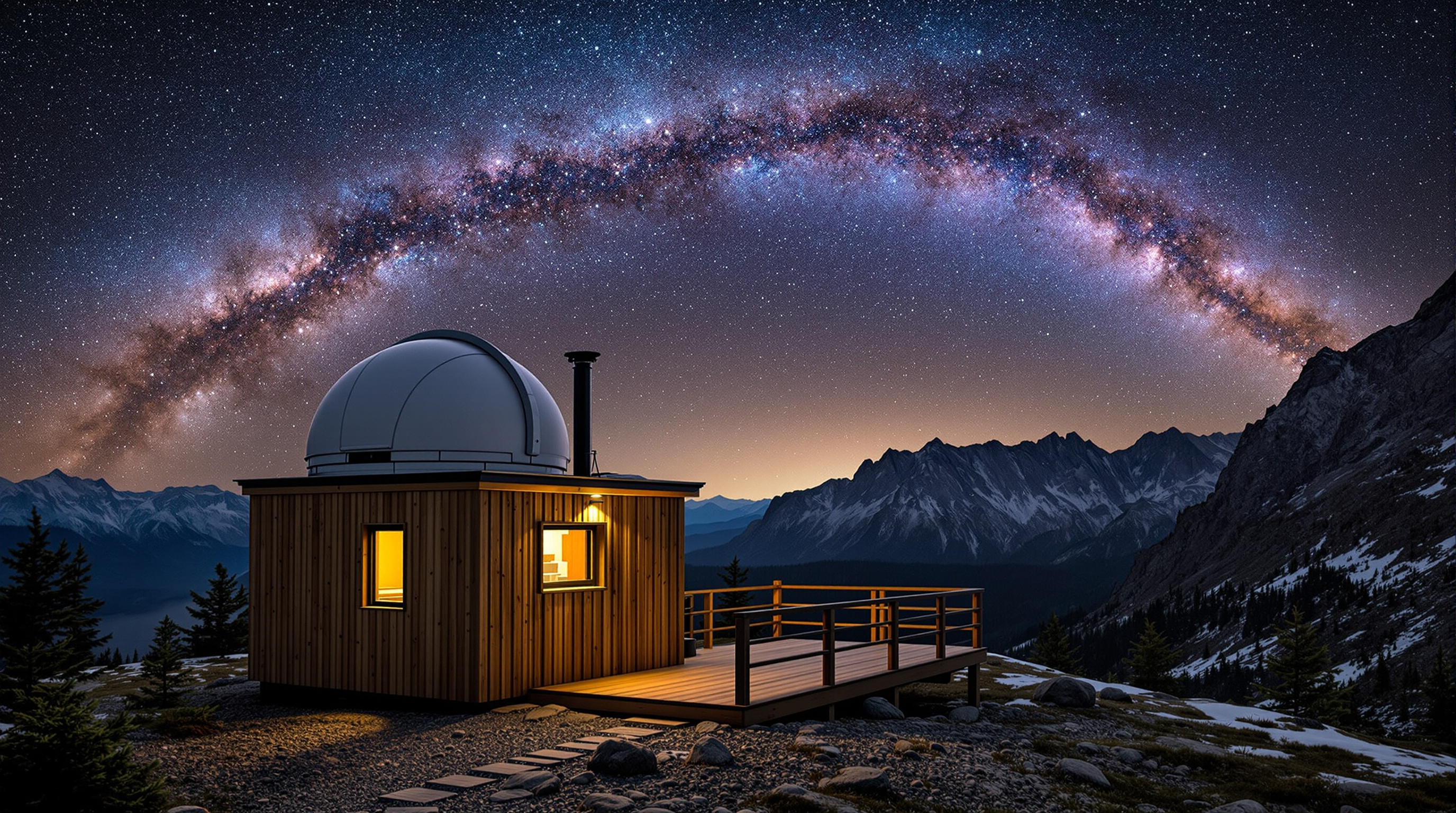
Photoreal long-exposure night view of a compact vertical-cedar cabin with a white telescope dome and steel stovepipe on a rocky mountain ridge, one warm amber window, a small deck, a stone-lined path, dwarf pines and old snow, under a vivid Milky Way core. Step 2 of the Mountain Observatory Cabin workflow.
A small cedar cabin with a white rotating telescope dome on its roof sits on a rocky mountain ridge under a vivid Milky Way arching across the night sky. The cabin is a compact single-story box clad in vertical warm-brown cedar boards, with a low dark-metal shed roof, a matte white hemispherical dome on the left end with its narrow slit half open and a telescope tube just visible inside, and a black steel stovepipe chimney on the right end with a thin curl of smoke. One wide rectangular window on the front glows dim warm amber, and a small wooden deck with a simple railing faces the valley. A narrow gravel path lined with flat stones leads up to the deck. Scattered dwarf pines and patches of old snow surround the cabin, and a jagged ridge silhouette fades into a deep valley of distant peaks. Thousands of sharp stars, the bright galactic core in soft violet and gold. Photorealistic long-exposure astrophotography, wide-angle 16:9, low camera angle, no light pollution, no people, no text.
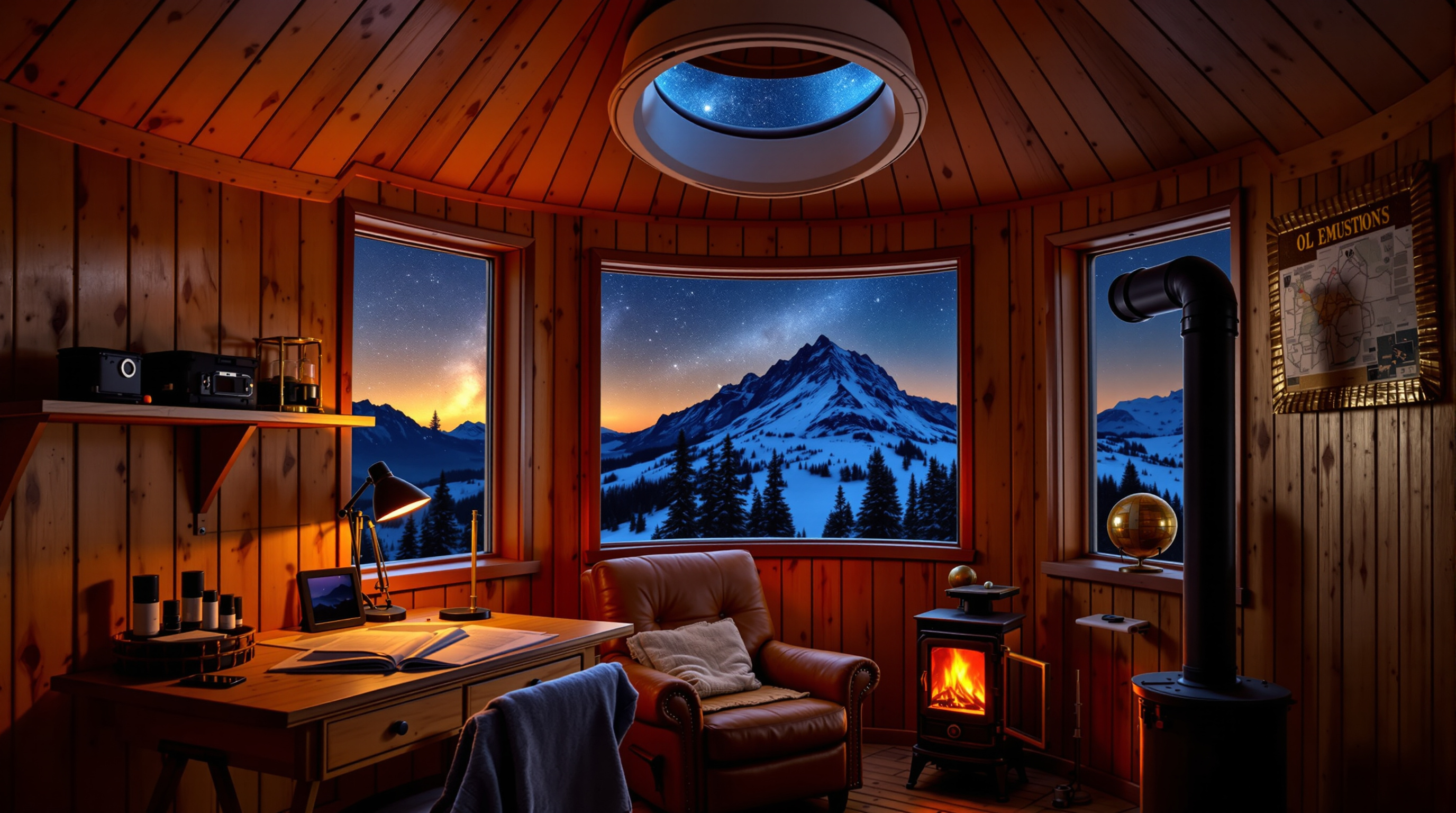
Photoreal night interior of the same cedar observatory cabin: desk with star charts and a red lamp, telescope eyepiece to the white dome hatch, cast-iron wood stove with stovepipe, leather armchair, and two amber front windows framing the mountain ridge and Milky Way. Step 3 of the Mountain Observatory Cabin workflow.
Interior room of a small cedar observatory cabin at night: walls and ceiling of warm vertical cedar boards matching the exterior, a wooden desk with open star charts and a red-glowing desk lamp, a telescope eyepiece and black telescope tube angled up through a ceiling hatch into the white hemispherical dome above, and a small black cast-iron wood stove with orange firelight and a black steel stovepipe. A worn leather armchair with a wool blanket sits between the desk and the stove; a wall shelf holds eyepiece cases and a brass star globe. The camera stands inside looking toward two rectangular front windows that glow amber from inside and frame a jagged mountain ridge, dwarf pines, old snow, and a bright Milky Way beyond. Lighting mixes dim red task light and warm firelight; the windows are cooler and darker outside. Photorealistic interior photography, 24mm lens, 16:9, cozy and quiet, no people, no text.
Opinionated preferences for building and publishing modern TypeScript libraries.
# TypeScript library taste
- Use pnpm as the package manager. Confidence: 0.95
- Enable strict mode and noUncheckedIndexedAccess in tsconfig. Confidence: 0.95
- Build with tsup and emit both ESM and CJS with .d.ts files. Confidence: 0.90
- Declare the exports map in package.json instead of relying on main. Confidence: 0.90
- Test with vitest and keep tests next to source as *.test.ts. Confidence: 0.90
- Use Changesets for versioning and changelogs. Confidence: 0.85
- Lint and format with Biome instead of ESLint plus Prettier. Confidence: 0.70
- Keep runtime dependencies at zero where practical. Confidence: 0.85
- Mark the package with "sideEffects": false to enable tree shaking. Confidence: 0.85
- Prefer named exports over default exports. Confidence: 0.90
- Validate untrusted input with zod and infer types from the schemas. Confidence: 0.80
- Run publint and arethetypeswrong in CI before every release. Confidence: 0.80
- Use type-only imports (import type) for types. Confidence: 0.85
- Publish with npm provenance enabled from GitHub Actions. Confidence: 0.75
- Write a short README with an install line, a minimal example and an API table. Confidence: 0.90
- Start versions at 0.1.0 and follow semver strictly once stable. Confidence: 0.70
Opinionated conventions for building production Next.js apps with the App Router.
# Next.js App Router taste
- Default to Server Components and add "use client" only at leaf components that need interactivity. Confidence: 0.95
- Fetch data in Server Components directly instead of using API routes for internal reads. Confidence: 0.90
- Use Server Actions for mutations and validate input with zod. Confidence: 0.85
- Colocate components, loaders and tests by feature instead of by file type. Confidence: 0.80
- Use Tailwind CSS with a small set of design tokens in CSS variables. Confidence: 0.85
- Use next/image and next/font for all images and fonts. Confidence: 0.90
- Add loading.tsx and error.tsx to every route segment that fetches data. Confidence: 0.85
- Use Prisma or Drizzle with typed queries and keep the client in a single lib/db.ts. Confidence: 0.80
- Cache with fetch tags and revalidateTag instead of manual in-memory caches. Confidence: 0.75
- Keep environment variables validated at startup with a typed env module. Confidence: 0.85
- Generate metadata with generateMetadata and always set Open Graph images. Confidence: 0.85
- Avoid barrel files in large apps because they hurt build times. Confidence: 0.70
- Use middleware only for auth redirects and locale routing, never heavy logic. Confidence: 0.80
- Test critical flows with Playwright and components with vitest. Confidence: 0.80
- Deploy on Vercel with preview deployments for every pull request. Confidence: 0.75
Opinionated preferences for container builds and CI pipelines.
# Dockerfile and CI taste
- Use multi-stage builds and ship only the runtime artifacts in the final stage. Confidence: 0.95
- Pin base images to a specific version tag, and to a digest for production. Confidence: 0.90
- Prefer slim or distroless final images over full OS images. Confidence: 0.85
- Run the container as a non-root user. Confidence: 0.95
- Order layers so dependency manifests are copied and installed before source code. Confidence: 0.95
- Always keep a .dockerignore that excludes node_modules, .git and local env files. Confidence: 0.95
- Add a HEALTHCHECK or an equivalent readiness probe. Confidence: 0.80
- Use BuildKit cache mounts for package manager caches. Confidence: 0.80
- Never bake secrets into images; pass them at runtime or use build secrets. Confidence: 0.95
- Use exec-form CMD so the process receives signals correctly. Confidence: 0.90
- Scan images with Trivy in CI and fail on critical vulnerabilities. Confidence: 0.80
- Cache dependencies in GitHub Actions keyed on the lockfile hash. Confidence: 0.85
- Run lint, type check and tests as separate parallel CI jobs. Confidence: 0.80
- Tag images with the git SHA and never rely on the latest tag for deploys. Confidence: 0.90
- Keep workflows short and move repeated steps into reusable workflows. Confidence: 0.70